My child is always losing and forgetting things. How can I help – without making it worse?
- Written by Celia Harris, Associate Professor in Cognitive Science, Western Sydney University
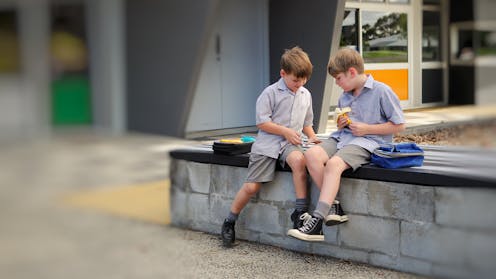
As school returns, parents and teachers might each be faced with the familiar chorus of “I can’t find my school jumper” and “I left my hat at home”. For parents of older kids, the stakes may be even higher: lost mobile phones or laptops left on the bus.
As parents, it can be tempting to take charge by packing schoolbags yourself, or texting older children a list of things to remember at the end of each day.
However, doing everything for your child robs them of an opportunity to learn.
What’s happening in their developing brain?
Our kids, in their busy lives, are constantly using and developing their memory skills – remembering where they put things, new conceptual knowledge, and routines required for the day-to-day.
Prospective memory – which involves remembering to do things in the future – is particularly challenging.
It’s prospective memory children draw on when they set a drink bottle down at play time and must remember to pick it up later, or get a note from their teacher and must remember to show their parent after school.
Success in prospective memory involves multiple cognitive processes going right.
Children must pay attention to what is needed in a given situation (“I can’t play outside if I don’t have a hat”), and then form and store a particular intention to act in the future (“I need to take my hat with me to school”).
Then, they must bring the intention back to mind at the crucial moment (taking the hat on the way out the door).
This “remembering to remember” requires memory to spontaneously occur at just the right time, without prompts or reminders.
These processes all require a higher-order cognitive skill known as “executive function”.
This is the ability to consciously control our attention and memory and to engage in challenging thinking tasks.
Processes that rely on executive function are hard, which is why lost drink bottles and forgotten hats are such frustratingly common experiences for parents.
Even for adults, the majority of day-to-day memory errors involve prospective memory.
Executive function develops later in childhood compared with some other skills, such as language and play.
The prefrontal cortex, which underpins executive function tasks, is not mature until early adulthood.
This means forgetfulness among children is common, and a natural part of development. Chances are you were like this too when you were a kid (you just might not remember it).
Could some kids struggle even more?
Yes.
Children (and adults) vary widely in their executive function skills.
While all children get better at executive function throughout childhood, this happens at different rates; some children may be more forgetful than others their own age.
One condition particularly related to forgetfulness is attention-deficit/hyperactivity disorder (ADHD).
Children with an ADHD-inattentive subtype may be more likely to lose things and be forgetful during everyday activities such as chores or errands.
Children with ADHD will still develop prospective memory skills over time, but may be more forgetful relative to other children their own age.
How can I help my kid?
Do build routines and stick to them. Research shows routines help children develop cognitive skills and self-regulation. Children are best able to remember a routine when it is “automatised” – practised often enough they know it without thinking.
Do promote “metacognition”: an awareness about one’s own cognitive processes. Research suggests children are over-optimistic about their likelihood of remembering successfully. Parents and teachers can help them to notice when remembering is hard and put in strategies that help.
Do model the behaviour you want to see. For example, you might set up your own lists and strategies to help you remember daily tasks. You could also have a family routine of “bags by the door” and checking them the night before. Don’t do it for them, do it together.
Do seek professional support if you’re worried. All children will forget sometimes, and some more than others. If your child is particularly absentminded or forgetful, it could be worth consulting a GP or school psychologist. Conditions such as ADHD must be observed in more than one setting (for example, home and school, or home and sport), and specific diagnostic criteria must be met. Diagnosis can be helpful in accessing supports.

What should I not do – and why?
Don’t rely on kids being able to spontaneously self-initiate memory – that’s the hardest part of prospective memory! Instead, use checklists and memory aids. For instance, if they are consistently leaving their drink bottle at school, you could put a tag on their bag that says “where is your drink bottle?” Using prompts isn’t cheating – it’s supporting success.
Don’t sweat the slip-ups – these are normal. One study with 3–5-year-old children found incentives in the form of food treats weren’t enough to improve performance. Punishing is also unlikely to help. Instead, use instances of forgetting as teachable moments – strategise about how to adjust next time.
Don’t leave things too late. Anxiety and stress can make forgetting more likely, because children can easily become overwhelmed. Pack bags the night before, practise new routines, and avoid rushing where possible.
Don’t judge. Prospective memory failures are sometimes perceived as character flaws, particularly when they affect other people (such as when forgetting to return a borrowed item).
Understanding how memory works, however, helps reveal that forgetfulness is an everyday part of development.
Authors: Celia Harris, Associate Professor in Cognitive Science, Western Sydney University