

More of us are drinking recycled sewage water than most people realise
- Written by: Ian Wright, Senior Lecturer in Environmental Science, Western Sydney University
The world is watching as Cape Town’s water crisis approaches “Day Zero”. Questions are being asked about which other cities could be at risk and what can they do to avoid running dry. In Perth, Australia’s most water-stressed capital, it has been announced that the city is considering reusing all of its sewage as part of its future water supply.
Read more: Cape Town is almost out of water. Could Australian cities suffer the same fate?
Drinking recycled sewage is a very confronting topic. But what many people don’t realise is that we already rely on recycled sewage in many Australian water supplies. Even in Australia’s biggest city, Sydney, it is an important part of the water supply. This is because many large towns discharge their treated sewage into the catchment rivers that supply the city.
But Perth is now looking to recycle all of its treated sewage. At the time of writing, the city’s water storages were at a low 35.3%. Cape Town’s reserves, by comparison, are at a critical low of 23.5% – but Perth was close to that point just a year ago when it was down to 24.8%.
Perth has been progressively “drought-proofing” itself by diversifying the city water supply. River flow and storage in dams accounts for only 10% of this supply. Desalination and groundwater extraction provide about 90% of the city’s supply. Only about 10% of Perth’s sewage is recycled, through advanced treatment and replenishment into its groundwater supplies.
Read more: Is Perth really running out of water? Well, yes and no
Justifiably, many people have concerns about drinking recycled sewage. This reflects long-standing concern about hazards of contaminated water. An example is the devastating waterborne disease of cholera, which claims the lives of more than 100,000 people a year. Cholera is rare in many countries, but is endemic in waters across Africa and much of Southeast Asia.
As wastewater treatment technologies improve and urban populations grow, however, interest in using treated sewage in drinking water supplies has been increasing. No Australian urban water supply currently uses “direct potable reuse” of treated sewage, but the concept is being seriously considered.
Read more: This is what Australia's growing cities need to do to avoid running dry
So how is treated sewage being indirectly reused?
There is, however, indirect reuse when water is drawn from rivers into which recycled sewage is discharged upstream. For instance, the catchment of Sydney’s giant Warragamba Dam has a population of about 116,000 people. This includes the large settlements of Goulburn, Lithgow, Moss Vale, Mittagong and Bowral. These communities discharge their treated sewage into the catchment rivers.
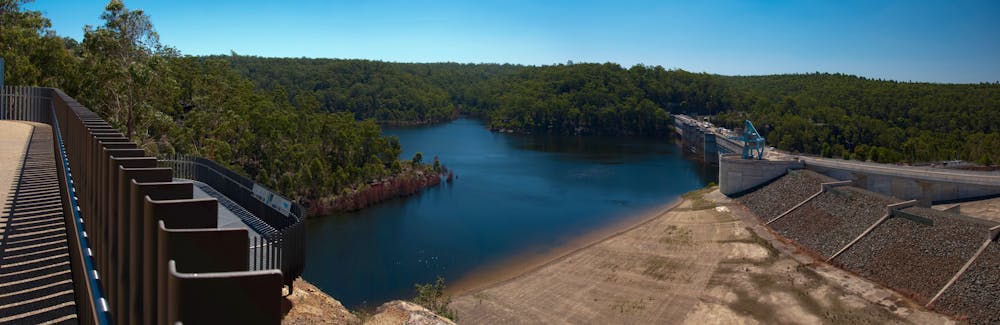 Several large towns discharge treated sewage into rivers supplying Warragamba Dam, which holds 80% of Sydney’s water reserves.
popejon2/flickr, CC BY-NC-ND
Several large towns discharge treated sewage into rivers supplying Warragamba Dam, which holds 80% of Sydney’s water reserves.
popejon2/flickr, CC BY-NC-ND
The New South Wales Environment Protection Authority regulates these discharges, which form a small part of the total annual catchment inflow to the dam. Such recycling of sewage is termed “indirect potable reuse”.
Residents in some parts of northwestern Sydney also drink water that is partly supplied by another form of indirect reuse of treated sewage. The North Richmond Water Filtration Plant extracts and treats water drawn directly from the Hawkesbury-Nepean River. A major contributor to the river flow is treated sewage discharged from upstream treatment plants.
These include plants in the Blue Mountains (Winmalee), St Marys, Penrith, Wallacia, and West Camden. The largest individual discharge of treated sewage to the river in recent weeks is from St Marys Advanced Water Recycling Plant, one of the biggest in Australia. This plant uses advanced membrane technology to produce highly treated effluent before it is discharged into the river.
 St
Marys Advanced Water Recycling Plant, one of the biggest in Australia, treats sewage and discharges the water into the Hawkesbury-Nepean River.
Ian Wright, Author provided
St
Marys Advanced Water Recycling Plant, one of the biggest in Australia, treats sewage and discharges the water into the Hawkesbury-Nepean River.
Ian Wright, Author provided
Available data are limited, but in the very low river flows in the recent dry summer I estimate that treated sewage comprised almost 32% of the Hawkesbury-Nepean flow in the North Richmond area for the first week of January. The water is highly treated at the Sydney Water-owned North Richmond plant to ensure it meets Australian drinking water guidelines.
Every year the river receives more and more treated sewage as a result of population growth. This is certain to continue, as Greater Sydney is forecast to gain another 1.74 million residents in the next 18 years. Much of this growth will be in Western Sydney, one of the most rapidly growing urban centres in Australia. This will result in more treated sewage, and urban runoff, contributing to the Hawkesbury-Nepean River flow.
Read more: As drought looms again, Australians are ready to embrace recycled water
Paying for desalination while water goes to waste
However, most of Sydney’s sewage is not recycled at all. Three massive coastal treatment plants (at North Head, Bondi and Malabar) serve the majority of Sydney’s population. These three plants discharge nearly 1,000 million litres (1,000ML) of primary treated sewage into the ocean every day. That is roughly an Olympic pool of sewage dumped in the ocean every four minutes!
Perhaps if Sydney was as chronically short of water as Perth there would be plans to recycle more of its sewage. Instead, Sydney has adopted desalination as a “new” source of drinking water, rather than treating larger volumes of sewage for any form of potable reuse.
Sydney’s desalination plant sits idle about 10 kilometres south of the Malabar treatment plant. It has a capacity for supplying 250ML a day. Even though it isn’t supplying water now, it is very expensive. In 2017, the privately owned plant, sitting on standby, charged Sydney Water A$194 million.
Only when Sydney’s storages fall below the trigger of 60% will the plant supply drinking water. With storages at 76.5%, the plant will not operate for a while.
Read more: The role of water in Australia's uncertain future
Authors: Ian Wright, Senior Lecturer in Environmental Science, Western Sydney University


















