why Jason Momoa’s Chief of War wasn’t filmed in its star’s homeland
- Written by Duncan Caillard, Postdoctoral Research Fellow, School of Communication Studies, Auckland University of Technology
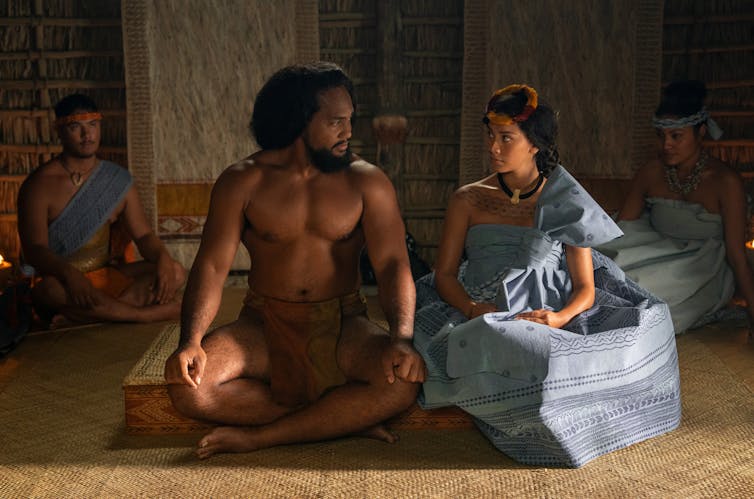
Jason Momoa’s historical epic Chief of War, launching August 1 on Apple TV+, is a triumph of Hawaiians telling their own stories – despite the fact their film and TV production industry now struggles to be viable.
The series stars Momoa (Aquaman, Game of Thrones) as Kaʻaina, an ali'i (chief) who fights for – and later rises against – King Kamehameha I during the bloody reunification of Hawaii.
Already receiving advance praise, the nine-episode first season co-stars New Zealand actors Temeura Morrison, Cliff Curtis and Luciane Buchanan, alongside Hawaiian actors Kaina Makua, Brandon Finn and Moses Goods.
A passion project for Momoa, the Hawaiian star co-created the series with writer Thomas Pa'a Sibbett after years in development. With a reported budget of US$340 million, it is one of the most expensive television series ever produced.
It is also a milestone in Kānaka Maoli (Native Hawaiian) representation onscreen. Controversially, however, the production only spent a month in Hawaiʻi, and was mostly shot in New Zealand with non-Hawaiian crews.
Momoa has even expressed an interest in New Zealand citizenship, but the choice of location is more a reflection of the troubled state of the film industry in Hawaiʻi. On the other hand, it is a measure of the success of the New Zealand screen industry, with potential lessons for other countries in the Pacific.
Ea o Moʻolelo – story sovereignty
Set at the turn of the 19th century, Chief of War tells the moʻolelo (story, history) of King Kamehameha I’s conquest of the archipelago.
Hawaiʻi was historically governed by aliʻi nui (high chiefs), and each island was ruled independently. Motivated by the threat of European colonisation and empowered by Western weaponry, Kamehameha established the Hawaiian Kingdom, culminating in full unification in 1810.
The series is an important example of what authors Dean Hamer and Kumu Hinaleimoana Wong-Kalu have called “Ea o Moʻolelo”, or story sovereignty, which emphasises Indigenous peoples’ right to control their own narrative by respecting the “the inalienable right of a story to its own unique contents, style and purpose”.
Chief of War is also the biggest Hawaiian television series ever produced. Although Hawaiʻi remains a popular setting onscreen, these productions have rarely involved Hawaiians in key decision-making roles.
Sea of troubles
The series hits screens at a time of major disruption in Hollywood, with streaming services upending established business models.
“Linear” network television faces declining viewership and advertising revenue. Movie studios struggle to draw audiences to theatres. The consequences for workers in the the industry have been severe, as the 2023 writers strike showed.
Those changes have had a catastrophic impact on the Hawaiʻi film industry, too.
Long a popular location – Hawaii Five-O (1968-1980, 2010-2020), Magnum P.I. (1980-1988, 2018-2024) and Lost (2004-2010) were all shot on location in Hawaiʻi – it is an expensive place to film.
Actors, crew and production equipment often have to be flown in from the continental United States, and producers compete with tourism for costly accommodation.

An industry in transition
These are not uncommon problems in distant locations, and many governments try to attract screen productions through tax incentives and rebates on portions of the production costs.
New Zealand, for example, offers a 20-25% rebate for international productions and 40% for local productions. Hawaiʻi offers a 22-27% rebate.
But this is less than other US states offer, such as Georgia (30%), Louisiana (40%) and New Mexico (40%). Hawaiʻi also has an annual cap of US$50 million on rebates.
To make things even harder, Hawaiʻi offers only limited support for Indigenous filmmakers. Governments in Australia and New Zealand provide targeted funding and support for Aboriginal, Torres Strait Islander and Māori filmmakers.
By contrast, the Hawaiʻi Film Commission doesn’t provide direct grants to local filmmakers or producers (Indigenous or otherwise). Small amounts of government funding have been administered through the Public Broadcasting Service, but this is now in jeopardy after US President Donald Trump recently cut federal funding.
The Hawaiʻi screen industry faces a perfect storm. For the first time since 2004, film and TV production has ground to a halt. Many workers now doubt the long-term sustainability of their careers.
Lessons from Aotearoa NZ
While there are lessons Hawaiʻi legislators and industry leaders could learn from New Zealand’s example, there should also be a measure of caution.
The Hawaiʻi tax credit system is out of date. But despite industry lobbying, legislation to update it failed to reach the floor of the legislature earlier this year. New tax settings would help make local production viable again.
Secondly, decades of investment in Māori cinema have seen it become diverse, engaging and creatively accomplished. Hawaiʻi could benefit from greater direct investment in Hawaiian storytelling, respecting its cultural value even if it doesn’t turn a commercial profit.
On the other hand, New Zealand has a favourable currency exchange rate with the US which can’t be replicated in Hawaiʻi. And New Zealand film production workers have seen their rights to unionise watered down compared to their American peers.
But if Hawaiʻi can get its settings right, a possible second season of Chief of War may yet be filmed there, which could mark a genuine rejuvenation of its own film industry.
Authors: Duncan Caillard, Postdoctoral Research Fellow, School of Communication Studies, Auckland University of Technology