NZ is looking for a deal over Trump’s new tariffs – that could come with a high political price
- Written by Jane Kelsey, Emeritus Professor of Law, University of Auckland, Waipapa Taumata Rau
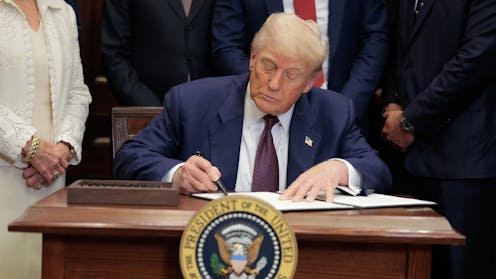
When the Trump administration arbitrarily imposed 15% tariffs on New Zealand exports on August 1, up from a previously announced 10%, no one should have been surprised.
“Reciprocal” tariffs, based on the difference in value between what the United States imports from and exports to other countries, were signalled on April 2, Trump’s “Liberation Day”. New Zealand’s latest tariffs are higher than some, lower than many.
Many governments are now frenetically seeking deals before the tariffs take effect on August 7. New Zealand’s chief trade negotiator Vangelis Vitalis has been dispatched to Washington urgently to plead New Zealand’s case, with Trade Minister Todd McClay also on his way.
Labour’s trade spokesperson has declared the lack of a deal for lower tariffs – along similar lines to ones struck by the European Union and United Kingdom – a “major fail”.
But politicians should be careful what they wish for. Bigger countries have already caved in to Trump’s demands, signing vague deals at a high political and economic price with no real guarantees.
Trump’s economic rationale
Trump has a long expressed love for tariffs as leverage over countries that depend on US markets. Essentially, these are taxes the US charges on imported goods.
It’s not New Zealand exporters who “pay” these taxes, it is US importers, and likely their customers. Similarly, New Zealand exporters don’t “save” millions from tariff cuts.
Trump hopes making imports more expensive will spur domestic production, support local business and create jobs, and the trade imbalance with the US would decline. As a bonus, in June alone, tariffs earned the US$26 billion in revenue, partly compensating for massive tax cuts contained in Trump’s “One Big Beautiful Bill”.
By imposing tariffs unilaterally, Trump breaches the US tariff limits at the World Trade Organization (WTO) and its “most-favoured-nation” rule of treating all countries equally. But the US has already paralysed the WTO’s dispute system. US tariff limits and other trade rules in US free trade agreements are also being ignored.
Domestically, Trump has used the 1977 International Emergency Economic Powers Act to justify bypassing Congress to impose tariffs, on the basis that threats to the US economy constitute a “national emergency”.
This was ruled unlawful by the Court of International Trade and is currently under appeal at the Federal Circuit Court of Appeals. Meanwhile, the tariffs continue. The Trump-friendly Supreme Court would likely endorse them.
US economist Paul Krugman predicts this approach will not be rolled back by future administrations and will become “the new normal”.
Exaggerated claims, few guarantees
The various bilateral “deals” other countries have sought to mitigate Trump’s tariffs look vague and precarious.
The talks and the outcomes remain secret. The vaguely worded “frameworks” – not signed agreements – lack detail and allow Trump to make exaggerated claims at odds with the other country’s statements. Krugman describes these “understandings” as, for the most part, “vaporware”.
Take the European Union’s promise to buy goods worth US$250 billion a year for three years, mainly in fossil fuels such as liquefied natural gas. One commentator described this as as “delusional” and “totally unrealistic”, given EU imports of energy in 2024 were only worth about $65 billion.
The EU also admits it lacks the power to deliver on a promise to invest $600 billion in the US economy, because that would come entirely from private sector investment over which Brussels has no authority.
Nor is there any guarantee Trump will uphold his part of the deal or not demand more. The EU said its landmark regulations on Big Tech survived unscathed; Trump says they remain on the table as further “non-tariff barriers” – trade-speak for anti-business regulations.
To take another example, Japan has said its 15% tariff deal operates from August 1, while the US gives no start date.
The White House said “Japan will invest $550 billion directed by the United States to rebuild and expand core American industries” to be spent at “President Trump’s direction”. The investment will be in a list of industries, including energy, semiconductors, pharmaceuticals, critical minerals and shipbuilding, with the US retaining 90% of the profits.
Bloomberg reports Japan expects only 1–2% of that $550 billion to be actual investment, with the rest made up of loans, and makes no reference to Trump having control.
Trump’s political agenda
Trump’s demands are not just about trade. His strong-arm tactics – which Brazil, China and France have termed economic blackmail – aim to punish political foes and damage competing powers, notably China and Russia.
They are also a form of retaliation over other countries’ foreign policy decisions (such as Canada’s intention to recognise Palestinian statehood), a way to exploit foreign natural resources (such as Pakistan’s oil), and to remove obstacles to corporate donors (such as Canada’s digital services taxes).
What will Trump demand, and get, from New Zealand in these secret negotiations? Governments face high political costs as they navigate their own domestic processes to “secure” such deals.
At the very least, New Zealand’s negotiations need to be transparent and consulted on before commitments are made. More broadly, the country will need to rethink of its trade strategy in the light of the new international realities.
Authors: Jane Kelsey, Emeritus Professor of Law, University of Auckland, Waipapa Taumata Rau