

5 ingenious things trees do that human designers can learn from
- Written by: Stanislav Roudavski, Founder of Deep Design Lab and Senior Lecturer in Digital Architectural Design, The University of Melbourne
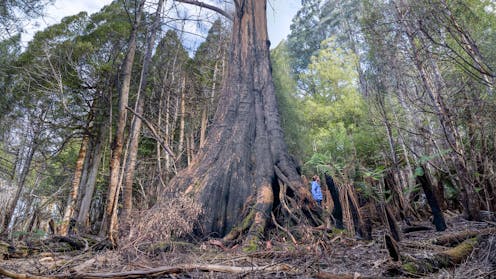
Tasmania’s mountain ash (Eucalyptus regnans) is the world’s tallest flowering plant. It can grow 100 metres tall and live for more than 600 years.
These trees play a crucial role in their ecosystems, providing habitat and contributing to the overall health of the shared living world. But their numbers are dwindling due to logging, land degradation, fire and climate change.
This sad situation is indicative of a much bigger problem: humans consistently undervalue plants, despite having much to learn from them.
At Deep Design Lab, we design and build homes for wildlife, learning from successful solutions in the natural world. To compensate for the loss of large hollows in large old trees, our team has 3D-printed nest boxes for owls and other species. We have also studied what makes a good tree for birds, to replicate the design.
Our recent research on Tasmania’s large old eucalypts has given me another reason to reflect on the many things about trees that urban planners, designers and the public could learn from. Here are the top five.

1. Dead trees and fallen branches
People often cut down dead trees for fear they might fall, causing injury to humans or damage to property. They also tend to remove fallen logs and branches, to tidy up.
But dead trees provide vital habitat for wildlife. Microbes, insects, lizards, birds and mammals often prefer dead trees to live ones. That’s because dead wood is easier to digest and dead branches devoid of leaves are easier to land on, or view the surroundings from.
Exposure to diverse ecosystems also supports human health and wellbeing. So it’s much better to retain dead trees and design spaces to keep them safely in place, whether standing or fallen.
2. Old trees
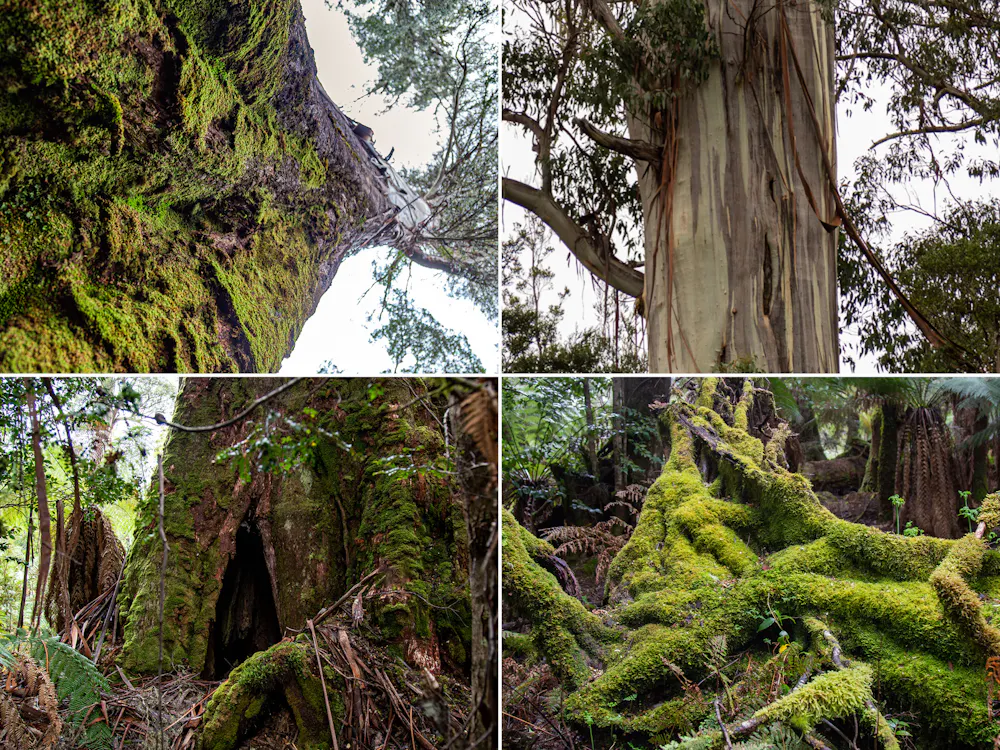
Mature trees have many features younger trees don’t. These include hollows, cracks, peeling bark and large quantities of fruit, nectar and seeds.
Canopies of such trees have many more of the horizontal and dead branches that birds prefer to use.
More than 300 species of Australian native mammals, birds, reptiles and amphibians use tree hollows. But suitable hollows take time to form – often hundreds of years.
Countless species of insects and microbes also flourish in tree hollows.
Designers and land managers should preserve old trees and incorporate them into the planning processes. Homeowners should also appreciate their unique contributions. With the help of trees, our urban environments could be wild, lush and green rather than clipped, neat, tidy and barren.
3. Roots
Trees obtain water and nutrients through their roots. When water is scarce, the roots change shape and adapt to maximise uptake.
The environment surrounding the roots supports the growth of beneficial microorganisms and inhibits harmful ones. This regulates the growth of neighbouring plants.
Unfortunately urban design often traps roots under hard, sealed surfaces such as bitumen or concrete.
Instead, we should create permeable surfaces using soil, gravel, bark chips or perforated pavers with holes that allow the passage of fluids and gases, enabling tree root growth. Urban spaces with healthy trees are more biodiverse, resilient, cooler, moister and aesthetically pleasing.
4. Bark ‘streamers’
Strips of peeling bark called streamers, hanging from tree trunks and branches, create their own microhabitats for insects such as flightless tree crickets.
Yet the role of bark streamers is often overlooked and requires more research. Understanding their value can informed maintenance of trees that grow in cities. Such maintenance should find ways to retain or even add useful features such as streamers while also controlling for fire danger and other risks.
Our lab is also interested in using bark streamers to design artificial features that could improve the ecological value of younger trees.
Such features can also add new home for wildlife to human-made structures such as building surfaces or utility poles. This approach might provide shelter or perching opportunities in places where natural trees cannot grow, for example on rooftops or near gas pipes.
 Bark streamers are yellow in this laser scan, which quantifies and captures the geometry and distribution of these features to providing blueprints to guide design.
Deep Design Lab
Bark streamers are yellow in this laser scan, which quantifies and captures the geometry and distribution of these features to providing blueprints to guide design.
Deep Design Lab
5. Litter
The leaves, seeds, twigs and branches that fall to the ground enrich the soil, retain moisture and provide habitat for fungi, insects, and other organisms.
However, in urban areas, humans often remove this material for aesthetic or safety reasons, disrupting ecological interactions. As a result, trees are deprived of nutrients and risk drying out. Meanwhile, small plants, insects and fungi die. Animals, such as lizards and birds, must leave.
Designers and the public should find ways to retain organic litter using socially attractive strategies. This may include creating designated wild zones, putting up interpretive signage to explain what’s going on, or modifying maintenance practices to preserve ecological benefits while meeting public expectations.
 Laser scanning offers a different view of the forest floor. These shapes can be used in designs of urban surfaces, border stones and street furniture.
Deep Design Lab
Laser scanning offers a different view of the forest floor. These shapes can be used in designs of urban surfaces, border stones and street furniture.
Deep Design Lab
Plants as designers
Humans tend to value forms of intelligence that resemble their own brain-based cognition and discount other forms of problem-solving and innovation.
The capacity of trees to construct supportive habitats for themselves and other organisms requires further research. Ecosystems are dynamic and complex, so our knowledge is far from complete.
In response, our lab examines trees and their functions using technology such as laser scanning, computer modelling and digital fabrication. We recognise, preserve and encourage the formation of patterns made of branches, leaves, roots and dead wood.
By taking tips from these natural designs, humans can create more sustainable and resilient environments for themselves and other living beings.
With thanks to my co-creators Julian Rutten and Alexander Holland of the Deep Design Lab, who co-authored the original research and contributed to this article.
Authors: Stanislav Roudavski, Founder of Deep Design Lab and Senior Lecturer in Digital Architectural Design, The University of Melbourne
Read more https://theconversation.com/5-ingenious-things-trees-do-that-human-designers-can-learn-from-252735


















