Why do some clothes shrink in the wash? A textile scientist explains how to ‘unshrink’ them
- Written by Nisa Salim, Director, Swinburne-CSIRO National Testlab for Composite Additive Manufacturing, Swinburne University of Technology

When your favourite dress or shirt shrinks in the wash, it can be devastating, especially if you followed the instructions closely. Unfortunately, some fabrics just seem to be more prone to shrinking than others – but why?
Understanding more about the science of textile fibres can not only help you prevent the shrinkage of clothing, but also might help you “rescue” the occasional garment after a laundry accident.
It’s all down to the fibres
To know more about clothing shrinkage, we first need to understand a little about how textiles are made.
Common textile fibres, such as cotton and linen, are made from plants. These fibres are irregular and crinkled in their natural form. If you zoom deeper inside them, you’ll see millions of tiny, long-chain cellulose molecules that naturally exist in coiled or convoluted shapes.

During textile manufacturing, these fibres are mechanically pulled, stretched and twisted to straighten and align these cellulose chains together. This creates smooth, long threads.
On a chemical level, there are also links between the chains called hydrogen bonds. These strengthen the fibre and the thread and make it more cohesive.
Threads are woven or knitted into fabrics, which locks in the tension that holds those fibres side by side.
However, these fibres have good “memory”. Whenever they’re exposed to heat, moisture or mechanical action (such as agitation in your washing machine), they tend to relax and return to their original crinkled state.
This fibre memory is why some fabrics wrinkle so easily and why some of them may even shrink after washing.

How does washing shrink the fabric?
To understand shrinkage, we again need to zoom down to the molecular level. During laundering, hot water helps to increase the energy level of fibres – this means they shake more rapidly which disrupts the hydrogen bonds holding them in place.
The way a fabric is knitted or woven also plays a role. Loosely knitted fabrics have more open spaces and loops, making them more susceptible to shrinkage. Tightly woven fabrics are more resistant because the threads are locked into place with less room to move.
Additionally, cellulose is hydrophilic – it attracts water. Water molecules penetrate inside the fibres, causing swelling and making them more flexible and mobile. Adding to all this is the tumble and twist action inside the washing machine.
The whole process makes the fibres relax and recoil back to their natural, less stretched, crinkled state. As a result, the garment shrinks.
It’s not just hot water – here’s why
This doesn’t just happen with hot water, as you may have experienced yourself with clothes made of rayon, for example.
Cold water can still penetrate into fibres, making them swell, along with the mechanical action of the tumbling in the washing machine. The effect is less dramatic with cold water, but it can happen.
To minimise shrinkage, you may use cold water, the lowest spin speed or the gentlest cycle available, especially for cotton and rayon. Machine labels don’t always fully explain the impact of spin speed and agitation. When in doubt, choose a “delicate” setting.
What about wool?
Different fibres shrink in different ways; there is no single mechanism that fits all.
While cellulose-based fabrics shrink as described above, wool is an animal-derived fibre made of keratin proteins. Its surface is covered in tiny, overlapping scales called cuticle cells.
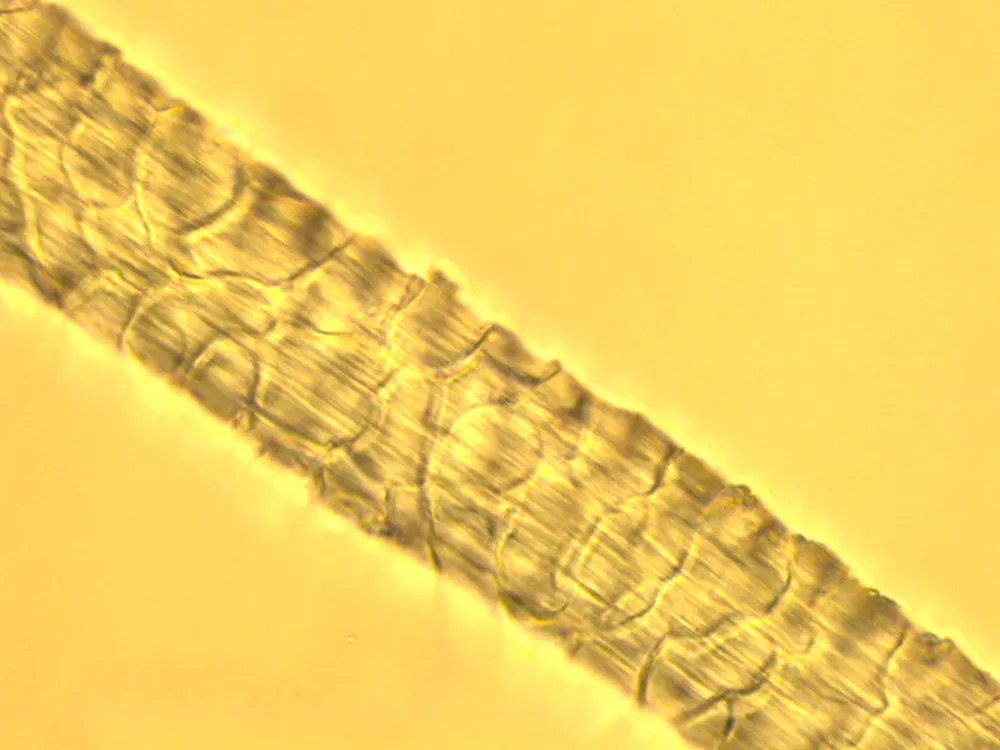 Wool fibre under a microscope with the cuticles visible as overlapping scales.
snap the reel/Shutterstock
Wool fibre under a microscope with the cuticles visible as overlapping scales.
snap the reel/Shutterstock
During washing, these cuticles open up and interlock with neighbouring fibres causing fibre entanglement or “felting”. This makes the clothing feel denser and smaller – in other words, it shrinks.
Why don’t synthetics shrink as much?
Synthetic fibres such as polyester or nylon are made from petroleum-based polymers, engineered for stability and durability.
These polymers contain more crystalline regions that are highly ordered and act as an internal “skeleton”, preventing the fibres from crinkling.
 The weave of nylon stockings under a microscope shows how the threads are much smoother and more crystalline than natural fibres.
Alexander Klepnev/Wikimedia Commons, CC BY
The weave of nylon stockings under a microscope shows how the threads are much smoother and more crystalline than natural fibres.
Alexander Klepnev/Wikimedia Commons, CC BY
Textile scientists and engineers are also working on fabrics that resist shrinkage through advanced material design. Among promising innovations are blended yarns that combine natural and synthetic fibres.
Some researchers are working on shape-memory polymers that can change shape – or return to a previous shape – in response to temperature or water, for example. This is different to stretch fabrics (such as those used in activewear) that are made up of highly elastic fibres which “bounce back” to their original state after stretching.
How can I unshrink a piece of clothing?
If a favourite garment has shrunk in the wash, you can try to rescue it with this simple method.
Gently soak the item in lukewarm water mixed with hair conditioner or baby shampoo (approximately one tablespoon per litre). Then, carefully stretch the fabric back into shape and dry it flat or under gentle tension – for example, by pegging the garment to a drying rack.
The reason this works is because conditioners have chemicals known as cationic surfactants. These will temporarily lubricate the fibres, making them more flexible and allowing you to gently pull everything back into place.
This process can’t completely reverse extreme shrinkage but it can help recover some of the lost size, making the clothes wearable again.
Authors: Nisa Salim, Director, Swinburne-CSIRO National Testlab for Composite Additive Manufacturing, Swinburne University of Technology