It might seem like Trump is winning his trade war. But the US could soon be in a world of pain
- Written by Peter Draper, Professor, and Executive Director: Institute for International Trade, and Director of the Jean Monnet Centre of Trade and Environment, University of Adelaide
Last week, US President Donald Trump issued an executive order updating the “reciprocal” tariff rates that had been paused since April.
Nearly all US trading partners are now staring down tariffs of between 10% and 50%.
After a range of baseline and sector-specific tariffs came into effect earlier this year, many economists had predicted economic chaos. So far, the inflationary impact has been less than many predicted.
However, there are worrying signs that could all soon change, as economic pain flows through to the US consumer.
Decoding the deals
Trump’s latest adjustments weren’t random acts of economic warfare. They revealed a hierarchy, and a pattern has emerged.
Countries running goods trade deficits with the US (that is, buying more than they sell to the US), which also have security relationships with the US, get 10%. This includes Australia.
Japan and South Korea, which both have security relationships with the US, were hit with 15% tariffs, likely due to their large trade surpluses with the US.
But the rest of Asia? That’s where Trump is really turning the screws. Asian nations now face average tariffs of 22.1%.
Countries that negotiated with Trump, such as Thailand, Malaysia, Indonesia, Pakistan and the Philippines, all got 19%, the “discount rate” for Asian countries willing to make concessions.
India faces a 25% rate, plus potential penalties for trading with Russia.

Is Trump winning the trade war?
In the current trade war, it is unsurprising that despite threats to do so, no countries have actually imposed retaliatory tariffs on US products, with the exception of China and Canada. Doing so would drive up their consumer prices, reduce economic activity, and invite Trump to escalate, possibly limiting access to the lucrative US market.
Instead, nations that negotiated “deals” with the Trump administration have essentially accepted elevated reciprocal tariff rates to maintain a measure of access to the US market.
For many of these countries, this was despite making major concessions, such as dropping their own tariffs on US exports, promising to reform certain domestic regulations, and purchasing various US goods.
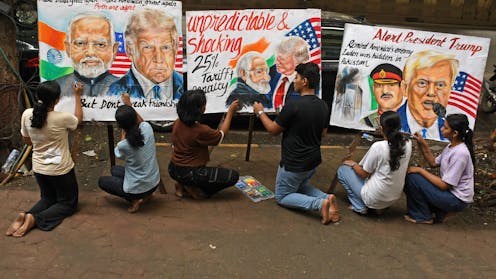
Protests over the weekend, including in India and South Korea, suggested many of these tariff negotiations were not popular.
Even the European Union has struck a deal accepting US tariff rates that once would have seemed unthinkable – 15%. Trump’s confusing Russia-Ukraine war strategy has worried European leaders. Rather than risk US strategic withdrawal, they appear to have simply folded on tariffs.
Some deals are still pending. Notably, Taiwan, which received a higher reciprocal tariff (20%) than Japan and South Korea, claims it is still negotiating.
Through the narrow prism of deal making, it is hard not to escape the conclusion that Trump has gotten his way with everyone – except China and Canada. He has imposed elevated US tariffs on many countries, but also negotiated to secure increased export market access for US firms and promised purchases of planes, agriculture and energy.
Why economic chaos hasn’t arrived – yet
Imposing tariffs on goods coming into the US effectively creates a tax on US consumers and manufacturers. It drives up the prices of both finished goods (products) and intermediate goods (components) used in manufacturing.
Yet the Yale Budget Lab estimates the tariffs will cause consumer prices to rise by 1.8% this year.
This muted inflationary impact is likely a result of exports to the US being “front-loaded” before the tariffs took effect. Many US importers rushed to stockpile goods in the country ahead of the deadline.
It may also reflect some companies choosing to “eat the tariffs” by not passing the full cost to their customers, hoping they can ride things out until Trump “chickens out” and the tariffs are removed or reduced.

Who really pays
Despite Trump’s repeated claims that tariffs are a tax paid by foreign countries, research consistently shows that US companies and consumers bear the tariff burden.
Already this year, General Motors reported that tariffs cost it US$1.1 billion (about A$1.7 billion) in the second quarter of 2025.
A new 50% tariff on semi-finished copper products took effect on August 1. That announcement in July sent copper prices soaring by 13% in a single day. This affects everything from electrical wiring to plumbing, with costs ultimately passed to US consumers.
The average US tariff rate now sits at 18.3%, the highest level since 1934. This represents a staggering increase from just 2.4% when Trump took office in January.
This trade-weighted average means that, on typical imported goods, Americans will pay nearly one-fifth more in taxes.
Alarm bells
The US Federal Reserve is concerned about these potential price impacts, and last week opted to maintain interest rates at their current levels, despite Trump’s pressure on Chairman Jerome Powell.
And on August 1, economic data released in the US showed significant slowing in job creation, some worrying signs in economic growth, and early signs of business investment paralysis due to the economic uncertainty unleashed by Trump’s ever-changing tariff rates.
Trump responded to the report by firing the US Bureau of Labour Statistics commissioner, a shock move that led to widespread concerns official US data could soon become politicised.
But the worst economic impacts could still be yet to come. The domestic consequences of Trump’s tariff policies are likely to amount to a massive economic own goal.
Authors: Peter Draper, Professor, and Executive Director: Institute for International Trade, and Director of the Jean Monnet Centre of Trade and Environment, University of Adelaide