

Jewish Australian women reflect on life after October 7
- Written by Lynne Michelle Swarts, Senior Academic Tutor, St Andrew's College, and Sessional Academic, Discipline of Hebrew, Biblical and Jewish Studies,, University of Sydney
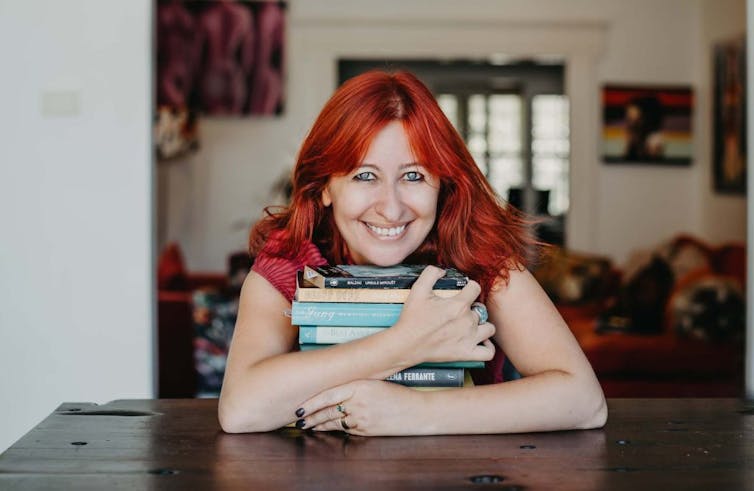
Ruptured is a timely and powerful anthology that explores the fractured experiences of 36 Jewish women in Australia in the aftermath of the October 7 2023 Hamas attacks and the ensuing war in Gaza. The title is luminous and haunting in its simplicity.
Each voice grapples with the shock-waves of recent events, which – as editors Lee Kofman and Tamar Paluch note – cast a shadow “laced with the unmistakable imprint of intergenerational trauma”.
This book is not just a chronicle of pain and upheaval, but a testament to the strength and resilience each woman demonstrates in the struggle to maintain their sense of identity and belonging in contemporary Australia.
Review: Ruptured: Jewish Women In Australia Reflect on Life Post-October 7 – co-edited by Lee Kofman & Tamar Paluch (Lamm Jewish Library of Australia)
In Australia, where Jews have always felt an integral part of society, antisemitism has increased three-fold since October 7. One in five Australians now hold antisemitic attitudes, the editors report, the highest rate across Anglosphere nations.
Ruptured draws on a tapestry of perspectives, its reflections both deeply personal and urgently communal. Its voices cross generations, incorporating migrants from the former Soviet Union and Israel, queer women, women of mixed heritage, second-generation Holocaust survivors and women, like me, descended from families who have lived in Australia for generations.
Everything changed
Contributors include journalists such as former Age writer Julie Szego, Rachelle Unreich, who wrote about her mother’s experience surviving the Holocaust in a 2023 book and Sunday Life columnist Kerri Sackville.
There’s legal academic Kim Rubinstein and political scientist Kylie Moore-Gilbert, a specialist in the Middle East and a former political prisoner in Iran. There’s also a rabbi, cookbook authors, psychotherapists, educators, musician Deborah Conway and artists like Nina Sanadze.

“The effect of October 7 seems to have been felt by every Jew,” writes lawyer Melinda Jones.
Kofman’s essay, Writing in a Time of War, grasps that seriousness. She recounts how her life changed when Israel was invaded, and the destruction in Gaza began:
Then everything – everything – in my partly uncluttered, mostly fulfilling life changed … And I could no longer write.
It wasn’t Hamas’ barbarism or Palestinian suffering that silenced her – she always hoped that her writing could bring light to a darkened world. What broke her was “the outbreak of antisemitism from Australia’s hyper-educated, progressive elites, including many writers […] whose books fill the shelves of my study”. She adds, “it was a mindf…k to realise that people who live and breathe words […] could be so selective about suffering.”
Psychiatrist and psychotherapist Lynette Chazan echoes this existential dread: “Our existence” as Jews “is again up for grabs”. Like a modern prophet, she asks: Is Israel’s destruction dressed up in human rights, “the world’s clandestine fetish?”
While the war is undeniably catastrophic for innocent Palestinians in Gaza, Kofman argues that in Australia, empathy for Jews has evaporated under the guise of anti-Israel sentiment. Her peers on the left she writes, were more focused on the
demonisation of Israel and ‘Zionists’ – meaning Jews who affirm Israel’s right to exist. Meaning nearly 80% of Australian Jews according to conservative estimates.

‘A double life’
This anthology sensitively covers recurring themes, include silencing, alienation, shock, horror, racism and vile anti-Jewish visceral hatred. Every author writes of living what grief and trauma counsellor Irena Zilberman calls “a double life”.
Scrolling through social media on October 7 and 8, finding out terrible truths. The near naked and dead body of 23-year-old German-Israeli citizen Shani Louk, taken from the Nova music festival, on the back of a pick-up truck. Julie Szego and Deborah Conway describe their disbelief on October 9, when chants at a rally in front of the Sydney Opera House, included “Where’s the Jews” and “f…k the Jews.”
Bodycam videos of mutilated, raped, dismembered and burnt bodies from the Nova music festival continue to surface. Interior architect and writer Kate Lewis writes of Eshkol, a small town near the Gaza Strip, where parts of her Australian family live. Its residents, like those in the nearby kibbutzim, were ravaged by “unthinkable inhumanity, ripped apart and butchered”. Burnt alive.
 The funeral of 23-year-old German-Israeli citizen Shani Louk, taken from the Nova music festival.
Abir Sultan/AAP
The funeral of 23-year-old German-Israeli citizen Shani Louk, taken from the Nova music festival.
Abir Sultan/AAP
Zilberman finds out her uncle and aunt were killed at Ofakim, near Gaza. She describes her loneliness when she continues to see friends for whom these atrocities have little impact. Similar isolation and despair are felt by many of these writers when close, non-Jewish friends say little … or nothing. Szego notes, “First there is silence,” from those once considered friends and then “silence from comrades and ‘good’ people”.
Authors write of their efforts to learn as much as possible on Israel. Psychoanalyst, art psychotherapist and artist Julia Meyerowitz-Katz eloquently calls this moment “Against Silence”. Simonne Whine, founder of grassroots activist Jewish identity movement J-United, writes “it’s part of my increasing commitment to actively combat hatred”, to try to “make some sense of it all”. She continues:
my bedside table became a battleground of sticky notes and highlighted passages […] The more I read the more I understood none of this was new.
Against silence
These women read the same books that I did: Israeli producer Noa Tishby’s Israel: A Simple Guide to the Most Misunderstood Country on Earth and ex–Palestinian militant Mossab Hasan Yousef’s Son of Hamas.
Or they listened to former US Defense department official, columnist and writer Dan Senor’s podcast, Call Me Back and the podcast by Israeli philosopher journalist Yossi Klein Halevi, produced by Shalom Hartman Institute. Or they discovered leading Israeli journalist Nadav Eyal, the chairman for the Israeli Movement for Freedom of Information, on Senor’s podcast.
We are all forced to consider our resilience as Jews in the face of persistent, intense hatred. It feels reminiscent of the dangers faced in 1930s Germany, where Jewish shops were vandalised and antisemitic signs paraded through the streets. Actor Dena Amy Kaplan observes: “we, as Jews, are stronger and closer than ever.” Writer, director and musician Galit Klas agonises, “Who will hide my daughter?”
 Julie Szego.
Tony Lupton/Wild Dingo Press
Julie Szego.
Tony Lupton/Wild Dingo Press
Julie Szego reflects on the disbelief felt by many Australian Jews when reading an open letter in Overland published “barely a fortnight after the attacks, barely a week after the Israeli ground invasion of Gaza […] condemning ‘war crimes committed by Israel in its ongoing genocide against the Palestinian people’.”
Similar petitions and open letters have appeared across social media and in publications like the Sydney Review of Books. According to Szego, the petitioners overlook several critical issues. She writes that they don’t mention hostages, they ignore or “contextualise” the events of October 7, nor do they acknowledge Hamas’ use of human shields. Nor, she writes, do they mention Iran, a key supporter of Hamas. Surprisingly, the signatories represent notable individuals from literature, arts, academia and human rights groups.
High school teacher Siana Einfeld speculates, after documenting the hate in her northern Melbourne suburb, on whether her city is safe for Jews anymore, when antisemitic slogans, boycotting of Jewish businesses and artists, and even violence towards Jews and Jewish sites has become the new normal.
Writer and corporate communications consultant Jessica Bowker mentions the silver lining of increased resilience and compassion since October 7. She has sought out Jewish friends and “those who empathise the positives of October 7” – becoming, in the words of Deborah Conway and New York Times foreign policy journalist Bret Stephens, “more Jewy”. Is the challenge, as Rabbi Jacqueline Ninio teaches, to hold onto hope?
Who should read this book?
This anthology comes just weeks after Australia’s antisemitism special envoy Jillian Segal’s plan to combat antisemitism. Its well-timed arrival prompts me to ask: who should read this book?
Anyone interested in the way Jewish women feel right now, in our “lucky” country. I think it should be read by women – including academics, creatives and the literary left who should know better – who deny Jewish agency, who think they know more clearly than the contributors to this anthology what it is to be “othered”. I’m not holding my breath.
Are there equivalent books written anywhere else in the world? I don’t think so. As Einfeld puts it, she lives in a place where she still believes “co-existence [with fellow non-Jewish Australians] is possible”.
This book is a major contribution to that aspiration.
Authors: Lynne Michelle Swarts, Senior Academic Tutor, St Andrew's College, and Sessional Academic, Discipline of Hebrew, Biblical and Jewish Studies,, University of Sydney

















