

FactCheck: does South Australia have the 'highest energy prices' in the nation and 'the least reliable grid'?
- Written by Dylan McConnell, Researcher at the Australian German Climate and Energy College, University of Melbourne
Look, this is probably the single most important issue to most households in South Australia — what they’ve been left with now are the highest energy prices in Australia — some say in the world — and the least reliable grid.
And it’s all because this government decided we had to go headlong into intermittent renewable energy without the baseload to support that transition.
– SA Liberal Party leader Steven Marshall, speaking at the SA Votes: Leaders’ Debate, Adelaide, March 5, 2018
Electricity prices and the reliability of South Australia’s energy grid will be key issues for voters in this Saturday’s state election.
During a public leaders’ debate, SA Liberal Party leader Steven Marshall claimed that under the Weatherill Labor government, South Australians had been left with “the highest energy prices in Australia – some say in the world – and the least reliable grid”.
Marshall said this was “all because this [Labor] government decided we had to go headlong into intermittent renewable energy without the baseload to support that transition”.
Let’s look at the evidence.
Checking the source
A spokesperson for Marshall told The Conversation that when the opposition leader said energy prices, he was referring to retail electricity prices.
To support Marshall’s statement, the spokesperson provided The Conversation with two 2017 documents from the Australian Energy Market Operator, one 2015 document from the Australian Energy Regulator, a letter from the Essential Services Commission of South Australia (ESCOSA) to the SA Minister for Energy Tom Koutsantonis, and a 2017 article from the Australian Financial Review.
Regarding the reliability of South Australia’s grid, the spokesperson said the Australian Energy Market Operator’s Electricity Statement of Opportunities shows that “in 2017-18 South Australia has the highest percentage of unserved energy at 0.0025%”, adding that “the reliability standard is 0.0020%”.
You can read the full response from Marshall’s office here.
Verdict
SA Liberal Party leader Steven Marshall said South Australia has “the highest energy prices in Australia — some say in the world”.
It’s true that South Australia has the highest retail electricity prices in Australia (although not in the world).
Marshall also said South Australia has the “the least reliable grid”.
In the energy industry, the word “reliability” means having enough energy generation capacity and inter-regional network capacity to supply customers.
The Australian Energy Market Operator is currently preparing estimates of unserved energy (the measure of reliability) for 2016-17. It is possible that there will be unserved energy for South Australia over this period.
However, it’s far from clear that South Australia would have had the highest level of unserved energy in the National Electricity Market.
People in South Australia do experience interruptions to their electricity supply.
But more than 97% of these are due to distribution outages (caused by things like trees falling on power lines) and are unrelated to the source of electricity – renewable or otherwise – flowing through the power lines.
There are many factors that affect electricity prices, grid reliability and power outages. Increasing levels of renewable energy generation is one factor.
Therefore, Marshall’s assertion that these outcomes are “all because this [Labor] government decided we had to go headlong into intermittent renewable energy without the baseload to support that transition” is incorrect.
Responding to the sources
The sources provided by Marshall’s spokesperson are from reputable government agencies. However, it’s far from clear that the sources support the conclusions Marshall drew in the leaders’ debate.
For example, the spokesperson cited an Australian Energy Market Operator (AEMO) report stating that South Australia would breach the regulator’s reliability standard in 2017-18.
But this is a projection, and doesn’t include some measures that have already been taken to ensure that the grid is reliable in 2017-18.
You can read more analysis of the sources provided by Marshall’s office here.
‘Energy’ vs ‘electricity’ prices
In making his statement, Marshall referred to “energy” prices. Energy and electricity prices are different things. Marshall’s spokesperson later told The Conversation that the MP was referring to “household electricity prices”.
Energy is a broad term that includes sources such as petrol, diesel, gas and renewables, among other things. Electricity is a specific form of energy that can be produced from many different sources.
The retail electricity price is what you’ll typically see in your home electricity bill, and is usually expressed in cents per kilowatt-hour (c/kWh).
Does South Australia have the highest retail electricity prices in the nation?
According the Australian Energy Market 2017 Residential Electricity Price Trends report, South Australia does indeed have the highest retail prices in the nation. Current prices for the typical SA customer are 37.79c/kWh.
According to that report, the Australian Capital Territory has the lowest retail electricity prices in Australia, at around 23.68 c/kWh.
The retail electricity price includes the wholesale price of the electricity, the network costs (or the “poles and wires” that bring the electricity to your home), retailing costs, and levies related to “green schemes” (such as the renewable energy target or solar feed-in tariffs).
The chart below shows how the different components contributed the electricity price increase in South Australia between 2007-08 and 2015-16.
For many years the drivers for retail prices have been network costs – which have very little to do with renewables.
But over the past 18 months, there has also been a increase in wholesale electricity prices across the entire National Electricity Market. A range of factors have contributed to this. These include the increase in gas prices, and the tightening of the supply-demand balance.
The closures of South Australia’s Northern Power Station in 2016 and Victoria’s Hazelwood Power Station have contributed to a reduction in electricity supply (capacity).
The ACCC is also investigating “transfer pricing” – which is when a business that’s an energy generator as well as a retailer shifts costs from one part of its business to another.
But as I’ll explain below, even if wholesale prices become the main driver of retail prices, it’s not accurate to place the blame squarely on renewables.
Does South Australia have the highest retail electricity prices in the world?
Because of differences in tax structures and energy systems, it’s no simple matter to compare energy and electricity prices between countries.
A 2017 Australian Competition and Consumer Commission report compared retail electricity prices among countries in the Organisation for Economic Co-operation and Development (OECD).
Australian prices were in the lower end of the range, but above the OECD total. While SA prices are above the Australian national average, they would still not be the most expensive in the OECD on a purchasing power parity basis.
Does South Australia have the ‘least reliable grid’?
In the context of energy supply, the word “reliable” will mean different things to different people.
The Australian Energy Market Commission defines “reliability” as having sufficient generation, demand side response, and interconnector capacity in the system to generate and transport electricity to meet consumer demand.
Under this definition, the National Energy Market meets a reliability standard as long as the maximum expected amount of “unserved energy” in any region doesn’t exceed 0.002% of the region’s annual energy consumption.
“Unserved energy” means the amount of customer demand that can’t be supplied within a region of the National Electricity Market, specifically due to a shortage of generation or interconnector capacity.
Marshall’s office did refer The Conversation to the AEMO’s Electricity Statement of Opportunities, which predicts South Australia’s unserved energy over 2017-18 at 0.0025%, just above the reliability standard.
However, and crucially, these projections do not include the new state-owned diesel generators (which can provide up to 276 megawatts) among other things. And these projections are made in order for the market to respond, and prevent the shortfall from occurring.
Between 2010-11 and 2015-16, the amount of unserved energy in the National Electricity Market was zero.
AEMO is currently preparing estimates of unserved energy for 2016-17. It is possible that there will be unserved energy for South Australia over this period.
However, it’s far from clear that South Australia would have had the highest level of unserved energy.
In fact, AEMO directed more load-shedding in New South Wales than South Australia on proportional basis. If this load-shedding were to be considered unserved energy, then New South Wales may technically have been less reliable.
Then why has South Australia had so many blackouts?
The technical definition above might not be of much comfort to South Australians experiencing power outages.
The average South Australian experienced 970 cumulative minutes of blackout in 2016-17. This was extraordinarily high due to the statewide blackouts in September 2016 caused by extreme weather. In 2015-16, the average total was 173 minutes.
But across the National Electricity Market the vast majority of these – over 97% – are due to distribution outages, which can be caused by anything from trees falling on power lines to “possum flashovers”. These occur regardless of the source of electricity flowing through the power lines.
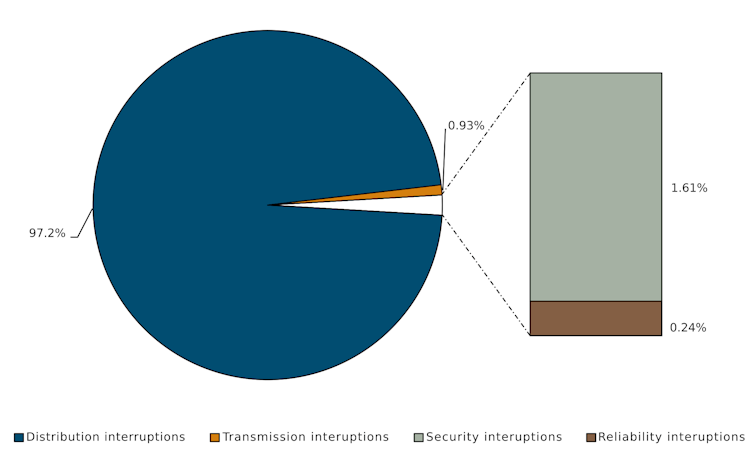 Sources of supply interruptions in the NEM: 2007-08 to 2015-16.
AEMC 2017, Reliability Frameworks Review, Interim Report (page 54)
Sources of supply interruptions in the NEM: 2007-08 to 2015-16.
AEMC 2017, Reliability Frameworks Review, Interim Report (page 54)
South Australia may have the highest number of supply interruptions, but this is essentially unrelated to electricity supply mix.
Is this ‘all because’ of state Labor policy?
No. Even if wholesale prices become the main driver of retail prices, it’s not accurate to place the blame squarely on renewables.
Increased renewable energy generation may have contributed to decisions for some power plants to close. But so would other factors – such the A$400 million safety upgrade required for the Hazelwood power plant to have stayed open.
As mentioned above, other factors such as gas prices and competition issues have also contributed to increases in wholesale electricity prices. And as shown below, these are not confined to South Australia.
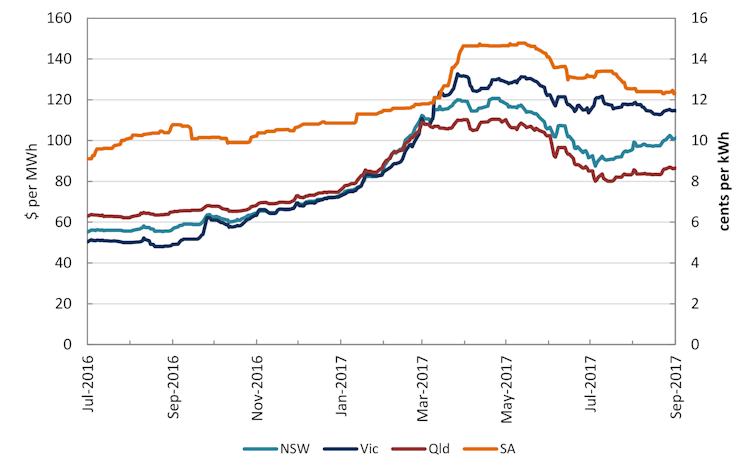 Electricity futures prices for 2017–18.
ACCC 2017, Retail Electricity Pricing
Inquiry, Preliminary report (page 56)
Electricity futures prices for 2017–18.
ACCC 2017, Retail Electricity Pricing
Inquiry, Preliminary report (page 56)
Gas prices are particularly important in the South Australian context, which is the most gas-dependent region in the National Electricity Market.
In addition, the SA market is the most concentrated in terms of competition.
In this sense, Marshall was not correct to say that price increases are “all because this [Labor] government decided we had to go headlong into intermittent renewable energy without the baseload to support that transition”.
Indeed, a large proportion of the existing renewable investment in South Australia has been financed as a result of the federal Renewable Energy Target, introduced by the Howard government, rather than state policy. – Dylan McConnell
Blind review
I broadly agree with the verdict.
The price question is not contentious. South Australia has the highest retail electricity prices in Australia – but not in the world.
An argument could be made for South Australia being the least reliable system in the National Energy Market – if you look beyond the technical definition. A series of power losses and near misses in 2016-17 clearly raise questions for SA residents.
But, as the author rightly points out, the vast majority of these were caused by storms and other technical issues – not by renewables. – David Blowers
The Conversation is fact-checking the South Australian election. If you see a ‘fact’ you’d like checked, let us know by sending a note via email, Twitter or Facebook.
The Conversation thanks The University of South Australia for its support.
 The Conversation FactCheck is accredited by the International Fact-Checking Network.
The Conversation’s FactCheck unit is the first fact-checking team in Australia and one of the first worldwide to be accredited by the International Fact-Checking Network, an alliance of fact-checkers hosted at the Poynter Institute in the US. Read more here.
Have you seen a “fact” worth checking? The Conversation’s FactCheck asks academic experts to test claims and see how true they are. We then ask a second academic to review an anonymous copy of the article. You can request a check at checkit@theconversation.edu.au. Please include the statement you would like us to check, the date it was made, and a link if possible.
Authors: Dylan McConnell, Researcher at the Australian German Climate and Energy College, University of Melbourne

















