

why we should stop calling these small winged children ‘cherubs’
- Written by Philip C. Almond, Emeritus Professor in the History of Religious Thought, The University of Queensland
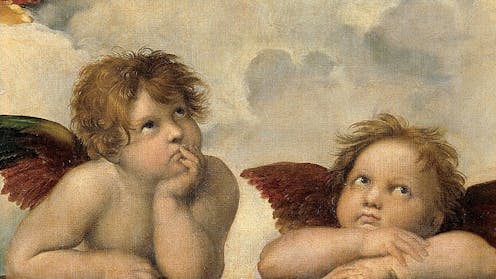
We are all familiar with cherubs – small, winged children that have a status in Western art history as angels.
But did you know this image you hold in your head of a cherub is completely unlike the cherubs of the biblical and medieval traditions?
Here’s what you should know about these mythical creatures.
Cherubs were originally fearsome
The Cherubs in the book of Ezekiel in the Old Testament were fearsome creatures.
Each had four faces – those of a human, a lion, an ox and an eagle – and four wings.
By the 4th century within Christianity, angels had become creatures with two wings, sufficient to enable them to travel from heaven, where they usually resided, to earth, generally to bring messages from God to us.
In the order of heavenly beings constructed by Pseudo-Dionysius in the late 5th century, Cherubs were second in importance to the Seraphs, followed by Thrones, Dominions, Virtues, Powers, Principalities, Archangels and Angels.

So, in the Dionysian order, Cherubs aren’t even angels, but are way above them, close to God. There, they supported the divine throne or the divine chariot by means of which God travelled around.
In a later tradition they, along with the archangel Gabriel, guarded the entrance to the Garden of Eden.
Cherubs as we know them come from Putti
What we now call Cherubs in Christian art were originally depictions of Putti – chubby, male children – from Ancient Greece and Rome. We are most familiar with a Putto as Eros, Amor or Cupid, usually naked, winged and with arrows used to incite love.

Putti were re-introduced into the West by the Italian sculptor Donatello in 1429 in sculpture.
In his art, the Putti were spiritelli – what we would call “sprites” or “elves”. They were little creatures – playful, lively and mischievous – often associated with love.
Suddenly, the Putti were everywhere. They especially adorned churches, playing with their Putti friends in childish glee, singing and dancing to the music of the lute or mandolin, climbing on fountains, pouring water through a vase or through the mouth of a fish.
 Madonna with Four Cherubs, Donatello, c. 1440.
Staatliche Museen zu Berlin, Skulpturensammlung und Museum für Byzantinische Kunst / Antje Voigt, CC BY-SA
Madonna with Four Cherubs, Donatello, c. 1440.
Staatliche Museen zu Berlin, Skulpturensammlung und Museum für Byzantinische Kunst / Antje Voigt, CC BY-SA
The wings of the Putti suggested angelic status to Christian artists. And so, within the history of Christian art, these Putti have been and are still called “Cherubs”. But we do not know how they came to be known by this name.
The Putti became child-angels
In the 15th century, when the classical Putti were introduced into Christian art, they were looked upon as child-angels rather than as Putti. That is, they were Christianised.
We find child-angels with haloes and multi-coloured wings surrounding Mary and Jesus in Bernardino Fungai’s The Virgin and Child with Cherubim, painted around the end of the 15th century.
 Bernardino Fungai, The Virgin and Child with Cherubim, between 1495 and 1510.
Wikimedia Commons/National Gallery
Bernardino Fungai, The Virgin and Child with Cherubim, between 1495 and 1510.
Wikimedia Commons/National Gallery
We know child-angels best of all as the two playful infantile figures of the Sistine Madonna (1514) with coloured wings, where Raphael has added them into the painting almost, it appears, just for the fun of it or as an afterthought.
Even Cherubs are not always Cherubs
Although we now might refer to all of these winged child-angels as Cherubs, the artists who painted them likely divided them into various celestial creatures, classified in some cases by the colour of the clothing they wore.
Cherubs often appear in blue clothing and with Mary, the mother of Jesus – their blue clothing perhaps reflecting her traditional blue clothes.
Child-angels dressed in blue are often paired with child-angels in red, the traditional colour of the Seraphs, those of a higher angelic order than the Cherubs.
In the French court painter Jean Fouquet’s Virgin and Child (1452), Mary the Queen of Heaven and Jesus are surrounded by naked red Seraphs and, behind them, naked blue Cherubs. So here we have the two highest orders of celestial creatures, surrounding Mary and Jesus.
 Mary and Child Surrounded by Seraphim and Cherubim, Part of the Melun Diptych, Jean Fouquet, from 1452 until 1458.
Royal Museum of Fine Arts Antwerp/Wikimedia Commons
Mary and Child Surrounded by Seraphim and Cherubim, Part of the Melun Diptych, Jean Fouquet, from 1452 until 1458.
Royal Museum of Fine Arts Antwerp/Wikimedia Commons
On occasion, we find Seraphic infants only in attendance on Mary, now as winged heads, with no Cherubic children present at all.
Giovanni Bellini, in a 1485 painting known as Madonna of the Red Cherubim – but better titled “the Madonna of the red Seraphs” – has red winged, red-headed child-angels, their bodies in the clouds surrounding the head of Mary. It wasn’t until the 19th century that the name “Cherub” became common for all these baby angels.
 Madonna of the Red Cherubim, Giovanni Bellini, c. 1485.
Gallerie dell'Accademia/Wikimedia Commons
Madonna of the Red Cherubim, Giovanni Bellini, c. 1485.
Gallerie dell'Accademia/Wikimedia Commons
But to call these child-angels all “Cherubs” is a misnomer, still perpetrated in Western art history.
Most artists just depicted child-angels or even infant-angels, with no connection to the biblical Cherub. That said, some, when dressed in blue, are probably intended as Cherubs; others, when dressed in red, are likely meant as Seraphs.
The history of the Western art of celestial creatures needs to be rewritten as a consequence.
Authors: Philip C. Almond, Emeritus Professor in the History of Religious Thought, The University of Queensland




















_Madonna_dai_cherubini_rossi_-_Giovanni_Bellini_-_gallerie_Accademia.jpg)