

E-bikes could slash our reliance on cars – but overpowered illegal models on the roads make us all less safe
- Written by Richard J. Buning, Research Lead, Micromobility Research Cluster, The University of Queensland
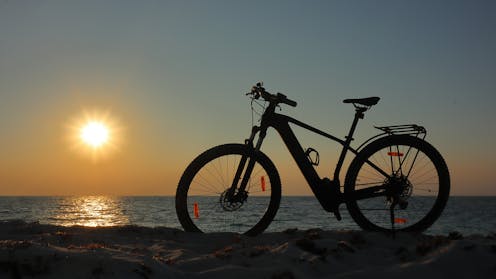
Since the invention of gears, nothing has encouraged more people to get on a bicycle than the introduction of electric motors and batteries.
When people have an e-bike, they drive less and cycle more. A study of frequent car drivers in Sweden found the distance people drove fell close to 40% once they were provided with an e-bike.
Conventional bikes don’t have anywhere near the same ability to get people out of their cars, due to their reliance on muscle power.
E-bikes aren’t bikes as we’ve known them – they perform more like a car, motorbike or e-scooter. We need to start thinking of e-bikes as a distinct form of transport.
But as authorities grapple with a tide of overpowered e-bikes used illegally on roads, making the best use of these vehicles will also have to include clearer, tighter regulations.

What do e-bikes have over regular bikes?
E-bikes overcome five challenges limiting use of conventional bikes:
Distance
E-bikes allow riders to go further than conventional bikes. E-bikes designed for city use offer a range of about 30 to 80 km per charge. They’re particularly attractive in regional Australian towns characterised by sprawl and little to no public transport. High-end e-bikes can offer 100 km in range or more, but come with big price tags. Riding 100 km every week for a year would cost about A$20 in electricity to charge.
Hills
Hilliness is a major challenge for many cyclists, especially those who aren’t fit or who ride bikes to get from place to place rather than for exercise. By contrast, the electric motors of e-bikes make uphill climbs much more manageable. In hilly Australian cities such as Brisbane and Sydney, e-bikes open up new routes.
Weather
People don’t like to ride conventional bikes as much if it’s very hot or cold. E-bikes require less physical effort, meaning riders sweat less in hot weather. In the cold, e-bikes can increase wind chill compared to a conventional bike, but they also help riders reach their destinations faster and reduce overall exposure to cold. Owners do have to take weather into account, because cold can reduce battery life, while heat can reduce how long a battery lasts. Long exposure to heavy rain may damage e-bikes too. Good undercover storage is necessary.
Cargo
Riding a pushbike with two kids or groceries on board is challenging. Extra weight requires extra effort. Cargo e-bikes make it much easier to transport loads between 100 and 200 kg. These models are heavier and bulkier than regular e-bikes, making storage and manoeuvring in tight spaces more difficult.
Physical limitations
E-bikes can be a useful option for groups who can’t easily use conventional bikes. These include older adults, pregnant people and individuals with medical conditions limiting their movement. Caution does have to be taken, though. The sudden acceleration of an e-bike can startle riders and increase risk of falls, while travelling at higher speeds can be challenging for those with slower reflexes. Proper training is essential.

Risks stem from regulatory failure
Like any form of transport, e-bikes come with risks. Reports of e-bikes catching fire and hitting pedestrians have triggered public anxiety and even proposals to restrict or ban them.
Many residential and commercial buildings have banned e-bike charging or parking indoors to avoid any battery fires, while public transport bans have been floated.
The reality is, battery fires and lethal crashes are overwhelmingly due to non-compliant e-bikes with low quality batteries or with power levels well beyond the limit legally allowed on Australian roads.
Many of these vehicles shouldn’t be thought of as e-bikes. They’re more like unregistered illegal electric motorcycles.
What defines a true e-bike?
Most countries have adopted the European EN15194 e-bike standard, which defines an e-bike as a vehicle with:
- continuous rated power of no more than 250 watts
- maximum pedal-assisted speed of 25 kmh
- maximum speed of 6 kmh when using only a throttle.
It must also meet the safe battery standards (known as EN50604).
Unfortunately, in 2021 the Australian government removed e-bikes from its definition of a “road vehicle”. Bar Western Australia, all Australian states followed suit.
At a stroke, non-compliant vehicles became exempt from import standards. Overpowered vehicles with questionable batteries could be freely imported – as long as they were only used on private land.
This loophole has been widely used to import thousands of dangerous vehicles. Once in Australia, many end up on the roads. Some souped-up or illegally modified bikes can reach speeds as high as 90 kmh – and have caused deaths. These models have also become popular among younger Australians.
If nothing is done, the flood of illegal and unsafe models could undermine the real benefits of e-bikes.
In recent months, cycling researchers and advocacy groups have called for authorities to step in and close loopholes permitting the import of illegal devices, ban their sale and encourage uptake of European-standard e-bikes.
A new form of transport
E-bikes are quietly revolutionary. Once the e-bike sector is properly regulated, authorities should focus on making the most of their potential.
Separated lanes are vital and are especially important for e-bike riders, who can travel faster and may be more at risk of injury if they crash compared to traditional bikes.
Temporary subsidies are another option to drive uptake. Researchers overseas have shown the benefits from e-bike subsidies outweigh the cost.
If we do this right, millions of Australians could eventually rely on an e-bike rather than a car.
Authors: Richard J. Buning, Research Lead, Micromobility Research Cluster, The University of Queensland

















