

The most powerful tool in an astronomer’s arsenal is a lens – but not the kind you might think
- Written by Tania Barone, Research Associate in Galaxy Evolution, Swinburne University of Technology
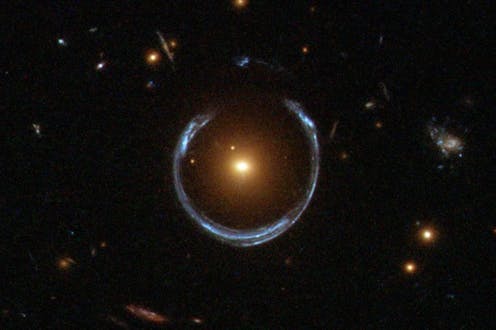
Astronomers are living in a golden age of bigger and better telescopes. But even our most advanced technology pales in comparison to the power of nature’s own “cosmic magnifying glasses” – strong gravitational lenses.
In less than 50 years we have gone from the first-ever discovery of a strong gravitational lens to now finding thousands. As new telescopes come online, we’re expecting to discover thousands more.
With these lenses, we can look deep into the universe, and catch glimpses into the most puzzling of contemporary cosmic mysteries: dark matter and dark energy.
So, what are gravitational lenses and how do they work?
A spectacular demonstration of gravity
Gravitational lenses are the most visually spectacular demonstration of Albert Einstein’s theories of gravity.
According to Einstein, mass bends and warps the very fabric of space, in much the same way that a heavy bowling bowl placed on a mattress will bend the mattress beneath it.
Everything with mass (you, me, a leaf, an atom) bends space-time in this way.
But it’s only when an object is really massive – such as entire galaxies and clusters of galaxies – that this effect becomes so apparent. As light travels from distant objects and passes these massive galaxies, the warped space-time around them bends and focuses this light, magnifying it for us to see.

We’re not always in the right place to see this effect. Just like how you need to align a magnifying glass in front of your eye, we only observe the gravitational lensing effect when there is a chance alignment of the background object, the foreground lens, and us.
On the rare occasions when this happens, through our telescopes we see multiple, distorted but magnified versions of an object that we wouldn’t otherwise be able to see because it’s too faint.

Revealing the invisible
Even Einstein couldn’t have predicted how important gravitational lenses would become to modern astronomy. In fact, he believed them impossible to observe at all.
This was because Einstein was thinking about gravitational lensing around individual stars, not galaxies. It wasn’t until decades later that astronomers came to realise just how massive galaxies are, and just how full of them our universe is.
Impressively, gravitational lenses can also reveal details about things we can’t see at all.
Theories predict about 85% of the matter that makes up the universe is invisible stuff called dark matter. The way a gravitational lens bends and warps light allows us to measure how much matter is in galaxies – not just the regular matter we can see, but dark matter as well.
Gravitational lenses can also help us map galaxy clusters across the universe, helping us to understand its shape. Is our universe perfectly flat like a sheet of paper? Or does it have curvature to it like a sphere, or flare outwards like a horse saddle?
That depends on how dense the universe is, and mapping galaxy clusters helps us measure the density of a hypothetical force known as dark energy.
Looking at the distant universe
Gravitational lenses typically make the background objects ten to 100 times brighter than they would be otherwise. This effect provides a high-definition view of the distant universe.
The James Webb Space Telescope has been taking advantage of this magnification boost to get a glimpse into what the universe was like in its infancy more than 13 billion years ago, shortly (300 million years) after the Big Bang.
Looking far into the past helps us piece together how our own celestial home, the Milky Way galaxy, formed and how it might change in the future.
We’re about to be spoilt for choice
The catch to all this is gravitational lenses are rare – akin to a needle in a cosmic-scale haystack. To find them, we need high quality images of large swaths of the night sky.
This year, two new skywatching projects are expected to revolutionise the field: the European Space Agency’s Euclid space telescope and the Vera Rubin Observatory in Chile.
Euclid, which launched in 2023 and released its first batch of data earlier this year, will image a monumental one-third of the entire sky, with a clarity that only comes from being in space.
Conversely, the Vera Rubin Observatory will be working from the ground, but will image the entire southern hemisphere sky. It will create the most detailed time-lapsed view of the cosmos ever seen.
Over their lifetimes Euclid and the Vera Rubin Observatory are predicted to unveil 100,000 new gravitational lenses, 100 times more than we currently know.
How do we find these 100,000 gravitational lenses among the billions of galaxies observed by these telescopes? It is not feasible for scientists to wade through that many images alone.
Instead, Euclid is relying on citizen scientists to help train AI models to know what to look for. By having people each look through a few images and classifying whether they are gravitational lenses or not, AI models can learn from these examples and can then search the entire dataset (if you want to get involved, check out their website).
From individual lenses providing unique new insights into distant galaxies, to studying the effect over large statistical samples to understand the very nature of the universe, gravitational lenses do it all. They are the Swiss Army knife in an astronomer’s toolkit, and we’re about to be spoilt for choice.
Authors: Tania Barone, Research Associate in Galaxy Evolution, Swinburne University of Technology

















