

Australia has banned 3 ‘forever chemicals’ – but Europe wants to ban all 14,000 as a precaution
- Written by Bhavna Middha, ARC DECRA Senior Research Fellow in Environmental Sociology, RMIT University
Last month, Australia’s ban on the import, use and manufacture of three types of “forever chemical” came into effect. These chemicals – PFOA, PFOS and PFHxS – have long lifespans and resist breaking down. They’re considered harmful due to their ability to build up inside living organisms and their toxicity. In 2023, the World Health Organization’s cancer agency declared PFOA to be a human carcinogen (cancer-causing agent), and PFOS a potential carcinogen.
But these three chemicals are just a drop in the ocean. There are now more than 14,000 types of forever chemicals, known formally as per- and poly-fluoroalkyl chemicals, or PFAS for short. In response to public concern, the European Union has proposed to restrict all types of PFAS by 2030.
This approach may seem extreme. But the cost of cleaning up highly polluted PFAS sites and research on emerging harms shows the value. Phasing out the entire class could avoid still worse chemical pollution in years to come.
Australia’s ban on the three most concerning chemicals is positive. But it’s slow. Authorities wait until new evidence of harm emerges for specific chemicals. This risk-based approach leaves the door wide open for thousands of other PFAS chemicals – and all other industrial chemicals being developed at the staggering rate of 1.4 per second.
When it comes to PFAS, caution is wise
Since the 1950s, PFAS chemicals have been widely used in industrial products due to their usefulness in making products nonstick or resistant to water or fire.
The problem is, these forever chemicals are highly persistent. There’s little ability to reverse harm from exposure.
Some of these chemicals may not be harmful. But they often haven’t been tested to find out. This is why the EU is using the precautionary principle: if in doubt, act cautiously to avoid potentially large harms. A total ban would avoid “regrettable substitution”, where banned chemicals are quickly replaced by a slightly different variant.
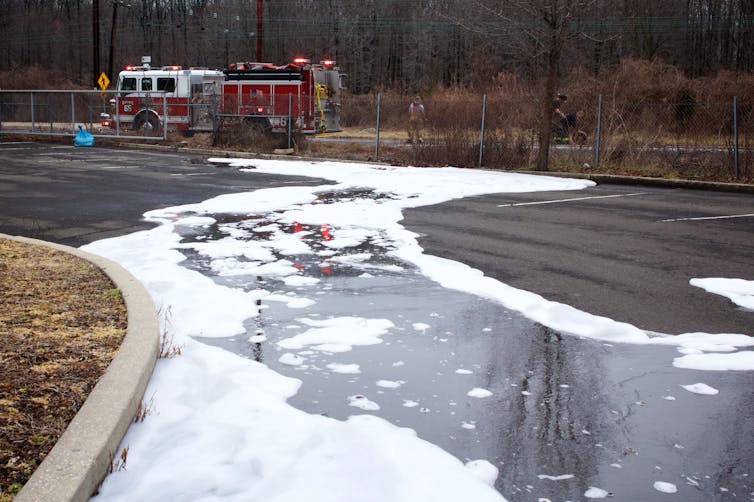
To date, the most severely affected communities and workers are those at or near chemical production plants, military sites, airports and other sites where PFAS-laced firefighting foam is used.
Since then, concern has broadened out to the much lower levels commonly found in drinking water, food, food packaging, cookware, carpets and air.

Control efforts have been slow
The 2001 Stockholm Convention on Persistent Organic Pollutants took aim at 12 industrial chemicals known to be toxic and persistent. In 2004, Australia ratified the convention and moved to control these chemicals.
No PFAS chemicals were in this first group. But over time, the convention was amended to phase out the forever chemicals PFHxS and PFOA and restrict PFAS.
Australia didn’t use the Stockholm Convention to ban these three chemicals. That’s because the government hasn’t completed work on a domestic treaty allowing it to ratify the amendments.
In recent years, public concern has centred on PFAS levels in drinking water. Australia’s expert health panel concluded there was limited to no evidence linking the PFAS group of chemicals to clinically significant harm. The panel stated the limited evidence available on cancer relates to PFOA, not the PFOS chemical used more commonly in Australia.
By contrast, peak bodies in the United States and Europe found some of these chemicals are linked to health issues such as lower birth weights, higher cholesterol, reduced kidney function, thyroid disease and several cancers.

If in doubt, act with caution
One of the clearest definitions of the precautionary principle is in the 1992 Rio Declaration on Environment and Development, which states:
where there are threats of serious or irreversible damage, lack of full scientific certainty shall not be used as a reason for postponing cost-effective measures to prevent environmental degradation.
This approach has proven its worth in marine pollution agreements for decades, as well as playing a major role in trade disputes regarding hormone-treated beef and genetically modified organisms
To make the wholesale PFAS phase-out successful, the EU’s chemical agency is consulting with manufacturers and users on how the chemicals are used and whether safer alternatives exist. Promising alternatives have been identified.
Some chemical companies and product manufacturers have omitted to share safety information on PFAS chemicals, to the detriment of the environment and human health. The EU’s chemical agency found noncompliance was rising and almost all chemicals on the market lacked crucial information on whether they caused cancer or other harms.
At present, manufacturers have most information about toxicity, while regulators are tasked with protecting the public and the environment without necessarily having enough data. In these cases, it makes sense to adopt the precautionary principle.
Forever chemicals will have a long legacy even if they are banned. Any ban should be accompanied by work defining acceptable levels of PFAS chemicals as a class in water, soil, air and food.
The case for a wider Australian ban
Most PFAS chemicals are imported into Australia. This means PFAS pollution can be handled largely by regulating imports of PFAS-containing products.
For products without an alternative or those essential to, say, healthcare, more research will be needed to eliminate the most risky compounds.
Any move towards a large-scale ban in Australia will incur a manufacturer backlash, as has happened in Europe.
But there’s a clear incentive for policymakers to act. At present, cleaning up PFAS contamination is inevitably paid for by taxpayers – and this cost will only grow. Regulating chemicals such as PFAS based on their individual risk is no longer fit for purpose.
By November 2025, Australia’s Senate committee on PFAS will file its report.
The committee could do a lot worse than looking to the European precautionary plan to ban the whole group of chemicals, while keeping in mind essential use. It would be sensible to permit new chemicals to be used only if they’re safe enough.
Authors: Bhavna Middha, ARC DECRA Senior Research Fellow in Environmental Sociology, RMIT University

















