

how Australia’s ageing train networks are crumbling as the climate changes
- Written by Haoning Xi, Lecturer (Assistant Professor), Newcastle Business School, University of Newcastle
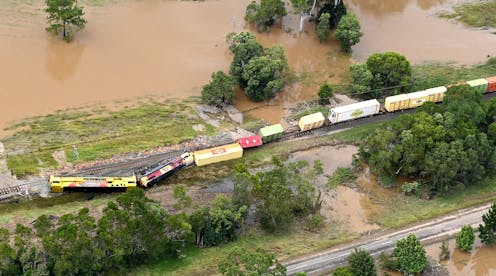
Last week’s torrential rain disrupted several Sydney train lines, in what is becoming a familiar story for commuters. Almost one in five trains in New South Wales ran late over the past year, and floods in May also saw a temporary closure of the North Coast line.
Other states are faring little better. In Queensland, the rail line from Brisbane to Cairns was shut for weeks due to floods in 2022.
Over in Western Australia, summer heatwaves routinely force trains to crawl at reduced speeds to avoid track buckling. In Melbourne, a derailment in July shut down two major lines for a week, disrupting the daily commute for tens of thousands of people.
From city transit to cross-country freight, Australia’s rail system is straining as the infrastructure ages and climate extremes grow more intense and frequent.
Old assets meet extreme weather
Much of Australia’s rail backbone was built decades ago. Some lines are more than a century old.
The Trans-Australian Railway, completed in 1917, still carries most freight between WA and the eastern states. It wasn’t designed for today’s rainfall.
In early 2022, extreme rain in outback South Australia washed out 300km of track. The event severed Perth’s land link for 24 days, costing about $320 million. Even in a normal year, the corridor is shut by flooding for an average of 40 days.
In February this year, North Queensland floods forced Queensland Rail to close sections of the North Coast Line, with nine bridges inundated.

In Perth, summer heat forces trains to slow as the steel of the tracks may warp. Speeds drop by 20km per hour at 39°C, and further at 41°C.
These heat restrictions have been imposed every summer for more than 30 years. As heatwaves intensify, so do the delays and the stress on equipment.
In 2024–25, only 82.5% of Sydney trains ran on time, well below the target of 92%. A backlog of almost 40,000 infrastructure defects, including worn rails, poor drainage and ageing signals, leaves the rail network vulnerable in storms.
Failures from commute to consumption
When a rail line fails, the impacts stretch from the morning commute to supermarket shelves.
Thousands of Sydney commuters have been hit with delays after flooding. Melbourne’s July derailment shut the Mernda and Hurstbridge lines, forcing 110,000 daily travellers to squeeze onto crowded replacement buses or find other travel options.
When the east–west line collapsed, WA briefly ran low on staples such as pasta, toilet paper and medicines.
The economic hit of these disruptions is large and recurrent. The Australasian Railway Association estimates major rail disruptions in NSW alone can cost up to $392 million a year in cancelled deliveries, shortages and repairs.
Between late 2021 and early 2023, Australia’s largest freight operator recorded eight interstate corridor shutdowns of a week or more. Each closure sends shockwaves through supply lines, pushing more freight onto highways, driving up costs, and exposing the fragility of a system where one washed-out bridge or buckled track can break a whole logistic chain.
A fragmented system with no-one at the helm
When Australia federated in 1901, railways were left under state control. The legacy has been a patchwork of networks with different rail gauges, standards and rules that didn’t line up at the borders.
Despite a century of effort, the Australian rail industry remains hampered by a pre-federation legacy of fragmentation. We have 29 separate rail networks, each with different standards, codes and rule books, and varied technologies and processes for building, operating and accessing the infrastructure.

A recent review of Australian rail operations found that overlapping agencies make it unclear who is accountable for maintenance. Repairs are often delayed, and nobody wants to take responsibility for failures.
Infrastructure Australia, the nation’s independent adviser on infrastructure, has likewise deemed the lack of resilience across transport corridors a nationally significant problem requiring coordinated, cross-jurisdictional action.
A national plan
So what can be done? Experts and industry bodies such as the Australasian Railway Association (ARA) point to a two-pronged solution: modernise the infrastructure and modernise the governance.
On the infrastructure side, there are positive moves. The federal government has committed new funding, more than $1 billion announced in 2024, to make the national rail network more resilient and reliable.
But more is needed. Industry voices are calling for a concerted, long-term program to “identify, fund and deliver” upgrades nationwide to improve rail lines’ redundancy, reliability and climate resilience. In practice, that means strengthening bridges, raising or rerouting tracks in flood-prone areas, deploying digital signalling and safety systems with IoT monitoring, and building alternative routes to keep services running when a line fails.
Equally important is rethinking governance. A resilient rail system needs a national strategy and better coordination across states.
The ARA has called for a National Freight Resilience Plan to ensure a consistent response to major disruptions. This could be expanded into a broader plan backed by federal leadership. A federal plan might mandate climate-adaptation standards for all federally funded projects and break down state silos.
The benefit? A more reliable, resilient, safer and smoother rail system for all of us.
Authors: Haoning Xi, Lecturer (Assistant Professor), Newcastle Business School, University of Newcastle

















