

Hossein Asgari’s Desolation speaks powerfully of the destructiveness of war and the hope that lies in fiction
- Written by Michelle Hamadache, Director of Creative Writing, Macquarie University
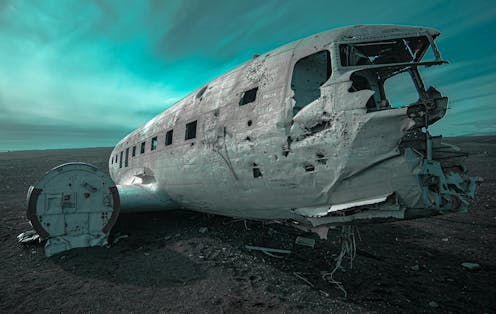
Hossein Asgari’s Desolation tells the story of Amin, an Iranian man whose life and family are shattered when the USS Vincennes shoots down an Iranian passenger plane in 1988.
The plane was carrying 290 passengers as well as crew, all of whom were killed. Among the dead was Amin’s older brother Hamid, a gifted mathematician, who was travelling to an interview to enter a prestigious US university. Grief transforms Amin and his family; their lives are irrevocably shaped and reshaped in its wake.
Review: Desolation – Hossein Asgari (Ultimo Press)
In some respects, Desolation is a war story. The novel explores the far-reaching effects of the Iran-Iraq War of 1980-88, US meddling and violence in the Middle East, and the “war on terror”. It boldly reimagines the events leading up to September 11 2001.
The tragedy of the downed plane coincides with the discovery of teenage Amin’s innocent yet forbidden romance with the girl across the road, the lively and sophisticated Parvaneh, whose family moved nearly 1,000 kilometres from Tehran to Mashad to escape Iraqi missile attacks. Amin is seen sneaking out of the house by a neighbour. Under the theocracy of Ruhollah Khomeini, Amin’s transgression risks flogging, but his secret courtship ends without punishment, in deference to the family’s loss and the shocking way Hamid died.

Decades later, Amin seeks out an Iranian writer who works in a cafe in downtown Adelaide. He watches him so closely that the writer becomes rankled enough to consider confronting the stranger.
The writer has absolutely no desire to listen to, let alone write, the story that Amin is determined he should not only hear but commit to the page. But Amin (a pseudonym he gives himself – we never learn his real name) secures his audience with a ruse older than the Thousand and One Nights.
He taunts and tantalises the writer with a mystery number, the meaning of which he will reveal the following day should the writer return. As the reader anticipates, the writer returns. This reluctant curiosity propels both writer and reader through the novel.
Despite Amin’s urgent need to share his story, there is no sense of it being a confession with the power to absolve or release the confessor. Rather, it is the story, in its purest sense, that must be passed on to the storyteller. The story matters for its own sake.
His urgent need to tell his story heightens the narrative momentum. Yet, once Amin has passed his story on, he relinquishes control to the writer. Stories are not tied to ownership and property in this exchange.
Truth and critical reading
Plot summary alone might suggest Desolation is about the radicalisation of Amin. At the start of the novel, he is an in-love adolescent. He becomes an angry and grief-stricken young man, acting as a proxy for the Iranian morality police. Finally, he finds himself involved in an Al-Qaeda cell.
But to read the novel in this way would be to ignore the many clues (including in the blurb and on the cover) that the book is about the relationship between truth and critical reading. It implies that limited and literal readers are always at risk of being duped by fake news and propaganda – of confusing “truth” with “facts” – and missing the message of fiction altogether.
In Desolation, inexplicable elements, often in the form of coincidence, disrupt and distort causal chains. Asgari excels at blurring the boundaries between the real and imaginary. Dreams and imagination have a subversive role in the novel. They are strange disruptions to the deliberate and precise enmeshment of historical events and realist fiction.
Amin was as likely as not to join a radical group. But the ironic distance Asgari establishes puts the onus back on the reader to interrogate and interpret the “why”. That Desolation is not a desolate novel is in part because of the challenge it presents to a flattened-out uncritical mode of engaging with narratives – a simplistic mode that tends to dominate in a world of conspiracy theories, “fake news” and Trumpian politics.

 Even Asgari’s use of epigraphs feeds into this infinite regress. Desolation is a novel that critiques both rationalist and religious thinking. The epigraphs position the novel between eternal life and death, providing a rich doubling of truth and irony.
The first epigraph, a surah from the Quran, promises eternal life: “And reckon not those who are killed in Allah’s way as dead: nay; they are alive (and) are provided sustenance from their Lord.”
The second is the well-known verse from the Bhagavad Gita: “Now I am become Death, the destroyer of the worlds.” That this verse is associated with Robert Oppenheimer and the atomic bomb is a reminder of the stakes of a polarised world, whether that polarisation is a result of religious or political extremes.
Missing from the “destroyer of worlds” quote are the words “I am time”. The power of narrative to compress the life of a character, and to weave present, past and future together in ways that heighten meaning and disrupt the status quo is harnessed with great skill by Asgari.
Framing narratives emphasise the boundedness of a book, its separation from the real, while doubling down on the work required by the reader. The epigraphs are another of the frames that set the terms for the reader – and in Desolation those terms are extreme: life, death and afterlife.
Closure?
Desolation draws on the time-honoured literary tradition of questioning truth and fiction, facts and lies, to say something specific and new to this moment. Its use of metafiction is not gimmicky or overly self-aware; rather, it is an integral device, reminding readers to stay alert and not fall prey to the authoritative voice.
Roles are reversed at the end of the novel, in an almost comical exchange. Now it is the writer wanting more from Amin, beseeching him for more, because books require “closure”.
Amin gives the writer a lesson in narrative theory, but provides some of the answers about what happened to the people in his life. These lifelike details ensure Desolation is never dull or esoteric. Asgari creates depth of character through vivid detail and his dramatisation of complex relationships. Desolation resists causal explanations, introducing elements of the surreal and the fantastical, but is very much through materialised worlds that the novel explores its themes.
The hubris of US imperialism is intrinsic to the plot, but so too are American films, music and literature, from E.T. to Bob Dylan to John Steinbeck. These cultural expressions provide serious pleasure and meaningful experiences to Iranians forced to live under theocratic rule. They are evidence that nothing is completely polarised or one-sided.
Amin is a difficult character, disillusioned and bitter later in life, diffident and drifting in his youth. His redeeming features are his propensity for falling deeply in love and allowing that love to shape and propel his actions. Contingency rather than causality, fatalism rather than agency, determine the course of his life.
But what is also dramatised to great effect in Desolation is the degree to which war is a destroyer of lives, not just those lives directly harmed through fighting, but those who experience its ripple effects. The whole fabric of society warps in ways that can’t be predicted or controlled.
The outermost edge of the novel is the premise that the reluctant writer has written Amin’s story. At some point outside the frame of the story, he believed in its purpose and meaning.
A similar act of faith exists, outside the aesthetic space of the novel, in the contract between reader and writer. Perhaps in a world of fake news, environmental disaster, wars, and the despotisms of Trump, Putin and Netanyahu, only the most desolate of narratives is able to deliver the message that, if there is hope, it lies in fiction.
Authors: Michelle Hamadache, Director of Creative Writing, Macquarie University
Even Asgari’s use of epigraphs feeds into this infinite regress. Desolation is a novel that critiques both rationalist and religious thinking. The epigraphs position the novel between eternal life and death, providing a rich doubling of truth and irony.
The first epigraph, a surah from the Quran, promises eternal life: “And reckon not those who are killed in Allah’s way as dead: nay; they are alive (and) are provided sustenance from their Lord.”
The second is the well-known verse from the Bhagavad Gita: “Now I am become Death, the destroyer of the worlds.” That this verse is associated with Robert Oppenheimer and the atomic bomb is a reminder of the stakes of a polarised world, whether that polarisation is a result of religious or political extremes.
Missing from the “destroyer of worlds” quote are the words “I am time”. The power of narrative to compress the life of a character, and to weave present, past and future together in ways that heighten meaning and disrupt the status quo is harnessed with great skill by Asgari.
Framing narratives emphasise the boundedness of a book, its separation from the real, while doubling down on the work required by the reader. The epigraphs are another of the frames that set the terms for the reader – and in Desolation those terms are extreme: life, death and afterlife.
Closure?
Desolation draws on the time-honoured literary tradition of questioning truth and fiction, facts and lies, to say something specific and new to this moment. Its use of metafiction is not gimmicky or overly self-aware; rather, it is an integral device, reminding readers to stay alert and not fall prey to the authoritative voice.
Roles are reversed at the end of the novel, in an almost comical exchange. Now it is the writer wanting more from Amin, beseeching him for more, because books require “closure”.
Amin gives the writer a lesson in narrative theory, but provides some of the answers about what happened to the people in his life. These lifelike details ensure Desolation is never dull or esoteric. Asgari creates depth of character through vivid detail and his dramatisation of complex relationships. Desolation resists causal explanations, introducing elements of the surreal and the fantastical, but is very much through materialised worlds that the novel explores its themes.
The hubris of US imperialism is intrinsic to the plot, but so too are American films, music and literature, from E.T. to Bob Dylan to John Steinbeck. These cultural expressions provide serious pleasure and meaningful experiences to Iranians forced to live under theocratic rule. They are evidence that nothing is completely polarised or one-sided.
Amin is a difficult character, disillusioned and bitter later in life, diffident and drifting in his youth. His redeeming features are his propensity for falling deeply in love and allowing that love to shape and propel his actions. Contingency rather than causality, fatalism rather than agency, determine the course of his life.
But what is also dramatised to great effect in Desolation is the degree to which war is a destroyer of lives, not just those lives directly harmed through fighting, but those who experience its ripple effects. The whole fabric of society warps in ways that can’t be predicted or controlled.
The outermost edge of the novel is the premise that the reluctant writer has written Amin’s story. At some point outside the frame of the story, he believed in its purpose and meaning.
A similar act of faith exists, outside the aesthetic space of the novel, in the contract between reader and writer. Perhaps in a world of fake news, environmental disaster, wars, and the despotisms of Trump, Putin and Netanyahu, only the most desolate of narratives is able to deliver the message that, if there is hope, it lies in fiction.
Authors: Michelle Hamadache, Director of Creative Writing, Macquarie University 
















