For the first time, scientists observed the ‘hidden swirls’ that affect the flow of sand, rocks and snow
- Written by Itai Einav, Professor in Geomechanics, University of Sydney
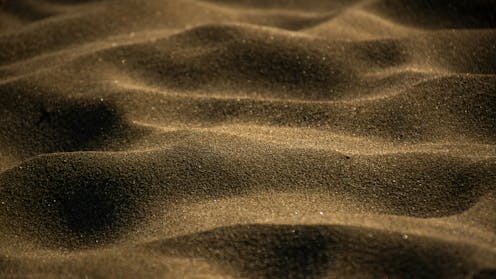
What looks like ordinary sand, rocks or snow flowing in one direction can actually hide swirling currents that move in multiple directions beneath the surface.
When grains move in a landslide, most follow the steepest downhill path. This is the “primary flow”, where particles largely follow the herd. But some grains move sideways or swirl in hidden patterns, forming “secondary flows” that subtly influence how far and fast the material travels.
Understanding how grains move beneath the surface could help explain the physics of avalanches and landslides, and even improve how we handle everyday materials like wheat in silos or powders in pharmaceuticals.
However, nobody has been able to observe these hidden swirls – until now. In a study published in Nature Communications today, we have captured secondary flows inside granular materials for the first time with our advanced X-ray imaging setup.
A bulldozing experiment
The idea these secondary flows exist isn’t new. Researchers have seen these hidden movements in powerful computer simulations of grains between rotating cylinders or in landslides that model each particle’s movement using basic laws of physics. But that’s a purely theoretical way to study them.
Observing the flows in real granular materials – such as sand, snow or similar – has been almost impossible. To look inside the flow, you’d either have to keep stopping the grains for standard X-ray scans or add a liquid that makes them see-through. Unfortunately, both approaches change how the grains naturally behave.
We set out to study the flow of glass beads (a perfect granular material for a lab setting) in a bulldozing experiment, where a conveyor belt pushes grains into a wall, causing them to pile up.

In our lab, we have developed an entirely new method called X-ray rheography which can take three-dimensional images of moving grains. Called DynamiX, this setup allows us to see what’s really happening beneath the surface.
To our surprise, the test revealed ripples on the surface, which earlier studies had linked to hidden secondary flows.
These flows had never been directly observed in three dimensions without stopping the motion or altering the material with fluid.
We could watch these hidden currents in action without disturbing the movement of the glass beads. Yet the complex geometry meant we could capture only the magnitude of the flow in one direction, along the conveyor belt as the primary direction, leaving the rest of the three-dimensional picture incomplete.

What we discovered underneath
To really pin down the secondary flows, we went further than just watching the grains with DynamiX.
We developed another X-ray method to map the surface of the flowing heap from X-ray images, linking tiny ripples on top to the swirling motion underneath. We also measured how grains move through the full depth of the pile, including sideways motions.
The main flow goes all in the same direction. So, the sideways movements we detected were the first direct experimental proof of secondary flows.
By looking inside these hidden flows, we are revealing the surprising versatility of granular materials. They can behave like solids that support buildings or like complex fluids with intricate internal currents.
 Movement of the secondary flow mapped with algorithms.
Andrés Felipe Escobar Rincón
Movement of the secondary flow mapped with algorithms.
Andrés Felipe Escobar Rincón
Swirling motions are common
While we didn’t study landslides directly, our experiments on bulldozed particles reveal something important.
We now know secondary flows are at play whenever particles are pushed, such as when ploughing snow or moving grains in agriculture, for example. The swirling motions we observed appear to be ubiquitous in complex particle flows.
What does this mean for landslides? Detailed experiments like ours provide crucial data that can be used to validate and improve mathematical models. Current models often ignore secondary flows and cannot predict them.
Read more: What causes landslides? Can we predict them to save lives?
Our work offers the experimental foundation for future modelling. Understanding and modelling these secondary flows could help engineers better predict the destructive power of landslides, including runouts that are currently underestimated.
It could also improve industrial processes, from powder handling in pharmaceuticals to snow clearing and beyond.
While our results are specific to bulldozed grains, they point to a broader principle – secondary flows are a fundamental feature of particle motion which must be considered in any realistic model of granular behaviour.
Beneath the surface of any moving pile of grains, hidden swirling currents are shaping the flow. Recognising these movements is key to understanding everything from avalanches to industrial particle handling.
Authors: Itai Einav, Professor in Geomechanics, University of Sydney