

Modern Australian
The Times

The Melbourne butcher’s son who converted to Judaism and guided 10,000 lives in death

  • Written by Janine Schloss, PhD candidate, Jewish Cultural Practice, Australian Centre for Jewish Civilisation, Monash University
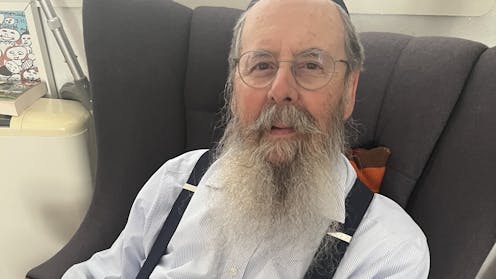
The Melbourne butcher’s son who converted to Judaism and guided 10,000 lives in death

Stella Prize shortlisted author Katia Ariel admits to a “pre-emptive regret” at not being able to include the personal details of each of the thousands of souls relayed to her by Ephraim Finch, director of Melbourne’s Chevra Kadisha – or, Jewish Burial Society. From the mid-1980s to 2015, he buried over ten thousand individuals. The book largely unfolds through a series of deep-dive conversations between Ariel, Finch and his wife, Cas.

Ariel writes that anyone living in the Melbourne Jewish community during this period would “for better or worse” have had something to do with the working-class butcher’s son (originally Geoffrey Finch), a voracious archivist and beloved community figure with a “broad Aussie accent”. In the foreword to her book on Finch, author Arnold Zable calls him a “community ferryman”.

Review: The Ferryman: The Life and Deathwork of Ephraim Finch – Katia Ariel (Wild Dingo Press)

Finch and Cas converted to Judaism when he was in his 20s, some years after she found a guide to modern Orthodox Judaism, Herman Wouk’s This is my God, in a newsagent and felt “the traditions make perfect sense […] nothing else feels as warm, as deep”.

In his three decades in his role, Finch was devoted to holding and guiding thousands of kindred souls to their resting place. He did this by chronicling the lives of each one of them in his personal archive. Many of these souls were Holocaust survivors. Ariel writes:

He will reiterate to me, over and over, how important it is to ask questions, to let people speak, to listen deeply.

Reading Ariel’s work, the reader is at once reassured of the power of story, while bearing the weight of the countless tales left untold.

‘Ritual becomes everything’

Ariel notes Finch’s practice of giving each family he encountered at the burial society a copy of Maurice Lamm’s The Jewish Way in Death and Mourning. According to Jewish law, the dead must be buried within 24 hours of dying, where possible. She is particularly intrigued by the ritual of tahara: the sacred act of purifying the body before burial, through washing and prayer.

Ariel pored over Finch’s journal entries, documents, photographs and transcripts of interviews with family members of the deceased, to shape them into a narrative. The result is a hybrid memoir that shines upon the remarkable Finch, a boy from Sydney who found his calling in Judaism and humanism – and ten years after retirement, continues to visit his “village”, Springvale Jewish Cemetery.

Katia Ariel. Wild Dingo Press

Towards the end of The Ferryman, Ariel reflects on when Finch’s handwritten chronicles first crossed her desk. She reverently interviews him and many of the bereaved he counselled. She spends countless hours in his home, with his family.

She accompanies him to visit familiar, revered souls in the “village”. She listens as Finch bears the details of every soul he has buried. “Hello, dear boy”, he says, as if to recognise the person beneath the grave.“You see, I buried this boy …”

She sits with some community members, too, including Finch’s longtime friend, Max Dzienciol, who opens up about losing his seven-year-old son, Nathan, hit by a car in 1990. He remembers Finch driving the hearse at Nathan’s funeral, and later holding his hand in the Coroner’s Court. He calls him “the person who’s there without you knowing”.

Ariel describes herself as “a Jew to the same extent that I am a secular humanist, a product of my agnostic world and its mixed-bag customs”. Except when it comes to births and deaths, when she has “never been so grateful for the structure, the scaffolding, of ancient tradition”.

In a stroke of creative genius, Ariel weaves herself into the flickering, incandescent accounts — lost daughters, fathers, brothers, friends. She learns there is no way to “memorialise all the memorialising”. Nonetheless, with Finch, she carves out a lyrical tribute to both the living and the dead, to all those Finch’s compassion touched.

As Ephraim’s quiet knowing awakens memories, his stoicism and faith – in humanity and in worlds beyond – is pervasive. As we tread a non-linear path, carefully and mutually laid by Ariel and Finch, readers might feel their own fears and experiences of grief soften and morph, into something more open to the crossing that awaits.

Beyond earthly stories

From the outset, it is clear the reader has been gently nudged to a place beyond earthly stories; a “tapestry” of community — a spiritual and eminently human “collaboration”, as Ariel puts it.

Yet the reader is pulled back from the brink of death, through all the gorges and rivers of life, while knowing, with searing clarity, they have been touched by a rare and wondrous human being in Ephraim Finch.


“The most urgent part is that I was a witness”, Finch confesses to Ariel early on in their encounters. At once Ariel understands his words and work speak beyond the personal, beyond Judaism: “I will sense, simply being next to this softly moving human, the shuddering proximity between us all …” They reach into the deepest, most mysterious and sacred of places, towards that “ongoing loop between the body and the spirit.” Every reader will find their core selves inside The Ferryman. Ariel reminisces, in the book’s final section, when she and Finch hear the words of Nick Cave’s Into My Arms playing as they drive home from an interview with two bereaved parents. It seems their working together on this book was preordained, she observes. The two sing in a gentle unison, “side by side in the same tiny boat on a nameless sea”. In his nonchalant style, Finch epitomises American–Israeli author Yossi Klein Halevi’s contention “Judaism is the love story between God and a people”. Halevi laments: “romance is often tumultuous. But […] the love story persists.” So too, Finch “like blotting paper”, speaks of the fathomless faith into which he has been absorbed. It has enabled him to be always there, as Dzienciol said, “without you knowing”; ever available for the delicate, weighty role of holding space for mourners – for “saying without saying”, Ariel notes, as he ferried precious souls across the waters. Historian Alistair Thomson, in his seminal work on oral history, sheds light on the concept of “deep listening”. He explains how the aural aspect of the interview process is brought to the fore by focusing “less on the creation or content of our interviews and more on how we are documenting the interviews”. Ariel’s synergy with her interviewee allows her to fully access and relay the story of one man with two names and countless lifetimes. Reading The Ferryman, I was overcome with the sense of being “in the poet’s hands”, as Maggie Nelson once wrote. Historian Laura Levitt says in the poet’s hands, “ordinary objects” are “transformed into talismans, offering a different form of doing justice and living on”. In The Ferryman, Ariel’s words reach inarticulable realms, for example, as she recounts the story of a tiny metal button that had once belonged to a Holocaust survivor’s camp pyjamas. Ariel calls it a “placeholder for hope … a symbol of survival”. I was affected in a wordless sense by the effortless arcs between disparate worlds in this image. Reflecting on her creative process, Ariel writes of being touched by emotion – by a language beyond words, as she seeks “glimpses of redemption, transient sunshowers of grace upon a scorched earth”. Not alone In his collection Autocorrect, Israeli fiction writer Etgar Keret momentarily portrays a God who not only lives, but takes on a physical presence. In the end, Keret is left bemoaning godlessness. The Ferryman, however shamelessly, houses a higher power on every page. Keret dares bring God to life. In a similar vein, Ariel’s memoir breaks convention and contemporary secularist expectations in its exploration of religion. She reveals a protagonist, Finch (still very much alive) who has walked the valley of the dead through the ages: as comfortable in the company of ghosts as he is with religious practitioners of all faiths, politicians, coroners, hospital staff and the bereaved. With rare humility and outreach, Finch expounds: see, you can be interested in people. But if you are interested in their stories […] It’s like letting people know they are not alone, that they are part of a string. As Ariel traverses the terrains of his extraordinary life, the reader, too begins to intuit all the particles – worldly and other, present and past – that comprise a human being, a family, a community. With grace, generosity, and care Ariel and Finch bestow deep insights into what it means to hold space for memory; to honour and sanctify the living and the dead in this post-Holocaust age. Correction: an earlier version of this review wrongly named Finch’s place of birth and the context in which he and Ariel sung along to Into My Arms. Authors: Janine Schloss, PhD candidate, Jewish Cultural Practice, Australian Centre for Jewish Civilisation, Monash University

Read more https://theconversation.com/the-melbourne-butchers-son-who-converted-to-judaism-and-guided-10-000-lives-in-death-261671

Make Dad a Guest in His Own Home This Father’s Day

Father’s Day can accidentally turn Dad into the unpaid event manager of his own celebration. He lights the barbecue, finds extra chairs, checks wh...

Where to Enjoy Your Off-Road Caravan on the Gold Coast

With a caravan, you can travel anywhere and everywhere without battling the rush of the peak holiday season or last-minute reservations. While the r...

How Osteopathy Supports Recovery from Sciatica and Nerve Pain

Sciatica isn't just annoying. It's genuinely painful. It sits deep in your glute and shoots straight down the back of your leg. It turns something as...

The Winter Jewellery Edit: Five Pieces You'll Wear All Season

As wardrobes shift to cosy knits, tailored coats and rich seasonal textures, jewellery becomes the finishing touch that pulls every winter outfit to...

7 Signs It's Time to Upgrade Your Piston Air Compressor

If you run a workshop, panel shop, or fabrication business anywhere around Perth, you already know what heat and dust do to equipment over a few sum...

How Long Do Bathroom Renovations Melbourne Take? Step-by-Step Process Explained

Planning a bathroom renovation is exciting, but one of the biggest questions homeowners ask is, "How long will it take?" While every project is uniq...

Why Your Skin Breaks Out: The Science of Acne Explained

Acne is the most common skin condition in the world. An estimated 85% of people experience it at some point between the ages of 12 and 24, and a gro...

10 Swimwear Trends Australian Women Are Wearing This Summer

Every Australian summer brings a fresh wave of swimwear trends, but some styles have much greater staying power than others. While fashion constantly ...

Why Regular Skills Updates Are Essential for Licensed Security Officers

A guard at a Brisbane shopping centre gets a call about a shoplifter who's turned aggressive.  They’ve done the job for six years. But their de-...

10 Benefits of Choosing Professional Tutoring Penrith Services

Every student has unique learning strengths, challenges, and academic goals. While classroom teaching provides essential knowledge and structure, so...

Sunshine Coast Baby Classes Prove Big Hit Among First-Time Mums

There's a movement gaining traction on the Sunshine Coast, providing a village of support, socialisation and relief for first-time mothers and babie...

Father's Day Gift Ideas for Men Who Are Hard to Buy For

Some dads are easy to buy for. Others do not want anything, already have everything, or give you the classic "don't worry about me" answer every yea...

Top 5 Mistakes That Wear Out Your Brakes Faster

Brakes don't need frequent replacements like oil changes do.   But a lot of the wear happens quietly, over months, because of habits most drivers...

Plantation Shutters vs Curtains: Which Is Better for Your New Home?

Moving into a new home is an exciting opportunity to personalise your space and make it your own. While many homeowners focus on furniture, flooring...

Celebration of Life vs Traditional Funeral: What's the Difference?

When saying goodbye to someone you love, there is no single way to honour their life. Every family has different traditions, beliefs, and preference...

Building Approval for Roofing Projects: What Homeowners Need to Know

Roofing projects are an important part of maintaining and protecting your home. Whether you're repairing storm damage, replacing an ageing roof, or ...

Chatswood Tutoring And Its Role In Academic Achievement

Academic success often requires more than classroom attendance alone. Students face increasing expectations as they progress through school, particu...

Why Laser Hair Removal Treatments Continue Growing In Popularity

Managing unwanted hair can become time-consuming and frustrating for many people, especially when shaving, waxing, and other temporary methods requi...
















