

why charging entry fees at iconic NZ natural attractions could have hidden costs
- Written by Stephen Espiner, Associate Professor, Department of Tourism, Sport & Society, Lincoln University, New Zealand
Recent calls from sections of the tourism industry to cut the international visitor levy (IVL) risk undermining one of the few bright spots in current government policies shaping the sector.
The IVL – paid at the border by a majority of non-residents arriving from overseas – almost tripled from NZ$35 to $100 following a review in 2024.
The resulting fund is intended to support the development of much needed tourism infrastructure in regions with high visitor-to-resident ratios, and to help support conservation initiatives.
In practice, a surprisingly high proportion of the estimated $230 million annual fund has recently been allocated to pay for more international tourism marketing.
Still, the levy remains important for communities dealing with the inevitable burden of growing visitor numbers, and for the Department of Conservation’s investment in biodiversity projects, visitor management and infrastructure.
But the government also wants overseas visitors to shoulder more of the costs associated with tourism in national parks and other popular natural areas.
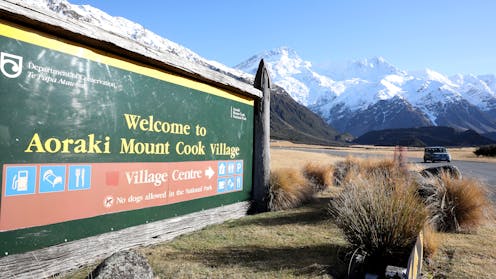
It proposes raising more than $60 million annually by charging international tourists an entry fee of between $20 and $40 at four specific natural attractions: Aoraki-Mount Cook National Park, Tongariro Crossing, Milford Sound and Cathedral Cove. Another six sites are yet to be announced.
The public will likely support the new site-specific fees, given around 80% of visitors to those sites are from outside New Zealand. But overseas visitors may well be confused, having already paid a levy at the border.
The messaging will need to be clear about how the two charges are distinct, and how revenue is being spent. The system will also need to be cost-effective and logistically feasible. Anything too complicated will not be welcomed by visitors, conservation staff or tourism operators.
Making nature ‘pay’
The proposed entry fee system raises bigger questions than its practicability, however. While the intention to reinvest funds in the areas where they’re collected seems appealing, a decentralised approach could undermine strategic conservation action at the regional or national level.
For every Aoraki-Mount Cook or Cathedral Cove, there are scores of less well-known sites that may have important conservation values or which need improved infrastructure. But because they don’t generate revenue like those iconic destinations, there is a risk they will miss out.
Furthermore, while the visitor levy and entry fees may be politically popular, we’ll need to be vigilant this doesn’t encourage future governments to reduce core conservation funding.
Any reduction in the Department of Conservation’s budget could jeopardise individual projects, habitats or areas that can’t compete for limited funding or make up the shortfall through visitor fees.
The real risk is that border levies and park entry fees, while apparently benign on the surface, actually signal a broader government agenda to make public conservation lands “pay” as part of its overall “going for growth” strategy.
Discussing the new entry fee proposal earlier this month, Conservation Minister Tama Potaka claimed the current return on public conservation land was only $50-60 million per annum, and that this may not be enough.
But a strictly financial valuation of these natural resources overlooks their intrinsic worth, and the huge ecosystem servicing value they provide in clean air and water, and carbon sequestration. Not to mention the human health and wellbeing benefits.
Values versus value
The government’s growth agenda also includes a plan to free up conservation lands for more concessions for tourism, agriculture and other business. But to date, there have been no assurances of more comprehensive monitoring to ensure conditions are adhered to and any impacts remain within acceptable limits.
Expanded car parks and more commercial opportunities are potentially inconsistent with many of the values for which conservation areas in New Zealand are set aside. Those values must endure beyond a single government term or the economic challenges of the day.
Current tourism management policy for conservation areas echoes the boosterism of the early 1990s, with its emphasis on more visitors at any cost. This time, at least, the government is attempting to recover some of the costs directly through the visitor levy and targeted park entry fees.
The challenge now is to ensure those resources are invested in comprehensive visitor management systems to future-proof iconic sites, but also to protect and maintain the many other conservation settings and natural landscapes on which New Zealand tourism relies.
Authors: Stephen Espiner, Associate Professor, Department of Tourism, Sport & Society, Lincoln University, New Zealand

















