

how an Indigenous-led project is harnessing technology to protect Kakadu’s rock art
- Written by Tristen Anne Norrie Jones, Academic Fellow, Archaeology, School of Humanities, University of Sydney
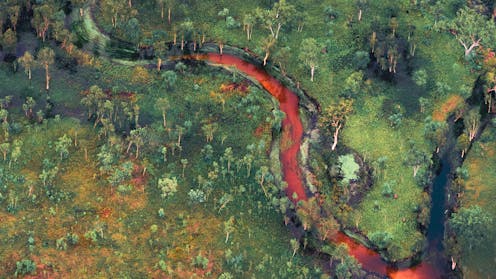
Kakadu National Park has become one of Australia’s most prized cultural landscapes since it was added to the World Heritage List in 1981. Each year, hundreds of thousands of people travel to the region, usually during the dry season, to witness the magical gunwardebim (local Kunwinjku language term for rock art) at Ubirr.
However, increasing tourism and accelerated climate change have exacerbated the threats to Ubirr and other cultural heritage sites in Kakadu.
In response, our team of collaborators has created a Bininj-led (Bininj is the Kunwinjku term for Aboriginal people) conservation management plan for the cultural sites at Ubirr.
This initiative – first prompted in 2019 by Alfred Nayinggul, Senior Traditional Owner of the Mirrar Erre and Manilakarr clan, and other Traditional Owners – is now a collaboration between Bininj and researchers from four Australian universities.
Our initial results have been published in the International Journal of Heritage Studies.
Rock art showcasing a rich cultural history
Ubirr contains thousands of rock art paintings, with the oldest paintings said to be at least 18,000 years old. These paintings depict everything from extinct megafauna to Aboriginal peoples’ experiences of European contact.
They form part of a living cultural landscape, and fold together ancient and contemporary lifeways. The rock art at Ubirr communicates important spiritual beliefs and cultural law, passed down orally for generations.
The Traditional Owners maintain cultural responsibility for the bim’s (rock art) ongoing care and protection. As Alfred Nayinggul explains:
Yes, [Ubirr] is a place with many rock paintings. And the tourists all go there to see them […] But long ago, our ancestors lived there. And so those paintings belong to us. We care for those paintings.
In recent years there have been growing anxieties regarding the management of the cultural heritage at Kakadu. Tourists frequently stray from designated paths, leave litter behind and, in rare instances, vandalise sacred sites.
During the wet season, from November through March, powerful cyclones inundate cultural sites with water. And during the late dry season, from August to October, uncontrolled hot wildfires can degrade the sandstone and pigments that make up the rock art.
Managing threats to culture
Our project commenced with an on-Country workshop in March 2021, where a plan of action was co-designed by senior Traditional Knowledge holders from the Bunitj and Manilakarr Clans, Njanjma rangers, Kakadu National Park rangers, and researchers.
Our goal was to document the cultural knowledges, concerns and aspirations of the Traditional Owners for Ubirr.
We adopted “cultural values mapping” as our key research method. Unlike conventional mapping, which tends to focus on physical features, cultural values mapping records intangible elements such as stories, spiritual connections, and the cultural significance Traditional Owners associate with certain places.
The process involved Traditional Owners sketching directly onto large satellite images, overlaying transparent sheets to build up layers of cultural information. They recorded sacred sites, traditional living areas, resource zones and, importantly, areas under threat from tourism, fire and other environmental damage.
Through repeated mapping sessions, multiple Knowledge Holders produced their own spatial knowledge banks of Country.
These cultural maps can now direct the cultural heritage management strategies implemented to care for Ubirr. Cultural information was recorded in both Kunwinjku and English, with oral histories documented in a short film about the cultural importance of Ubirr to Bininj.
We also spent time on Country documenting the rock art and cultural sites at Ubirr. This fieldwork was led by the East Alligator daluk (female) ranger team, and provided an opportunity for younger daluk to learn from senior women.
The photographs from this fieldwork are a baseline recording that can now be used by Kakadu rangers when they undertake their annual bim monitoring program.
We used the rock art recordings to produce 3D models of key sites. These are an important educational resource for Traditional Custodians who may find it difficult to access Country.
As we planned the project, some Bininj research team members voiced concerns that digitising cultural sites in this way might reduce these important cultural sites to mere data points – detached from the broader contexts that make them significant.
To address this, we turned to a gaming software (Unreal Engine 5) to construct an interactive environment in which to situate the 3D data. This model incorporates water, weather, vegetation, and site-recorded soundscapes.
The result is a living, digital version of the Kakadu wetlands in which the rock art recordings maintain their connection to Country.
A blueprint for future projects
Our Indigenous-led mapping approach has strong potential to be scaled up and delivered in other land and cultural heritage management contexts, including for national parks and Indigenous Protected Areas.
It shows how mainstream digital technologies can be adapted to respect Indigenous protocols, while still producing scientifically rigorous results.
Importantly, it contributes to a growing body of work advocating for digital technologies that are respectful, culturally sensitive, and aligned with Indigenous worldviews.
Authors: Tristen Anne Norrie Jones, Academic Fellow, Archaeology, School of Humanities, University of Sydney

















