

Why was the Afghanistan earthquake so deadly? A disaster resilience expert explains
- Written by Iftekhar Ahmed, Associate Professor in Construction Management/Disaster Resilience, University of Newcastle
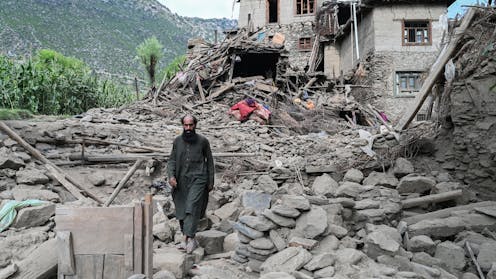
The death toll following the recent earthquake in Afghanistan continues to rise. Taliban-led health authorities now say at least 800 people have been killed and 2,000 injured.
The earthquake struck just before midnight local time on Sunday in a mountainous region near the city of Jalalabad, along the eastern border with Pakistan. It was of a relatively low 6.0 magnitude. But its epicentre was shallow at 8km underground, resulting in strong shaking on the surface and a series of aftershocks.
Most of the dead and injured were sleeping indoors at the time of the earthquake, and were crushed by collapsing buildings. Because of the remoteness of the affected areas, and also blockage of road networks from landslides caused by the earthquake, the exact death toll may take a long time to find out.
A region prone to earthquakes
The Himalaya and Hindu Kush mountains, and their foothills, where the impacted area in Afghanistan is located, are seismically active because of the ongoing friction between the Eurasian and Indian tectonic plates.
This has led to some of the most devastating earthquakes in the region such as the 2015 Gorkha earthquake in Nepal and 2005 Kashmir earthquake in Pakistan.
Afghanistan also has its fair share of earthquakes, especially in the currently impacted region. In October 2023 an earthquake here killed more than 1,500 people. The previous year, more than 1,000 people were killed by another earthquake.
The 2011 earthquake in Christchurch, New Zealand, was of a similar magnitude and occurred at a shallower depth as the most recent one in Afghanistan. Yet, even though it impacted a built-up city, only 185 people died.
The hundreds of deaths in scattered rural hamlets in Afghanistan present a sharp contrast.

Earthquakes don’t kill people, buildings do
An oft-quoted phrase, “earthquakes don’t kill people, buildings do”, is helpful to understand the factors that contribute to the high death toll of this earthquake and past ones in Afghanistan.
Rural communities in Afghanistan can’t afford sturdy and manufactured building materials. Because of this they build homes with locally available natural materials such as earth, stone and raw lumber.
Such buildings do not follow engineered designs, building codes or formal professional standards that prevent easy damage by earthquakes in wealthier countries.
A typical form of construction in Afghan rural areas is walls made of mud bricks or stone masonry. This is known as “monolithic” construction.
Such construction is unable to resist the strong side-to-side shaking caused by an earthquake. As a result, buildings easily tumble and crush people. Reports of collapsed rubble where there were once buildings are emerging widely from Afghanistan, as was also the case in previous earthquakes.

A trigger for design change
Examples from other countries in the region demonstrate a better level of earthquake-resilient building design can be achieved in similar socio-economic conditions.
After the 2005 Kashmir Earthquake in Pakistan, the government established the Earthquake Reconstruction and Rehabilitation Authority. It assisted in helping affected people build safer houses through a community-based program backed by technical guidance.
In Nepal, after the 2015 Gorkha earthquakes the government established the minimum standards of their National Building Code, that allow rules of thumb to comply with a basic level of earthquake resilience.
More than 25 years ago, Indian earthquake engineer Anand Arya pioneered his approach to reducing earthquake risk for “non-engineered” buildings. Among other techniques, this approach includes adding continuous bands in the walls, and reinforcements in the corners of a building and along doors and windows, which can provide strength to traditional masonry buildings.
These examples demonstrate that not a lot of money is always required to improve earthquake resilience. Rather, a degree of technical and institutional support can achieve safety in cost-effective ways.
Admittedly, such buildings would not be entirely earthquake-proof. But they would still impart a level of strength that can lead to less damage, and importantly, save lives.
One can hope this earthquake will be a trigger for such an initiative in Afghanistan, so a “building back better” process can assist the impacted communities to be more resilient to future earthquakes.
Authors: Iftekhar Ahmed, Associate Professor in Construction Management/Disaster Resilience, University of Newcastle

















