

do I need to worry when flying?
- Written by Lucia McCallum, Senior Scientist in Geodesy, University of Tasmania
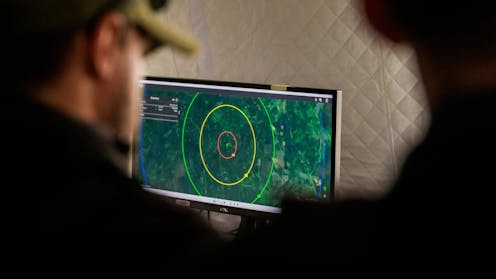
On Sunday, a plane carrying European Union chief Ursula von der Leyen was reportedly forced to land in Bulgaria using paper maps after its GPS navigation systems were jammed. Bulgarian authorities claim the jamming was deliberate Russian interference, though a Kremlin spokesperson told the Financial Times this was “incorrect”.
GPS interference is on the rise, so you might be wondering how it works. And can anything be done about it? And – perhaps most importantly – do you need to worry?
How does GPS jamming work?
The Global Positioning System (GPS) and other satellite navigation systems use radio signals from satellites to calculate position. To determine position, a GPS needs a direct line of sight to at least four satellites.
There are two ways to disrupt satellite navigation.
The first is jamming. This works by simply broadcasting high-intensity radio noise in the same frequency band used by the navigation satellites.
Jamming drowns out the satellite signal, like a person shouting loudly in your ear stops you hearing what someone is saying on the other side of the room. This appears to be what happened in Bulgaria.
The second way to interfere with satellite navigation is called spoofing, and it’s a little more elegant. Spoofing involves sending radio signals that pretend to be coming from the navigation satellites.
Where jamming stops the satellite navigation system from producing any location, spoofing tricks it into giving a false location – with potentially catastrophic results.
Are jamming and spoofing becoming more common?
Jamming and spoofing do appear to be growing more common, especially in conflict zones in the Middle East and Eastern Europe.
A clandestine Russian base near the Polish border is reportedly responsible for satnav interference in the Baltic region.
Ships in the Red Sea report frequent interference, likely from Houthi rebels in Yemen.
These increasingly common incidents highlight how vulnerable our reliance on satellite navigation makes us.
What can be done about interference?
The best response to interference is to have backup navigation options in place. The US-run GPS is the best known and most commonly used satellite navigation system, but there are others.
The EU runs a parallel system called Galileo, while Russia has one called GLONASS and China operates its own BeiDou satellites.
Each of these systems operates using slightly different radio frequencies. Some navigation systems can tune in to more than one set of satellites – so even if one is jammed, others may be available.
Galileo also has a “safety of life” feature, which allows users to detect spoofing. Australia’s in-development SouthPAN system will also offer a similar feature.
Another common feature of navigation systems is inertial sensing. This relies on sensors such as gyroscopes and barometers to directly detect movement and calculate position.
Most car navigation systems use inertial sensors to track location in cities or tunnels where there is no direct line of sight to satellites. Inertial sensing works well for short periods of time, but quickly becomes inaccurate and needs to be recalibrated by checking in with satellite systems.
Many researchers around the world are trying to develop new alternatives to satellite navigation using extremely precise sensors. One recent development uses tiny fluctuations in Earth’s magnetic field to detect position, for example.
Read more: Quantum navigation could transform how we travel. So what is it, and how does it work?
Should you be worried about flying?
Everyday air passengers have no need to worry about jamming or spoofing. For one thing, it’s very rare – especially outside conflict zones.
For another, the aviation industry is highly regulated and extremely safe. Even where satellite navigation doesn’t work, there are backup options.
What all of us can take away from this latest incident is how dependent we have become on satellite navigation. What matters is that we have a diverse range of systems so we are not dependent on just one.
Authors: Lucia McCallum, Senior Scientist in Geodesy, University of Tasmania
Read more https://theconversation.com/russias-gps-interference-do-i-need-to-worry-when-flying-264334

















