Third time lucky for a 4-year parliamentary term? A lack of checks and balances is still the problem
- Written by Grant Duncan, Visiting Scholar in Politics, School of Policy and Global Affairs, City St George's, University of London
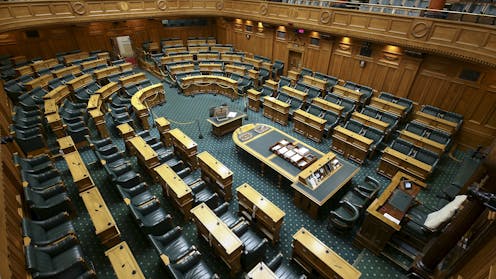
If history is a guide, any future referendum on extending the parliamentary term to four years will be rejected by New Zealanders. Two previous referendums, in 1967 and 1990, saw nearly 70% of voters favour retaining a three-year term.
But it’s clearly an idea that won’t go away. With the Term of Parliament (Enabling 4-year Term) Legislation Amendment Bill now due for its second reading – and expected to pass into law – New Zealanders will once again be tasked with deciding on this significant constitutional question.
The intention behind changing to four years, according to its proponents, is to help improve lawmaking, allowing more time to develop and progress policy and legislation without the uncertainty and downtime of more frequent elections.
Retaining the three-year term, on the other hand, would allay concerns about accountability and a lack of constitutional safeguards. And this lies at the heart of the debate.
New Zealand’s unwritten constitution lacks some of the checks and balances found in other democratic systems: there’s no supreme written document to appeal to, no upper house, and parliaments are able to pass legislation that’s not consistent with the Bill of Rights Act.
Although proportional representation has clipped the executive’s wings since 1996, the government of the day still wields a lot of power to set the legislative agenda, often using parliament’s urgency procedures to ram laws through with little consultation.
So, New Zealand’s “political” constitution relies on politicians observing norms and conventions – as described in the Cabinet Manual – and on their fear of being ousted at the next election for overstepping the mark.
Ultimately, accountability comes from the people, as it should. But with relatively few immovable guardrails between elections, it is perhaps not surprising many New Zealanders are suspicious of handing governments a longer leash.
A ‘self-serving’ agenda?
Just how vexed these questions are can be seen in the current bill’s evolution. It has its origins in the National Party’s coalition agreements with ACT and NZ First.
But when it was first introduced, the bill set out to create checks and balances on executive power, making any extension to four years conditional: following each election, overall membership of select committees would be “proportional to the party membership in the House of Representatives of the non-executive members”.
In other words, select committees – vital to the vetting of new laws – would have a higher proportion of MPs from parties outside the government. If opposition parties did not get a fairer share of seats on select committees, the parliamentary term would remain at three years.
Given select committees are governed under parliament’s standing orders, putting a rule about their membership into statute was highly unusual. It was also getting too complicated to be a manageable referendum question – which should be kept plain and simple.
In any case, voters should always know in advance what the maximum term of the next parliament will be, and how long the people they elect will serve. Following public submissions, the proposed referendum will now only ask voters to choose between three or four years, with no conditions attached.
All of which has the ironic consequence of ACT giving a dissenting opinion on the amended bill that’s now gone back to the House.
A four-year term, it argued, “risks concentrating too much power in the hands of the executive”, meaning people may now see it as “a self-serving move by politicians rather than a balanced reform”.
‘Muddling through’
The now simplified bill still leaves unaddressed the question of safeguards against executive overreach. And it happens to coincide with the prominent example of Donald Trump pushing the boundaries of executive power under the US constitution.
Fearing such executive overreach, a majority may again be more likely to vote against change in the proposed referendum. But most MPs want four-year terms, so it’s now up to them to promote the idea without playing political football with it.
Still, the elephant in the room remains New Zealand’s lack of a single, overarching, publicly-approved written constitution. Having one could boost political trust with clear and enforceable checks and balances on executive power.
But past efforts towards writing one, such as in 2013, have fizzled out, swept under the carpet by politicians keen to avoid an argument over fundamental issues such as the place of the Treaty of Waitangi in the constitution.
And the recent heated debate about the principles of the Treaty of Waitangi reveals an apparent political impasse in addressing, let alone resolving, such matters.
Many New Zealanders might also be wary of any written constitution that gave greater powers of review to “unelected judges”. And there would be endless debate about whether the British monarch should be head of state.
The Kiwi way has been to tinker with the constitution, rather than boldly overhaul it. A four-year term of parliament could be one more step in what public policy scholars call a “muddling through” process – unless a majority of voters tick “three” for the third time running.
Authors: Grant Duncan, Visiting Scholar in Politics, School of Policy and Global Affairs, City St George's, University of London