

Australia’s rivers play secret symphonies. Click to hear what this underwater world is telling us
- Written by Katie Turlington, PhD Candidate, Australian Rivers Institute, Griffith University
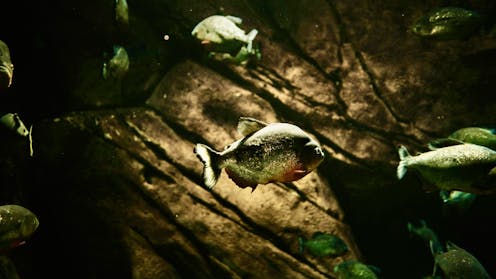
Scientists have long used sound to study wildlife. Bird calls, bat echolocation and whale songs, for example, have provided valuable insights for decades. But listening to entire ecosystems is a much newer frontier.
Listening to rivers is especially tricky. Beneath the water is a soundscape of clicks, pops and hums that most of us never hear. Many of these sounds are a mystery. What produces them – an insect? A fish? The water itself?
A new tool developed by my colleagues and I aims to help scientists decode what underwater river sounds really mean. We hope it will help monitor river health and tell the untold stories of these fascinating underwater places.
Sonic sleuthing
Rivers around the world face growing threats, including pollution, water extraction and climate change. So scientists are always looking for better ways to keep an eye on river health.
Sometimes river animals make sounds to attract a mate or ward off rivals. Other times the noise may simply be incidental, made when the animal moves or feeds.
These sounds can reveal a lot. Changes in the pattern or abundance of a sound can be a sign that a species is in decline or the ecosystem is under stress. They might reveal that a species we thought was silent actually makes sounds. Or we might discover a whole new species!
That’s why scientists use sound to monitor ecosystems. It essentially involves lowering waterproof microphones into the water and recording what’s picked up.
Recorders can run continuously, day and night, without disturbing wildlife. Unlike cameras, the recorders work in murky waters. And scientists can leave a recorder running and leave, allowing them to capture far more information with far less effort than traditional surveys.
Every recording is a time capsule. And as new technology develops, these sound files can be re-analysed, offering fresh insights into the state of our rivers.
But there’s a catch. Analysing the hours of recordings can be very time-consuming. Unlike for land-based recordings, no automatic tools have existed to help scientists identify or document what they’ve recorded underwater.
The best method available has been painfully old-fashioned: listening to recordings in real time. But a single recorder can capture tens of thousands of sounds each day. Manually analysing them can take a trained professional up to four times longer than the recording itself.
Our new, publicly available tool sought to address that problem.
A smarter way to listen to rivers
Our tool uses R, a free program for analysing data. The author of this article wrote a code instructing the program to analyse sound from underwater recordings.
We then uploaded sound recordings from Warrill Creek in Southeast Queensland. The program scanned the recordings and pulled out each individual sound.
Using the frequency, loudness and duration of every sound, it compared them all — a mammoth task if done by hand. Finally, it grouped similar sounds together — for example, clicks with clicks or hums with hums — turning them into simple clusters of data.
This process allows researchers to study the sounds more easily. Instead of spending hours listening to a recording and trying to distinguish the clicks of waterbugs from the grunts of a fish, the tool sorts the sounds into groups so researchers can jump straight to analysing patterns in the data.
For example, they might analyse which sounds are present in which rivers, or how the sounds change over time or between regions.
In yet-to-be published research, we tested the tool on a further 22 streams and found it successfully processed the sound data into groupings.
Our study found the tool is accurate. It correctly identified almost 90% of distinct sounds – faster and with far less effort than manual listening.
Listen to life beneath the surface
Listen to this recording of waterbugs from the order Hempitera. You’ll hear a chorus of sharp clicks, like marbles rattling in a glass. The recording is filled with hundreds of near-identical calls — a task that would take hours to label by hand.
After we uploaded the sound file, the tool grouped these repetitive calls automatically, saving huge amounts of listening time.
Below is an underwater recording of aquatic macroinvertebrates. The calls of these tiny river creatures, from the orders Hemiptera and Coleoptera, hum like cicadas. The sound is interspersed with the grunts of a fish (order Terapontidae), all set against the quiet backdrop of flowing water.
The tool can handle these layers, grouping sounds to show the community beneath the surface.
In this next clip, the sound of flowing water is prominent. This is one of the biggest challenges in listening to rivers. But our tool can separate out sounds masked by the constant background noise, so scientists can analyse them.
Below, a chorus of clicking macroinvertebrates fills the recording, until a vehicle sound cuts across from above the water’s surface. It shows how easily human noise crosses the boundary between air and water.
Helping protect our rivers
The tool allows underwater recordings to be processed at scale. It moves beyond hours of manual listening towards truly exploring what rivers are telling us.
It’s also flexible, able to handle data sets of any size, and adaptable to different ecosystems.
We hope the tool will help protect rivers and other water resources, such as oceans. It opens up new ways to monitor these environments and find strategies to protect them.
Scientists have only just begun exploring freshwater sound. By making this tool free, easy to use and publicly available, we hope more people can join in, ask questions and make discoveries of their own.
Authors: Katie Turlington, PhD Candidate, Australian Rivers Institute, Griffith University

















