

Modern Australian
The Times

New report reveals glaring gaps between Australia’s future needs and science capabilities

  • Written by Chennupati Jagadish, President of the Australian Academy of Science and Emeritus Professor of Physics and Electronic Materials Engineering, Australian National University
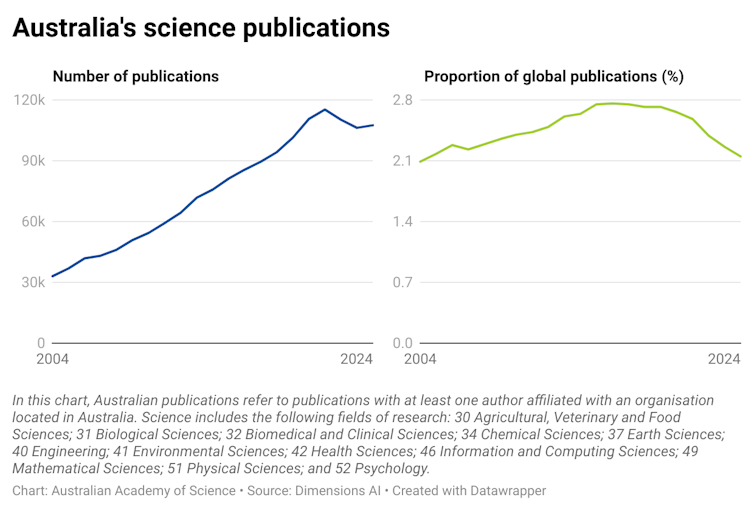
Chart showing Australian science publications compared to global output.

Since 1945, three-quarters of all global economic growth has been driven by technological advances. Since 1990, 90% of that advance has been rooted in fundamental science, according to Michael M. Crow, president of Arizona State University.

Corporate leaders in the United States understood this decades ago when they urged Congress to back “patient capital” for research – because this type of investment creates openings for breakthrough applications.

Think of the building blocks of our modern economy – wifi, smartphones, advanced cancer therapies, drought-tolerant crops and satellite navigation. These began as basic research, often with no obvious immediate application. Then they became the platforms for whole new industries.

But in Australia, we still treat research funding as a discretionary extra, subject to the ebb and flow of political expediency and annual budgets. Despite decades of speeches, reviews and strategic papers, our investment in knowledge creation and its application has nose-dived.

Today, the Australian Academy of Science released a landmark report that systematically measures our science capability against future needs for the first time.

The findings are blunt. We have gaps – in workforce, infrastructure and coordination – that will cripple our ability to secure a bright future for the next generation, unless we act now.

What did the report find?

The new report maps Australia’s scientific capability and shortfalls across three major areas.

Over the next decade, Australia is facing a demographic change with an ageing population, a decreasing fertility rate, and increasing growth in urban and regional cities.

The second national challenge is technological transformation. In most areas of life, we’re experiencing rapid technological changes. This includes advances in artificial intelligence (AI) that are already changing the shape of the workforce.

The third challenge is climate change, decarbonisation and environment. It’s imperative for Australia to transition to a net-zero economy and become resilient against the impacts of climate change.

What do we need to have in place for Australia to meet these challenges by 2035? Two key factors are science literacy and education, and national resilience. In a world of fractured geopolitics and technological competition, the countries that will thrive are those that can generate and apply knowledge for their own needs, in their own context.

The report has found eight key science areas that will be most in demand by 2035: agricultural science, AI, biotechnology, climate science, data science, epidemiology, geoscience and materials science.

For each of these, the report contains a full dashboard that shows gaps in capabilities – from education to workforce needs, research and development spending, publications and more.

Chart showing Australian science publications compared to global output.
Still not innovative enough Since 2008, Australia’s spending on research and development as a proportion of gross domestic product has fallen so far behind the OECD average, it would take an extra A$28 billion a year just to reach parity. In his election speech in 1990, then Prime Minister Bob Hawke issued a warning: being the lucky country was not enough, we had to become a clever country, too. Today, 35 years on, Hawke’s vision of the clever country remains just that – a vision. Former Prime Minister Malcolm Turnbull tried to rekindle the impetus in 2015 with “the innovation nation”. However, this year Treasurer Jim Chalmers conceded our economy is still “not dynamic or innovative enough”. The vast majority of global climate and earth system models have been developed in the northern hemisphere, and we need more work to understand Australian conditions as well as the Southern Ocean. Our AI capacity is hostage to developments offshore. We import more than we invent in biotechnology, advanced manufacturing and clean energy. These are not merely academic concerns – they are constraints on our sovereignty, resilience and competitiveness. We need a ‘reservoir of talent’ But scientific capability is not something you can simply conjure up on a whim. You need a “reservoir of talent”, infrastructure and knowledge that takes decades to build. Developing a climate scientist, a quantum physicist, or a vaccine researcher takes long-term investment in education, facilities and research programs. Abandoning or under-funding these pipelines for even a few years creates gaps. Knowledge can’t just flow when the tap is turned on if the reservoir is dry. Today’s report shows the current pipeline and study choices of students don’t match the needs of Australia’s future workforce. For example, in 2023 only 25.2% of students with a Year 12 qualification studied mathematics to at least intermediate level. Yet it’s a fundamental science discipline for AI. Chart that shows percentage of year 12 students studying higher and intermediate mathematics in Australia.
Similarly, our economy relies heavily on resources and critical minerals, yet Australia isn’t training enough geoscientists. It’s time for a whole-of-government science strategy, embedded in economic, education, defence and industry policy. The government should use the evidence in this report to address capability gaps and direct resources strategically to better position Australia for the next ten years and beyond. Thirty-five years after Hawke’s challenge, it’s never been clearer: if we don’t act now, our luck will run out. Authors: Chennupati Jagadish, President of the Australian Academy of Science and Emeritus Professor of Physics and Electronic Materials Engineering, Australian National University

Read more https://theconversation.com/new-report-reveals-glaring-gaps-between-australias-future-needs-and-science-capabilities-264355

The Growing Popularity of Lab Grown Diamonds in Sydney and Hong Kong

The diamond industry has changed significantly in recent years as more buyers seek ethical, affordable, and sustainable alternatives to mined diamon...

Modern AI SEO Agency vs Traditional SEO: What’s the Difference

Search engine optimisation has changed dramatically over the past few years. Search engines have become smarter, user behaviour has evolved, and bus...

Caravan Travel for Modern Australian Getaways: Plan a Comfortable Holiday

A family road trip is one of the best ways to explore Australia together. And, travelling by caravan gives you the freedom to take your time, stop a...

Mini Excavator and Trailer Package for Sale: What I Buy as One Deal in 2026

The first client who asked me for a mini excavator and trailer package for sale wasn’t trying to save a few hundred dollars on shipping. They we...

Make Dad a Guest in His Own Home This Father’s Day

Father’s Day can accidentally turn Dad into the unpaid event manager of his own celebration. He lights the barbecue, finds extra chairs, checks wh...

Where to Enjoy Your Off-Road Caravan on the Gold Coast

With a caravan, you can travel anywhere and everywhere without battling the rush of the peak holiday season or last-minute reservations. While the r...

How Osteopathy Supports Recovery from Sciatica and Nerve Pain

Sciatica isn't just annoying. It's genuinely painful. It sits deep in your glute and shoots straight down the back of your leg. It turns something as...

The Winter Jewellery Edit: Five Pieces You'll Wear All Season

As wardrobes shift to cosy knits, tailored coats and rich seasonal textures, jewellery becomes the finishing touch that pulls every winter outfit to...

7 Signs It's Time to Upgrade Your Piston Air Compressor

If you run a workshop, panel shop, or fabrication business anywhere around Perth, you already know what heat and dust do to equipment over a few sum...

How Long Do Bathroom Renovations Melbourne Take? Step-by-Step Process Explained

Planning a bathroom renovation is exciting, but one of the biggest questions homeowners ask is, "How long will it take?" While every project is uniq...

Why Your Skin Breaks Out: The Science of Acne Explained

Acne is the most common skin condition in the world. An estimated 85% of people experience it at some point between the ages of 12 and 24, and a gro...

10 Swimwear Trends Australian Women Are Wearing This Summer

Every Australian summer brings a fresh wave of swimwear trends, but some styles have much greater staying power than others. While fashion constantly ...

Why Regular Skills Updates Are Essential for Licensed Security Officers

A guard at a Brisbane shopping centre gets a call about a shoplifter who's turned aggressive.  They’ve done the job for six years. But their de-...

10 Benefits of Choosing Professional Tutoring Penrith Services

Every student has unique learning strengths, challenges, and academic goals. While classroom teaching provides essential knowledge and structure, so...

Sunshine Coast Baby Classes Prove Big Hit Among First-Time Mums

There's a movement gaining traction on the Sunshine Coast, providing a village of support, socialisation and relief for first-time mothers and babie...

Father's Day Gift Ideas for Men Who Are Hard to Buy For

Some dads are easy to buy for. Others do not want anything, already have everything, or give you the classic "don't worry about me" answer every yea...

Top 5 Mistakes That Wear Out Your Brakes Faster

Brakes don't need frequent replacements like oil changes do.   But a lot of the wear happens quietly, over months, because of habits most drivers...

Plantation Shutters vs Curtains: Which Is Better for Your New Home?

Moving into a new home is an exciting opportunity to personalise your space and make it your own. While many homeowners focus on furniture, flooring...

















