

Sydney once produced its own food – but urban development has devoured the city’s food bowl
- Written by Joshua Zeunert, Scientia Associate Professor in Environmental Design, UNSW Sydney
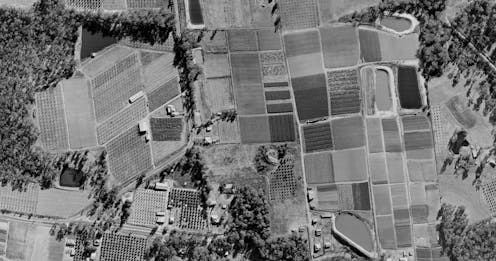
For much of Sydney’s history, the city supported its population with crops, orchards, dairies, abattoirs, oyster beds, wineries and market gardens scattered across the basin.
In 1951, New South Wales’ soon-to-be premier Joseph Cahill saw the development pressures building on the city’s food bowl. In parliament, he promised Sydney’s rural areas would be preserved “for vital food production […] soil conservation, irrigation, afforestation”.
Cahill’s promise was in vain. Farms continued to be paved over or turned into housing as the suburban expansion gathered pace. Smaller urban farms disappeared in the face of pressures from developers and larger rural producers. Urban development has now severely weakened Sydney’s local food economy.
Sydney still has room to grow food, which would boost resilience in the face of climate threats and extreme weather. But the city has long been geared towards converting farmland into houses, shops or industries. Today, the city’s five million residents rely almost entirely on food transported into the city’s topographic basin.
We have unearthed the diversity of what was lost in our new book, Sydney’s Food Landscapes and in our Google Maps database of the city’s former wealth of food production sites.
Botany: Sydney’s backyard vegetable garden
In 1770, the naturalist Joseph Banks recorded the botanical abundance of Kamay (Botany Bay). He later convinced the British House of Commons this would quickly lead to a self-sustaining colony. Following reconnaissance, Governor Arthur Phillip moved the settlement north to Port Jackson, but European crops didn’t grow well in the sandstone soils.
The colony almost collapsed in the “hungry years” of 1788–92. Soil fertility is usually blamed for this, but we argue poor agricultural planning and social factors were also central causes.
In the mid-19th century, Botany became a prolific food district. Chinese market gardeners transformed sandy wetlands through highly productive cooperatives, ingenuity, irrigation and liberal application of night soil as fertiliser. At their peak, market gardeners supplied up to half the city’s vegetables, hawking vegetables such as cabbages and turnips door to door.
Prejudice and industrialisation intervened. In 1901, the Immigration Restriction Act came into effect – laws aimed at limiting Chinese migration. Market garden leases were withdrawn amid persistent racism.
By the 1970s, most had been displaced by factories, ports and airports, with a few gardens remaining today at Matraville, La Perouse, Arncliffe and Kyeemagh – fragile traces of an industry once vital to Sydney’s food security.

Hawkesbury: Sydney’s engine room
From Botany, the story moved inland. Wheat and maize fields in Parramatta proved the colony’s first real agricultural success, but slash-and-burn practices soon exhausted soils. Farmers switched to citrus orchards, planting as widely as Pittwater.
Dyarubbin (the Hawkesbury River) was the true catalyst making the colony viable. In the 1790s, these rich floodplains became the “granary of the colony”. The Darug had cultivated the yam daisy, murnong, on these flats for millennia. The bloody dispossession known as the Sydney Wars lasted decades.
Convicts, ex-convict emancipists and opportunistic officials planted wheat, maize, fruit and vegetables. By 1810, Governor Lachlan Macquarie had proclaimed five farming towns to secure food supply.
Sadly, even Sydney’s most fertile soils for agriculture would succumb to suburbanisation after World War II. Large land parcels continue to be lost. Turf-growing, ornamental plants and cut flowers further typically prove more lucrative than food.
Lost landscapes
Botany and the Hawkesbury are only part of a kaleidoscopic legacy.
Histories range from the troubling use of child labour to produce 40,000 cabbages a year on Cockatoo Island, to local triumphs such as the Granny Smith apple and Narrabeen Plum varieties.
Six cows brought by the First Fleet escaped and made their way to rich grasslands. When rediscovered in what is now Camden, their numbers had multiplied. The rich “Cowpastures” catalysed a pastoral industry which would eventually dominate half the continent.
Dairies proliferated, with 517 registered in 1932. The gaols at Parramatta and Long Bay produced convict-grown crops. Liverpool became home to Australia’s first irrigation district in 1856, before giving way to industrial-scale poultry farming and billion-dollar empires.
Oyster leases producing what were praised as “the world’s finest oysters” dotted the Georges River. Warriewood’s “glass city” of greenhouses foreshadowed Spain’s plastic megafarms.
Vineyards expanded before the Phylloxera mite devastated much of the industry in 1888. One of the oldest wineries was paved over in 2015 for the construction of the Western Sydney International Airport. In the early 20th century, the St George region became Sydney’s “salad bowl”.
Could it have been different?
England gives its farmland greater protection through green belts, while Oregon in the United States relies on urban growth boundaries. Japan uses “productive green zones” to protect millions of farms ringing large cities and the European Union has policy settings to help small and medium producers near cities.
By contrast, Sydney has historically treated farming as a mere transition stage before urban development. Mid 20th century plans for a green belt collapsed under developer pressure, as agriculture was written out of official metropolitan plans.

Eating the future
As development squeezed out local food production, more and more food had to be brought in. Sydney now relies on trucks, ships and planes importing food from farms hundreds or thousands of kilometres away. The energy required for transport is greater than the calorific energy in the food. The city’s food system is exposed to natural disasters, global supply shocks and climate volatility.
Over the last 70 years, Sydney has engulfed most of its local food producers. It wasn’t due to poor soils, floods or disappointing harvests. It was a deliberate choice to privilege capital gains above all else.
It’s a slow process to re-centre a city around local food production. But it can be done, if planners and decision makers protect farms and food producers the same way they protect heritage buildings, parks and water catchments. Like clean water, food production has to be treated as vital civic infrastructure – not expendable land. Not all has been lost. Western Sydney still has available farmland.
Sydney may have eaten itself. But it need not starve. Its spectral metropolitan food landscapes offer both warning and inspiration for more resilient, equitable and sustainable futures.
Authors: Joshua Zeunert, Scientia Associate Professor in Environmental Design, UNSW Sydney

















