

Australia has some new marsupial species – but they’re already extinct
- Written by Jake Newman-Martin, PhD Candidate in Palaeontology, Curtin University
You are probably familiar with kangaroos. Wallabies too, and most likely quokkas as well.
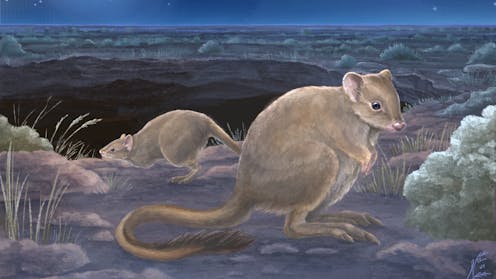
Less famous are their small endangered cousins, the bettongs. These little marsupials love to dig and have a thing for mushrooms.
Because of their size and relative scarcity, it has always been hard to work out exactly how many different species of bettongs there are and where they all live.
Scientists have believed there are five living species of bettongs – but our new research, published today in Zootaxa, changes our understanding of the diversity of these creatures. And knowing that might help us understand why many efforts to protect them have failed, and how we can do better in future.
A small hopping engineering crew
A single bettong weighs just a couple of kilos, but can move tonnes of earth each year in an effort to find food. This makes them “ecosystem engineers”, turning the soil over and improving ecosystem health as they forage.

There have long been five acknowledged living species of bettong: the boodie, the woylie, the northern bettong, the rufous rat-kangaroo, and the eastern bettong. There are also a few subspecies that are thought to have gone extinct due to feral cats and foxes.
But our new study changes things.
Bones and teeth
We measured the skulls and teeth of 193 bettongs from museums across Australia, as well as in the Natural History Museum of London and the Oxford University Museum of Natural History. We also looked at their arm and leg bones, to determine how the shape and function of their limbs can be used to tell between species, something that had not been done in detail previously.
The aim of our investigation was to better understand the woylie. It has always been difficult to identify woylie bones in fossil beds, so our work would also help palaeontologists in the field.

Our analysis surprisingly showed that what we have been calling a woylie was actually three separate species.
Meet the family
It was previously believed there were two subspecies of woylie.
The first is what we generally call a woylie: Bettongia penicillata ogilbyi, a living species found in Western Australia. The second is extinct: Bettongia penicillata penicillata (the brush-tailed bettong), once found in South Australia and New South Wales.
However, our study indicates there are enough differences in the teeth and skull to recognise these as two separate species.
We also identified an extinct third species, Bettongia haoucharae or the “little bettong”. Its partially fossilised remains were located in the Great Victoria Desert and Nullarbor Plain, indicating that it was well adapted for the arid outback.
 The official skulls used to define the species of the bettongs in this investigation showing differences in shape and size: (A) Bettongia ogilbyi sylvatica, (B) Bettongia ogilbyi odontoploica, (C) Bettongia penicillata, (D) Bettongia ogilbyi ogilbyi, (E) Bettongia haoucharae, and (F) Bettongia ogilbyi francisca.
Jake Newman-Martin, CC BY-NC
The official skulls used to define the species of the bettongs in this investigation showing differences in shape and size: (A) Bettongia ogilbyi sylvatica, (B) Bettongia ogilbyi odontoploica, (C) Bettongia penicillata, (D) Bettongia ogilbyi ogilbyi, (E) Bettongia haoucharae, and (F) Bettongia ogilbyi francisca.
Jake Newman-Martin, CC BY-NC
Once we were able to split the woylie (Bettongia ogilbyi) from the brush-tailed bettong (Bettongia penicillata) we could look more closely at the populations within the southwest.
From here we identified that the living woylies of the southwest are made up of two subspecies, both critically endangered. These are Bettongia ogilbyi sylvatica, or the “forest woylie”, and Bettongia ogilbyi ogilbyi, the “scrub woylie”.
The forest woylie is found throughout the cool wet forests southwest of Western Australia, particularly the Jarrah forest, while the scrub woylie is found in more open scrub habitats. Some individuals of scrub woylies were recorded as far as Shark Bay in Western Australia’s arid Gascoyne region. The scrub woylie was better adapted to dry conditions than the forest woylie, but was not a true desert dweller like the extinct little bettong.
So why does this matter?
The woylie is critically endangered, with about 12,000 individuals thought to remain. Conservation efforts have been focused on moving individuals to areas where they were thought to have previously occurred.
At least 4,000 woylies have been moved into different habitats during conservation efforts. However, our new study shows woylies were always restricted to southwest Western Australia and so were unsuited to some of the areas they were moved to. The bettongs that once lived in those other areas were very likely different species, with different adaptations.
 Rows of teeth showing adaptations for different diets in different species of bettong in this study. (A) Bettongia ogilbyi ogilbyi, (B) Bettongia ogilbyi francisca, (C) Bettongia ogilbyi sylvatica, (D) Bettongia haoucharae, (E) Bettongia ogilbyi odontoploica, and (F) Bettongia penicillata.
Jake Newman-Martin, CC BY-NC
Rows of teeth showing adaptations for different diets in different species of bettong in this study. (A) Bettongia ogilbyi ogilbyi, (B) Bettongia ogilbyi francisca, (C) Bettongia ogilbyi sylvatica, (D) Bettongia haoucharae, (E) Bettongia ogilbyi odontoploica, and (F) Bettongia penicillata.
Jake Newman-Martin, CC BY-NC
Woylies eat fungi, which are known to grow in damp places on the forest floor. The northern bettong is also a fungi specialist, and it faces a threat as temperature increases make mushrooms less available.
When woylies are moved out of the southwest they no longer have access to their fungi food sources. Some previous attempts to move individuals have failed – and researchers have been unsure of why the woylies could not survive where they were thought to have previously lived.
According to our research, the woylie actually was never present in these environments. It was instead another kind of bettong that was better adapted to live in these arid habitats.
 The ranges of the different bettong species.
Jake Newman-Martin, CC BY-NC
The ranges of the different bettong species.
Jake Newman-Martin, CC BY-NC
Moving individual animals can be a useful tool for both species conservation and ecosystem management. If a species becomes extinct, it may be substituted with a similar species that performs the functions previously carried out by the extinct species.
In the case of bettongs, it’s about finding which species can do that job and thrive in these arid ecosystems. This is worth doing as the ecosystems are suffering in their absence.
With the brush-tailed bettong elevated to full species and the description of the little bettong, our findings add two new extinct species to the ever-growing list of extinct mammal species in Australia.
Our work further highlights the terrible loss of unique marsupial species across Australia that we were not even aware of, and the urgency of protecting what remains.
Authors: Jake Newman-Martin, PhD Candidate in Palaeontology, Curtin University

















