

Is space worth the cost? Accounting experts say its value can’t be found in spreadsheets
- Written by: Basil Tucker, Senior Lecturer in Management Accounting, University of South Australia
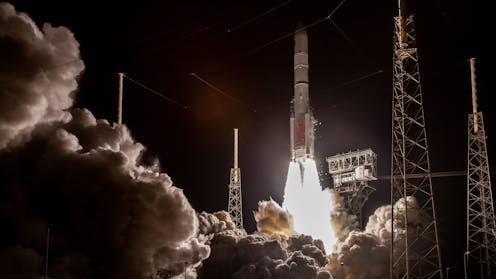
Since the early days of human space exploration, the endeavour has been haunted by a very good question: why spend so much on space when there are so many urgent problems here on Earth?
It’s a valid concern, and one that resonates with many people. The cost of living is rising, housing remains out of reach for growing numbers of people, healthcare systems are stretched, and education and climate change demand urgent action.
Against this backdrop, space exploration can seem like a luxury and an unnecessary detour when attention is needed here at home.
However, looking at space exploration purely as a question of dollars and cents may miss the bigger picture. As experts in accounting, we argue that asking only for the financial return on space investments risks overlooking the wider and often more profound benefits that space spending provides.
The limits of cost–benefit analysis
Historically, governments have justified space programs by quantifying their economic output. These calculations look neat on paper: dollars spent versus benefits gained.
But this narrow approach struggles to capture the full value of space-related technologies and their impacts.
For example, GPS was space technology invented for military purposes, but it has become a cornerstone of modern life.
Similarly, weather satellites, another spin-off of space research, help us predict and prepare for natural disasters, improving food security as well as saving lives.
These are tangible outcomes. But they didn’t come with a guaranteed return when they were first funded.
That’s because some of the most important innovations begin as long bets, driven by vision and the desire to explore more than certainty.
Intangible benefits
Even more, space exploration offers intangible benefits that are no less important. For many people, there’s something inherently inspiring about venturing beyond Earth. It signals boldness, curiosity, and a willingness to stretch human limits.
Space missions inspire young people to pursue careers in science, technology and engineering. They reinforce national pride and position countries as leaders on the global stage.
This is why space investment can’t be judged only by immediate fiscal outcomes. We need a broader lens, one that includes questions of ethics, identity, foresight and governance.
Instead of asking only “is this profitable?” we should ask:
how does space exploration reflect our values and aspirations as a society?
who ensures transparency and accountability in large-scale programs?
how do we strike a balance between urgent needs today and bold investments for tomorrow?
who benefits from these ventures, and who might be left behind?
These are not just economic questions. They speak to how we define progress, whom we include in our vision for the future, and how we steward public resources responsibly.
Beyond spreadsheets
When people raise objections to space funding, they may not just be talking about money. They’re expressing deeper concerns about equity, opportunity and unmet needs closer to home.
Instead of countering with spreadsheets, governments and policymakers would do well to engage with those deeper values. The job is not just to convince the public that space investment is worth it. This job is to make sure the result actually is worth it, in a way that reflects collective priorities.
This mindset is helpful far beyond the space sector. Public investment in healthcare, education, defence and agriculture also involves complex trade-offs. Each decision carries consequences – some visible, others subtle.
Whether funding a new hospital or researching future space habitats, the same questions should apply. Is this project aligned with our broader goals? Is it fair, transparent and forward-thinking?
As humanity’s ambitions stretch further, from revisiting the Moon to planning Mars missions to contemplating deep-space hibernation, these questions grow more urgent.
Should taxpayer money support the development of technologies for interplanetary travel? Who decides whether such work is visionary or indulgent? These are questions about who we are and want to be.
A broader view of value
We are not making a call to spend blindly. Like all public investments, space programs deserve rigorous scrutiny. Transparency, equity and sound governance are essential.
However, those discussions should be grounded in a well-rounded view of value. It can’t just be limited to costs and cash flow.
Backing space science doesn’t come at Earth’s expense. It often drives innovation that helps us here at home. It’s also about imagining what’s possible when we look beyond our planet while remaining rooted in the challenges we face right here.
The best public investments combine bold vision with a commitment to shared wellbeing. Space can do both if we approach it wisely.
Authors: Basil Tucker, Senior Lecturer in Management Accounting, University of South Australia


















