

New type of ‘sieve’ detects the smallest pieces of plastic in the environment more easily than ever before
- Written by Shaban Sulejman, PhD Candidate, Faculty of Science, The University of Melbourne
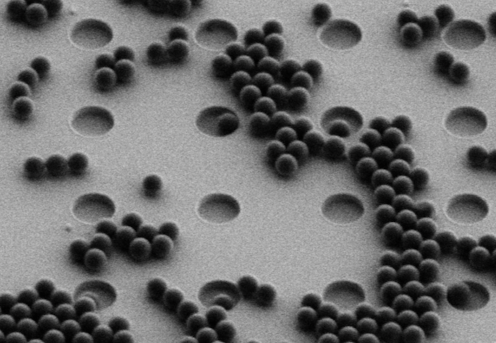
Plastic pollution is everywhere: in rivers and oceans, in the air and the mountains, even in our blood and vital organs. Most of the public attention has focused on the dangers of microplastics. These are fragments smaller than 5 millimetres.
But an even smaller class of fragments, nanoplastics, may pose a greater risk to our health and our environment. With diameters of less than a micrometre (one millionth of a metre), these tiny particles can cross important biological barriers and accumulate in the body. Because they’re so tiny, detecting nanoplastics is extremely difficult and expensive. As a result, determining the extent of their impact has been largely guesswork.
A cheap, easy and reliable way to detect nanoplastics is the first step in addressing their potential impact. In our new study published today in Nature Photonics, my colleagues and I describe a simple, low-cost method that detects, sizes and counts nanoplastics using nothing more than a standard microscope and a basic camera.
Breaking down into ever-smaller pieces
What makes plastics useful is their durability. But that is also what makes them problematic.
Plastics do not disappear. They are not broken down by the ecosystem in the same way as other materials. Instead, sunlight, heat and mechanical stress slowly split the plastic apart into ever-smaller fragments. Larger pieces become microplastics, which eventually become nanoplastics once they are less than a micrometre in size.
At such a small size, they can pass through important biological safeguards such as the blood–brain and placental barriers. They can then start to accumulate in our organs, including our lungs, liver and kidneys. They can also carry other contaminants into our bodies, such as pollutants and heavy metals.

Yet, despite these dangers, real-world data on nanoplastics are scarce.
Today, detecting and sizing particles below a micrometre often relies on complex separation and filtration methods followed by expensive processes, such as electron microscopy. These methods are powerful. But they’re also slow, costly and usually confined to advanced laboratories.
Other optical laboratory techniques, such as dynamic light scattering, work well in “clean” samples. However, they struggle in “messy” real-world samples such as lake water because they cannot easily distinguish plastic from organic material.
An optical sieve
To address these issues, our international team from the University of Melbourne and the University of Stuttgart in Germany set out to make detection simple, affordable and portable.
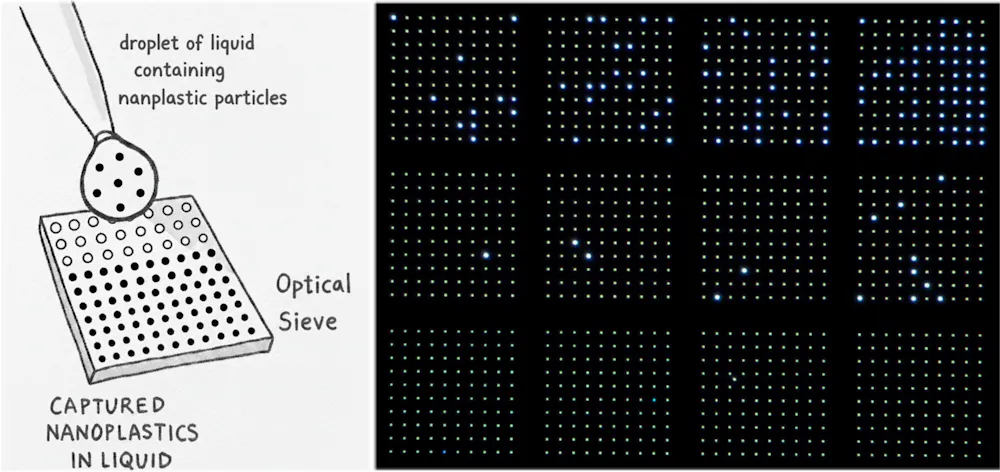
The result of our collaborative work is an optical sieve: an array of tiny cavities with different diameters etched into the surface of a type of semiconductor material called gallium arsenide. Essentially, a collection of tiny holes, invisible to the naked eye, in a flat piece of a suitable material.
Physicists call these cavities “Mie voids”. Depending on their size, they produce a distinct colour when light is shone on them. When a drop of liquid containing nanoplastics flows over the surface, the nanoparticles will tend to settle into cavities that closely match their size.
Then, with a chemical rinse, mismatched particles wash away while matched ones stay tightly held in place by electromagnetic forces.
That part is simple. But it wouldn’t make the process cheaper or more portable if it still required a large, expensive electron microscope to visualise the trapped particles.
But here’s the key: when a particle is captured inside a cavity, it changes the colour of that cavity. This means filled cavities are easily distinguishable from empty ones under a standard light microscope with an ordinary colour camera, often shifting from bluish to reddish hues.
By observing colour changes, we can see which cavities contain particles. Because only certain-sized particles fill certain-sized cavities, we can also infer their size.
In our experiments, using nothing but our optical sieve, a standard light microscope and a simple camera, we were able to detect individual plastic spheres down to about 200 nanometres in diameter – right in the size range that matters for nanoplastics.
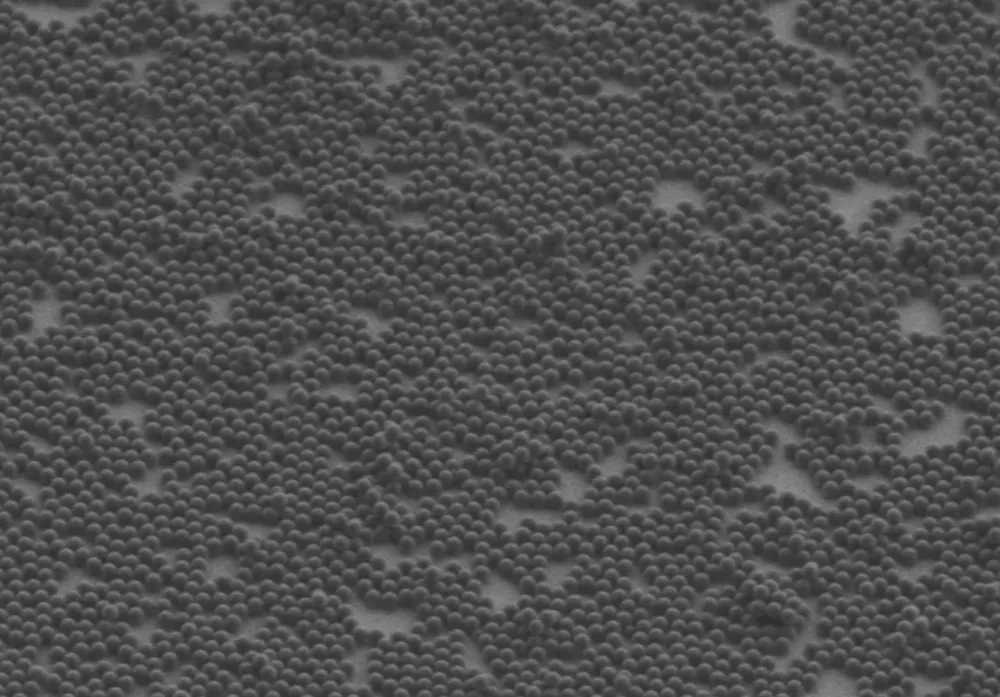 Nanoplastic particles with a size below one micrometer.
Lukas Wesemann and Mario Hentschel
Nanoplastic particles with a size below one micrometer.
Lukas Wesemann and Mario Hentschel
Putting it to the test
To validate the concept, we first used polystyrene beads in a clean solution. We observed clear colour changes for particles with diameters between 200 nanometres and a micrometre.
We then tested a more “real-world” sample, combining unfiltered lake water (including biological material) with clean sand and plastic beads of known sizes: 350 nanometres, 550 nanometres and a micrometre.
After depositing this mixture onto the optical sieve and then giving it a rinse, we were able to see distinct bands of filled cavities with diameters that matched the beads we had added.
This confirmed the optical sieve had successfully detected the nanoplastic particles in the lake water sample and determined their sizes. Importantly, this did not require us to separate the plastics from the biological matter first.
What’s next?
Our new method is a first step in developing a cheap, easy and portable method for routine monitoring of waterways, beaches and wastewater, and for screening biological samples where pre-cleaning is difficult.
From here, we are exploring paths to a portable, commercially available testing device that can be adapted for a range of real-world samples, especially those like blood and tissue that will be crucial in monitoring the impact of nanoplastics on our health.
The author would like to acknowledge the contribution of Lukas Wesemann to this article.
Authors: Shaban Sulejman, PhD Candidate, Faculty of Science, The University of Melbourne

















