

High-tech plans to save polar ice will fail, new research finds
- Written by Steven Chown, Director, Securing Antarctica's Environmental Future and Professor of Biological Sciences, Monash University
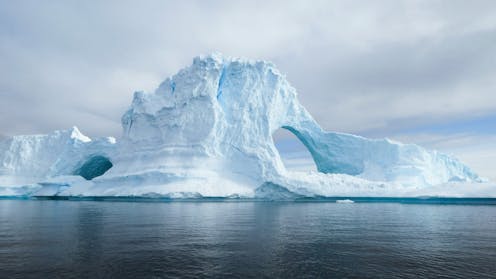
Our planet continues to warm because of greenhouse gas emissions from human activities. The polar regions are especially vulnerable to this warming. Sea ice extent is already declining in both the Arctic and Antarctic. The Greenland and Antarctic ice sheets are melting, and abrupt changes in both polar environments are underway.
These changes have significant implications for society through sea level rise, changes to ocean circulation and climate extremes. They also have substantial consequences for polar ecosystems, including polar bears and emperor penguins, which have become iconic symbols of the impacts of climate change.
The most effective way to mitigate these changes, and lower the risk of widespread impacts, is reducing greenhouse gas emissions. Yet decarbonisation is slow, and current projections suggest temperature increases of roughly 3°C by 2100.
Given the expected change, and the importance of the polar regions for planetary health, some scientists and engineers have proposed technological approaches, known as geoengineering, to soften the blow to the Arctic and Antarctic.
In research published today in Frontiers in Science, my colleagues and I assessed five of the most developed geoengineering concepts being considered for the polar regions. We found none of them should be used in the coming decades. They are extremely unlikely to mitigate the effects of global warming in polar regions, and are likely to have serious adverse and unintended consequences.
What is polar geoengineering?
Geoengineering encompasses a wide range of ideas for deliberate large-scale attempts to modify Earth’s climate. The two broadest classes involve removing carbon dioxide from the atmosphere and increasing the amount of sunlight reflected back into space (known as “solar radiation modification”).
For the polar regions, here are the five most developed concepts.
Stratospheric aerosol injection is a solar radiation modification approach that involves introducing finer particles (such as sulphur dioxide or titanium dioxide) into the stratosphere to reflect sunlight back out to space. In this case, the focus is specifically on the polar regions.
Sea curtains are flexible, buoyant structures anchored to the seafloor at 700 metres to 1,000m depth and rising 150m to 500m. The aim is to prevent warm ocean water from reaching and melting ice shelves (floating extensions of ice that slow the movement of ice from Greenland and Antarctica into the ocean) and the grounding lines of ice sheets (where the land, ice sheet and ocean meet).

Sea ice management includes two concepts. The first is the scattering of glass microbeads over fresh Arctic sea ice to make it more reflective and help it survive longer. The second is pumping seawater onto the sea ice surface, where it will freeze, with the aim of thickening the ice – or into the air to produce snow, to the same general effect, using wind-powered pumps.
Basal water removal targets the ice streams found in the Antarctic and Greenland ice sheets. These streams are fast-moving rivers of ice that flow toward the coast, where they can enter the ocean and raise sea levels. Water at their base acts as a lubricant. This concept proposes to remove water from their base to increase friction and slow the flow. The concept is thought to be especially relevant to Antarctica, which has much less surface melting than Greenland, and therefore melt is more about the base of the ice sheet than its surface.
Ocean fertilisation involves adding nutrients such as iron to polar oceans to promote the growth of phytoplankton. These tiny creatures absorb carbon dioxide from the atmosphere, which gets stored in the deep ocean when they die and sink.

The risk of false hopes
In our research, we assessed each of these concepts against six criteria. These included: scope of implementation; feasibility; financial costs; effectiveness; environmental risks; and governance challenges.
This framework offers an objective way of assessing all such concepts for their merits.
None of the proposed polar geoengineering concepts passed scrutiny as concepts that are workable over the coming decades. The criteria we used show each of the concepts faces multiple difficulties.
For example, to cover 10% of the Arctic Ocean with pumps to deliver seawater to freeze within ten years, one million pumps per year would need to be deployed. The estimated costs of sea curtains (US$1 billion per kilometre) are underestimates of similar-scale projects in easier environments, such as the Thames Barrier near London, by six to 25 times.
One project that planned to spread glass microbeads on ice has also been shut down citing environmental risks. And at their most recent meeting, the majority of Antarctic Treaty Consultative Parties made clear their view that geoengineering should not be conducted in the region.
Polar geoengineering proposals raise false hopes for averting some disastrous consequences of climate change without rapidly cutting greenhouse gas emissions.
They risk encouraging complacency about the urgency of achieving net zero emissions by 2050 or may be used by powerful actors as an excuse to justify continued emissions.
The climate crisis is a crisis. Over the time available, efforts are best focused on decarbonisation. The benefits are rapidly realisable within the near term.
Authors: Steven Chown, Director, Securing Antarctica's Environmental Future and Professor of Biological Sciences, Monash University
Read more https://theconversation.com/high-tech-plans-to-save-polar-ice-will-fail-new-research-finds-264794

















