

Shame can silence, subjugate and damage us – a philosopher considers its implications
- Written by Dan Dixon, Associate Lecturer in English and Writing, University of Sydney
To read Frederic Gros’s A Philosophy of Shame is to be reminded of how vulnerable we are to the emotion’s inhibitions and agonies. We shame, we are ashamed, and we expend significant energy imagining shameful situations so we might avoid them.
Shame makes us vulnerable to humiliation and ruin, and provides a method by which we can humiliate and ruin others. The cycle is often self-perpetuating: shame begets shaming.
Review: A Philosophy of Shame – Frédéric Gros, translated by Andrew James Bliss (Verso)
Gros is a philosopher and professor of political humanities at Sciences Po, Paris. This is not his first book structured around the interrogation of a single topic. Alongside his tremendously popular A Philosophy of Walking (2014), he is the author of Disobey! A Philosophy of Resistance (2020). The English translation of A Philosophy of War is forthcoming in 2026.
In his latest work, Gros goes so far as to crown shame as “the major emotion of our time, the signifier of new struggles” – a claim that may be plausible but is never substantially argued beyond the foreword. The struggles Gros describes are, in fact, predominantly of interest not for their novelty, but their eternal recurrence.
While themes and ideas repeat throughout, Gros avoids relying on a straightforward thesis. Instead, he elaborates a series of examples that reveal the power shame exerts over us. He rightly points out that:
we spend an awful lot of our lives striving to make a good impression, making sacrifices for ghosts and forcing ourselves to correspond to what we believe to be other people’s expectations.
Gros demonstrates shame’s expansive role in regulating our behaviour and shaping our self-image, while seeking out its positive potential.
His subjects are wide-ranging and at times erratically organised, a style perhaps evoking the unnerving sensations shame can produce. Each chapter explores a different set of circumstances in which the experience of shame manifests.
Gros considers honour killings, cases of sexual assault, the violence of the Holocaust, and class and race discrimination. He unpacks how shame silences, subjugates and damages. To support his thinking, he draws on artists and writers, including John Cassavetes, James Baldwin, Virginie Despentes, Annie Ernaux, Fyodor Dostoevsky, Karl Marx, Jean-Paul Sartre and Jean-Jacques Rousseau.
As he investigates his subject, he adopts different perspectives. He takes on the attitudes of the psychoanalyst, the literary critic, the political theorist, and (his actual job) the philosopher, using each disposition to examine historical, recent and fictitious scenarios in which shame plays a role.
Fascinating insights
Shame is a worthy subject for extended study because feeling ashamed is deeply unpleasant and, therefore, naturally resistant to examination. We are easily lured away from shame, conducting frantic internal searches for feelings that might displace it. Or we become excessively enthralled by it, so convinced by its logic and strength that the specificity of whatever shames us prevents us from questioning its authority.
Gros is at his best when attending rigorously to shame’s consequences as experienced by specific people in specific contexts. But his tendency to extrapolate patterns from these investigations can obscure the value of the specific.
For example, he returns numerous times to Primo Levi’s recounting of his experiences of shame in Auschwitz, and the subsequent complex shame of survival. Survivors of such horrors, Gros observes, cease to feel “that they are in the rightful place of the world of the living”.
By examining these instances of shame, Gros draws out the feeling’s profound irrationality, whereby victims become painfully self-conscious not about what they have done, but about what has been done to them.
Gros has declared in an interview that “the main ambition of my book was to multiply the meanings of what we call shame, drawing on the uses of the word in everyday language”. This method of philosophy has been called a grammatical investigation. Its power lies in the capacity to uncover assumptions, embedded in language, that we often overlook or take for granted.
There are moments when Gros makes excellent use of this strategy – for example, when he wonders what we are doing when we cry “shame on you!” at someone we consider our social inferior. Through a reading of Guy de Maupassant’s short story Boule de Suif – in which a woman is sexually humiliated by a group of bourgeois travellers – Gros interprets the phrase as an effort to “expel that which lies buried deeply within oneself”.
Fascinating insights are also generated by a lengthy reading of the rhetoric of rape trials, including a 1974 case in which the rape of two women near Marseille was initially assessed by a magistrate as doubtful, in part due to the womens’ homosexuality, and a belief they had “misled their attackers into believing they had consented”. “It was as if,” Gros writes, “the victims bore the shame of the act rather than those who had perpetrated it.”
A public outcry prompted the case to be referred to a higher court, resulting in heavy penalties for the offenders, and eventually a new law being passed containing “a broader definition of the crime”. This process entailed a re-imagining of how shame should be conceived; Gros cites plaintiffs and commentators who speak of the urgency of shifting the “burden of shame” from the victim to the perpetrator.
What we call the system of male domination, the patriarchy or the phallocracy, Gros writes, “is the symbolic institutionalisation of raw power. And shame is the emotional marker of its acceptance.”
In the minds of the oppressors, the default position of the marginalised subject is consent, and the consenting victim ought to be ashamed.
An ethical shame?
Of course, as soon as you start looking for shame, you see it everywhere. Gros interprets this as evidence of shame’s supreme importance, where it might better be read as evidence for the fruitfulness of a focused philosophical approach.
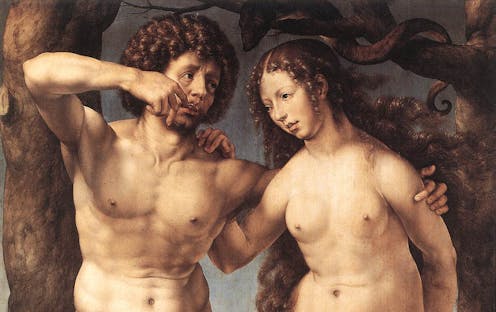
He makes several arguments for the foundational nature of shame in the stories that structure our societies. The capacity for shame is, of course, a major punishment inflicted on Adam and Eve for their disobedience to God.
Gros also identifies it as the catalyst in the founding myth of the Roman Republic: the rape of Roman noblewoman Lucretia by Tarquin, the son of the Roman king, triggers a vengeful rebellion that leads to the king’s flight and the republic’s inauguration.

At times, Gros seems to become a little entangled attempting to pin down shame according to a set of criteria. And he can generalise shame so broadly that the term’s meaning is diluted, running against the spirit of the grammatical investigation.
For instance, he identifies three broad states of mind that generate shame: disdain, indignation and disgust. He also identifies three central features of “shame-generating frameworks”: stigmatisation, stereotyping, and inferiorisation by mechanisms of race, gender and class.
This schematising undermines an incisive claim implicit throughout the book: that experiences of shame are distinctly personal and relational, even when they are a product of political and social conditions. While the aspects Gros lists contribute to experiences of shame, they fail to encapsulate the personal manner in which shame is felt. Shame is an individual response to an individual gaze: the unbearable exposure of a piece of our selves.
At times, Gros appears to be overwhelmed by the plethora of examples. Faced with such a wide variety of shame-related scenarios, he mistakes the ubiquity of shame for centrality. In Gros’s description, it becomes an emotion that displaces (or outranks) other experiences. “If there is a crisis in our schools,” he writes at one point, “then it is, above all, to do with a lack of shame.”



















.jpg)
