
‘Fortress stores’ can fight theft – but is it how we want to shop?
- Written by: Michael Townsley, Professor, School of Criminology and Criminal Justice, Griffith University
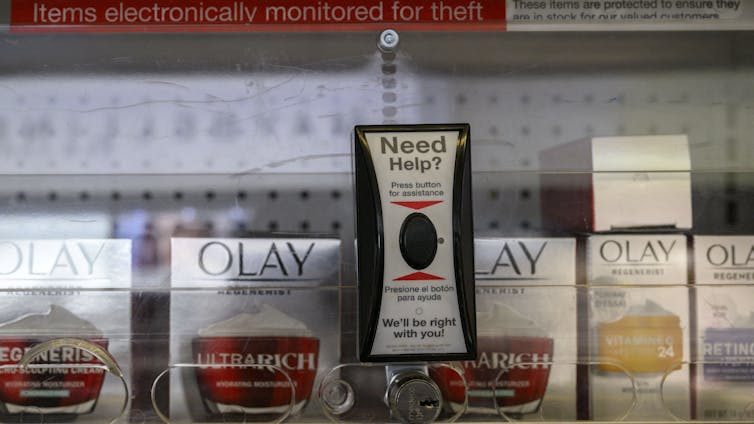
“Fortress stores” with security-tagged chicken and steaks in wire security cages. GPS-tracked jars of instant coffee. Everything from toothpaste and deodorant to face creams, locked inside display cases, with buttons to call for staff.
While those examples might sound extreme, they’ve already happened for shoppers in parts of the United Kingdom and the United States.

In Australia, we’ve only seen some of those measures, including trials of security tags on meat. But just last month, the owner of Dan Murphy’s and BWS said its bottle shops had moved expensive spirits and wine to locked displays, in conjunction with auto-lock doors and boosted staff training to deal with rising theft.
Other retailers – from Woolworths, Coles and IGA to Bunnings and Kmart – say they’re dealing with “a full-scale retail crime crisis”. Last week, new data showed 268,666 cases of theft in retail settings last year – almost half of the national thefts, even as residential thefts declined.
My research also found record levels of shoplifting, employee theft, fraud and customer aggression in the 2024 financial year, adding up to A$7.79 billion in merchandise losses, almost 2% of total turnover.
So what are retailers doing about rising thefts? And what other security or staffing measures could we see over the next decade that could change how we shop?
Tightening in-store controls
Back in 2008, when Woolworths began to phase in self-serve checkouts, its retail operations manager said:
The self-service checkout certainly doesn’t spell the death knell for manned checkouts, under no circumstances.
But over the years since then, self-checkout has become far more common, with far fewer checkout staff. That choice to save on checkout staff means retailers have also had to ramp up security.
It’s why if you’ve used supermarket self-service, you’ve likely seen your face pop up on the screen as you scan. That “public-view monitor” effect deters theft because humans tend to behave differently when we know we’re been watched.
To prevent what’s known as unpaid “push-outs” of trolleys full of goods, some supermarkets such as Coles are trialling wheel-locking technology.
If a customer tries to exit without paying, the wheels automatically lock and immobilise the trolley. Similar systems are used in the US.
For the growing number of Australian supermarkets with “smart gate” exits, the gate stays closed until cameras and computer vision systems confirm a payment has been made.
Major chains have also expanded computer-vision systems at self-checkout. For instance, Woolworths has rolled out camera-based AI in more than 250 stores across NSW, Victoria and Queensland. The system flags mis-scans by changing indicator lights (from green to red or orange) and displays an image of the unscanned item to prompt rescanning.
Similarly, some systems now recognise loose produce visually, automatically detecting, say, bananas or Roma tomatoes as they’re placed on the scale, reducing how much shoppers need to navigate the checkout menu. These computer-vision upgrades speed up honest transactions and intercept mis-scans.
More obvious security, but more aggressive thefts
The anti-theft response isn’t only digital. Retailers have made security more visible, including uniformed guards and putting body-worn cameras on staff in higher-risk locations.
This approach is usually targeted to “risky facilities”: the minority of outlets that generate a majority of incidents.
For example, analysis of a US-based retailer showed that 85% shoplifting for the entire business took place in just 20% of their stores.
So depending on where you live and shop in Australia, your experience of how visible the security is can be very different.
What’s driving the rise in retail theft, as well as aggression?
The spread of cameras, AI and merchandise protection has made theft easier to detect. But it has also pushed staff into more confrontations with suspected offenders.
As QUT researchers note, “customer aggression is growing” and frontline staff report they are bearing the brunt.
Thieves have learned that aggression can cause staff to back away, making retail theft a comparatively low-risk crime.
Retailers are also grappling with highly organised gangs.
Wesfarmers’ CEO Rob Scott recently said organised crime is a major threat, especially in Victoria, while sports retailer Rebel has said raids are “out of control”.
This week, the CEO of independent supermarket chain Ritchies IGA said violence in Victorian stores has hit a “crisis point” and they are considering closing some stores.
Earlier this year, Victoria Police’s Operation Supernova dismantled a syndicate accused of stealing $10 million in merchandise from Melbourne supermarkets in five months.
Is this how we want to shop?
Even with rising retail theft in Australia, the evidence still doesn’t support a widespread, cookie-cutter rollout of “fortress”-style security measures for all supermarkets, chemists or other big retailers.
But for some of the worst-affected stores, it is likely we will see more targeted “fortress” measures, including controlled entries and exits for individual aisles where high-risk item are located.
Trained greeters, clear sightlines and tidy, well-presented aisles can also make it easier to prevent theft.
Self-checkout was sold as convenience. But if the outcome is more tension, more hostility, and less human connection, it’s hardly an improvement.
Shoppers don’t want to see fights at the checkout, and staff shouldn’t have to manage them.
Unless retailers can get this balance right, the real question risks becoming why would anyone still bother shopping in person?
Authors: Michael Townsley, Professor, School of Criminology and Criminal Justice, Griffith University
Read more https://theconversation.com/fortress-stores-can-fight-theft-but-is-it-how-we-want-to-shop-264505


















