

how disability can make things even harder for refugees
- Written by Tadgh McMahon, Adjunct Senior Lecturer, College of Medicine and Public Health, Flinders University
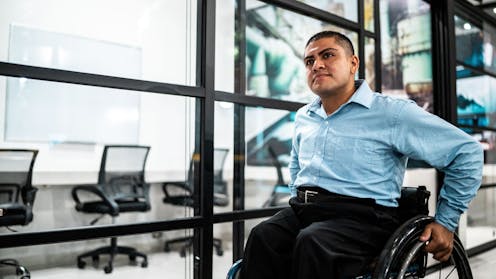
Settling in a new country as a refugee comes with a variety of opportunities and challenges, from forming social connections, to navigating government services, and many others. The challenges can be greater for refugees with disability, our new research shows.
We don’t have concrete data on how many refugees with disability have settled in Australia. But we know numbers have increased in recent years after a 2010 parliamentary inquiry recommended a policy change to reduce barriers to refugees with disability settling in Australia.
Still, there’s a significant research gap on the intersection of disability and migration in Australia. There’s also little international research on refugees with disability.
Through surveys and interviews, we explored the experiences of settlement and integration for refugees with disability in Australia.
Our 75 survey respondents were permanent residents who had lived in Australia for an average of 4.3 years. They were mostly from Iraq, Syria and Afghanistan.
For the survey, we used questions from our previous research with refugees conducted by Western Sydney University and Settlement Services International (SSI). This allowed us to put the experiences of refugees with disability into context, comparing them with refugees more broadly.
Our findings suggest intersecting issues – across domains including social connections, housing, and English language learning – influence the settlement and integration trajectories of refugees with disability in Australia.
Some good news
Among refugees with disability, 72% of respondents said they felt part of the Australian community always or most of the time. Some 65% rated their overall settlement experience in Australia as good or very good.
These two percentages are lower than what refugees in general reported in our previous research in 2021, wherein 87% felt part of the community and 83% had an overall positive settlement experience.
Our new research also indicates refugees with disability gain important support from their own communities.
They were more likely to feel supported or given comfort by their national and ethnic community (54%) than refugees in general (38%) in our previous research.
In their religious communities, 46% of refugees with disability felt supported. This is compared to 27% of refugees generally in our earlier research.
As Haneen, a proxy respondent for and sister of Jamal, a 56-year-old man with disability from Iraq, explained:
I go to the church on Sundays, every Sunday and Wednesday. Majority of time I try not to miss it and Jamal also joins me. My sisters and her friends, they say if you don’t bring Jamal, don’t come, we want to see Jamal be with you, they like to have him there.
A nuanced picture
Developing connections outside their own communities posed significant challenges for refugees with disability. Most found it hard or very hard to make friends in Australia (77%), to talk to their Australian neighbours (76%) and to understand Australian ways or culture (68%).
These figures were much higher than what refugees more broadly reported in our previous research: 29%, 31% and 25% respectively.
Refugees with disability said English language difficulties, compounded by experiences of disability, hampered opportunities to develop mixed social networks.
Generally, they also faced significant difficulties accessing government services. Reported reasons for this included language barriers (75%), problems using government mobile apps such as Medicare and MyGov (62%), long wait times for appointments (60%) and transport difficulties (58%). These were much higher rates than for refugees generally in our previous research.
Refugees appreciated the range of disability supports available in Australia. At the same time, they reported challenges navigating these services. Even when they accessed them successfully, some faced challenges such as inadequate hours of support from the National Disability Insurance Scheme (NDIS).
Adnan, from Afghanistan, described what would have helped him and his brother, Yazan, who has cerebral palsy:
NDIS should have a team of people [to work with refugee] families with […] a person with disability […] they should have a team that meets this person and sees the needs of this person directly, and to help […] the family to find the proper provider. Because we don’t know […] as a refugee we came with no knowledge, no experience.
Our respondents shared similar difficulties finding housing as other refugees. However, they were less satisfied with various aspects of their homes (for example, the number, size and accessibility of rooms).
Refugees with disability appeared strongly motivated to learn English, yet reported barriers accessing adult learning programs such as the Adult Migrant English Program. These barriers included unsuitable delivery options (for example, online-only classes), being unable to sit for long periods, and trouble with memory and learning.
Breaking down barriers
The disability royal commission highlighted that refugees with disability face a range of challenges when trying to access disability and mainstream services. As the review from the commission notes:
many organisations have policies or programs to support inclusion of people with disability and also people from CALD [culturally and linguistically diverse] backgrounds, but these policies often do not intersect, nor do they intersect with other initiatives around inclusion.
The NDIS has developed a CALD strategy for 2024–28 which outlines a series of actions to improve access by migrants and refugees with disability. This will be a positive step if implemented in full.
Although our sample size was small, our research underscores the intersecting barriers that hinder inclusion for refugees with disability. Challenges around social connections, engagement with services and other domains may be magnified by experiences of disability.
Australia has obligations under international conventions and domestic laws and policies to protect the rights of refugees and people with disability.
We urgently need policy frameworks and systems that explicitly respond to the intersecting opportunities and challenges experienced by refugees with disability.
Authors: Tadgh McMahon, Adjunct Senior Lecturer, College of Medicine and Public Health, Flinders University

















