

Volcanoes can help us untangle the evolution of humans – here’s how
- Written by Saini Samim, PhD Candidate, School of Geography, Earth and Atmospheric Sciences, The University of Melbourne
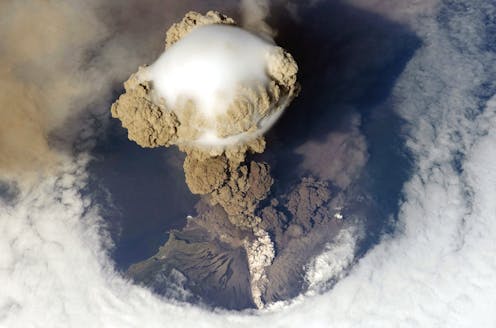
How did humans become human? Understanding when, where and in what environmental conditions our early ancestors lived is central to solving the puzzle of human evolution.
Unfortunately, pinning down a timeline of early human evolution has long been difficult – but ancient volcanic eruptions in East Africa may hold the key.
Our new study, published in Proceedings of National Academy of Sciences, refines what we know about volcanic ash layers in Turkana Basin, Kenya. This place has yielded many early human fossils.
We have provided high-precision age estimates, taking a small step closer to establishing a more refined timeframe of human evolution.
Millions of years of volcanic eruptions
The Great Rift Valley in East Africa is home to several world-renowned fossil sites. Of these, the Turkana Basin is arguably the most important region for early human origins research.
This region is also within an active tectonic plate boundary – a continental rift – that has triggered volcanic eruptions over millions of years.
As early humans and their hominin ancestors walked these Rift Valley landscapes, volcanic eruptions frequently blanketed the land in ash particles, burying their remains.
Over time, many fossil layers have become sandwiched between volcanic ash layers. For archaeologists today, these layers are invaluable as geological time stamps, sometimes across vast regions.
Excellent timekeepers
Volcanic eruptions are excellent timekeepers because they happen very quickly, geologically speaking. As hot magma erupts, it cools and solidifies into volcanic ash particles and pumice rocks.
Pumice often contains crystals (minerals called feldspars) which act as natural “stopwatches”. These crystals can be directly dated using radiometric dating.
By dating the ash layers that lie directly above and below fossil finds, we can establish the age of the fossils themselves.

Even when such minerals are absent, volcanic ash layers can still help in dating archaeological sites. That’s because ash particles from different eruptions have unique chemical signatures.
This distinct geochemical “fingerprint” means we can trace a particular eruption across large distances. We can then assign an age to the ash layer even without datable crystals.
For instance, an ash layer found in Ethiopia, or even on the ocean floor, can be matched to one in Kenya. As long as their chemical compositions match, we know they came from the same eruption at the same geological point in time. This approach has been applied in the region for many decades.
Previous landmark studies have already established the geology of the Turkana Basin.
However, the region’s frequent eruptions are often separated by just a few thousands of years. This makes many ash layers essentially indistinguishable in time. Furthermore, some ash layers have very similar “fingerprints”, making it difficult to confidently tell them apart.
These challenges have made it tricky to date the Nariokotome tuffs, three volcanic ash layers in the Turkana Basin. While it’s clear from the rock record these are three separate ash layers, their age estimates and chemical signatures are very similar. We set out to narrow them down.

What did we find?
Compared to previous methods, modern dating tools can achieve an order-of-magnitude improvement in precision.
In other words, we can now confidently distinguish volcanic ash layers that erupted within just 1,000 to 2,000 years of each other. Applying this high-precision method to the Nariokotome tuffs, we resolved them as three distinct volcanic events, each with a precise eruption date.
However, determining the ages is not enough to fully distinguish these volcanic layers. Because the ash layers landed so close together in time – and potentially from very similar volcanoes – they also have remarkably similar major element geochemical “fingerprints”. Major elements are the most abundant elements in rocks, but they can’t always tell us much about the age and source of the rock material.
That’s where trace elements prove especially useful. These are elements that occur in very small amounts in rocks but provide much more distinctive chemical signatures.
Using laser-based mass spectrometry, we analysed the trace element composition of both the ash particles and their associated pumices. This provided us with unique trace-element fingerprints for each layer – still similar, but distinct.
Retracing human history
Once we had both precise age estimates and distinct geochemical profiles, we traced these ash layers in key archaeological sites.
For instance, the Nadung’a site in West Turkana, believed to be a prehistoric butchering site, has yielded some 7,000 stone tools. Our updated age estimates now makes this site approximately 30,000 years older than previously thought.
More importantly, we showed these refined methods can be applied beyond Kenya. We traced the ash layers of equivalent ages from Kenya to the Konso Formation in Ethiopia, indicating they came from three individual eruptions, in which material was spread across large distances.
The Nariokotome tuffs are an important case study that shows the powerful combination of high-precision dating with detailed geochemical fingerprinting. As we apply these techniques to more ash layers, both within the Turkana Basin and potentially beyond Kenya, we’ll have a better understanding of key questions in human evolution.
Did new tool technologies and species emerge gradually or suddenly? Did more than one hominin species exist simultaneously? How did shifting environments, climate and frequent volcanism affect early human evolution?
Now that we have precise geological timelines for the places where these artefacts were found, we’re a step closer to answering these long-standing questions about early humankind.
The authors would like to acknowledge the contributions of David Phillips and Janet Hergt to this article.
Authors: Saini Samim, PhD Candidate, School of Geography, Earth and Atmospheric Sciences, The University of Melbourne
Read more https://theconversation.com/volcanoes-can-help-us-untangle-the-evolution-of-humans-heres-how-255013

















