

Since WWII, it’s been taboo to force nations to cede land after war. Russia wants to normalise conquest again
- Written by Jon Richardson, Visiting Fellow, Centre for European Studies, Australian National University
A frequent question around peace talks over Russia’s invasion of Ukraine is whether Ukraine should give up land as part of an interim or final settlement.
United States President Donald Trump has often suggested this would be a natural and inevitable outcome, particularly given Ukraine has – in his view – a weak hand of “cards”. When Ukrainian President Volodymyr Zelensky visited the White House last month, Trump told him there was no getting back Crimea, which has been occupied by Russia since 2014.
Trump has jokingly described his motivation for promoting peace in Ukraine as a desire to “get to heaven”. But as the saying goes, the path to hell is paved with good intentions.
Indeed, Trump has aligned himself with many Russian officials on territorial concessions, including Foreign Minister Sergei Lavrov, who has said history has many examples of peace agreements that shift borders.
It is important to debunk this notion. Acquisition of territory through war has, in fact, been taboo since the end of the second world war and the establishment of the United Nations.
While there have been many military conflicts, there are no evident examples of a UN member country ceding recognised, independent territory to another UN member following a war or invasion.
Wars and conquest
Until the early 20th century, territorial concessions were the norm after wars, backed by all sorts of narratives about hereditary rights, ancient borders, superior civilisations, punishments for unpaid debts or simple law of the jungle.
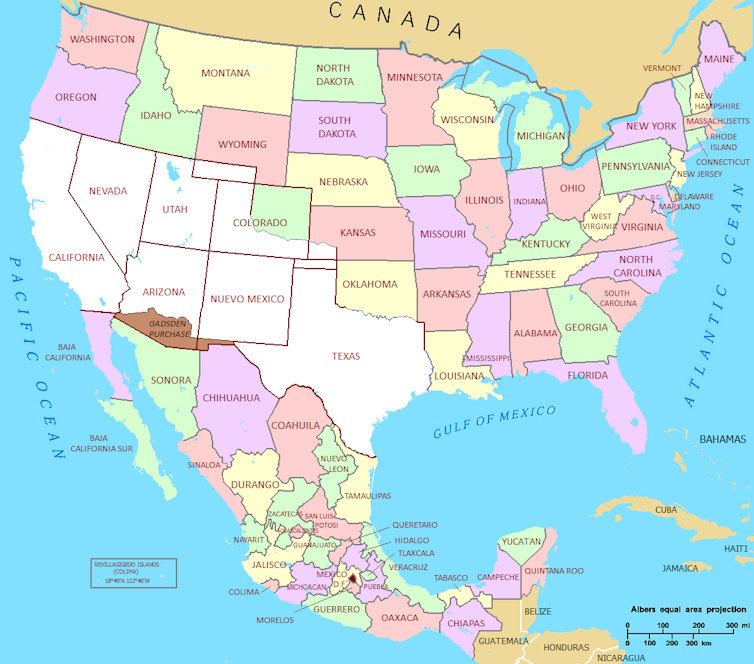
A classic example was the Treaty of Guadeloupe-Hidalgo, which ended the Mexican-American War of 1846–48. Mexico was forced to cede 55% of its territory, including present-day New Mexico, Utah, Nevada, Arizona, California, Texas and western Colorado.
In a recent article, Yale academics Oona Hathaway and Scott Shapiro explain that before the first world war, shifting borders was a legally recognised means by which states resolved disputes. They calculate there were more than 150 territorial conquests around the world before 1945.
The end of the second world war saw massive border changes in Eastern Europe. Soviet leader Joseph Stalin shifted the borders of Poland hundreds of kilometres westward at the expense of Germany, while the Soviet Union swallowed swathes of eastern Poland. Italy also lost some its pre-war territory to Yugoslavia and France.
The Soviet Union also got to keep regions it had absorbed in the wake of the 1939 Nazi-Soviet Non-Aggression Pact, including the Baltic States, Moldova, western Ukraine and parts of Finland. These changes reflected the facts on the ground and were accepted at the Yalta and Potsdam conferences.
But in the broader zeitgeist, it was time to put an end to wars of conquest. This was articulated in Article 2 of the UN Charter, which requires states to refrain from the use of force against the “territorial integrity or political independence” of any other state.
The principle was further cemented in UN Security Council resolution 242 following the 1967 Arab-Israeli Six-Day War, which decrees that acquisition of territory following war cannot be accepted.
That is why the international community has largely rejected any move towards Israeli sovereignty over the occupied Palestinian territories of the West Bank, Gaza and East Jerusalem, along with the Golan Heights. (The United States, however, accepted the latter in 2019.)
The taboo on conquest since 1945
The only successful territorial conquests broadly accepted by the international community since 1945 have been a few cases of newly independent countries in the 1960s taking over enclaves or neighbouring territory formerly held by colonial powers. This includes, for example, India taking Goa from Portugal.
But other seizures of ex-colonial territories have been broadly rejected, or at least strongly contested. The main examples are Morocco’s annexation of Western Sahara and Indonesia’s seizure of East Timor. Indonesia’s [takeover of West Papua] was accepted by the international community as part of a UN-mandated self-determination process, though this has since been condemned by many as deeply flawed.
South Vietnam’s ultimate takeover by the North might be regarded as a conquest, but neither Vietnam recognised the other as a separate country, seeing the conflict effectively as a continuation of civil war. Neither was a UN member.
Before Russia’s invasion of Ukraine, the most blatant attempt to conquer independent territory was Iraqi dictator Saddam Hussein’s invasion and annexation of Kuwait. This was repelled by a UN-sanctioned force.
Global opposition to Russia’s seizures
Distinct from invasions, there have been many unresolved border disputes that have occasionally flared into armed conflict. Russia, however, had no such dispute with Ukraine before its 2014 takeover of Crimea.
After the dissolution of the Soviet Union, Russia and Ukraine negotiated a border treaty to delineate their borders in precise detail. Russian President Vladimir Putin signed the treaty in 2003 and later affirmed that Russia had no territorial claim against Ukraine.
An overwhelming number of UN members have rejected Russia’s annexation of Crimea and four other regions of southeastern Ukraine.
However, the initial outrage at the invasion has weakened over time. Many countries have accused the US of a double standard, given its invasion of Iraq in 2003 (even if that didn’t involve territorial conquest). Trump’s statements about acquiring Greenland, Canada, Gaza and the Panama Canal have only further weakened confidence in US opposition to territorial conquest.
As political scientist Tanisha Fazal argues, the norm against territorial conquest risks suffering a “death of a thousand cuts”. Allowing Russia to keep parts of Ukraine could be a terminal blow.
What a lasting peace should look like
Some commentators have argued for an interim settlement under which Russia would retain control of occupied territory without Ukraine ceding it formally. A final settlement would be left to the future.
Some have called this de facto recognition of Russian annexation, but that is a misguided notion. De facto recognition implies acceptance of a new status quo, along with a return to business as usual.
The outcome of the war will only be partially about territory. Russia has imposed a brutal occupation on these regions, with widespread allegations of torture, killings, disappearances, population transfers and thefts of Ukrainian businesses and homes. Ukrainian language, culture and identity are being erased under a draconian regime.
Ukraine appears willing to accept an interim ceasefire to stop the bloodshed. But its territorial integrity should be fully supported by making clear to Russia that its invasion and occupation remain illegal and unacceptable.
This would include maintaining economic sanctions, demanding accountability for war crimes, returning property stolen from Ukrainians, and allowing Ukrainians transferred to Russia to return home. Ukraine must also be given the means to defend itself against a renewed Russian attack.
Advocates of anything less would be condoning and normalising flagrant territorial aggression. They would merit neither earthly rewards, such as Nobel Prizes, nor divine blessings.
Authors: Jon Richardson, Visiting Fellow, Centre for European Studies, Australian National University

















