

the ghostly photos taken by the Stasi's hidden cameras
- Written by: Donna West Brett, Lecturer in Art History, University of Sydney
When the Berlin Wall divided Germany from 1961 to 1989, East Germany’s Ministry for State Security – commonly known as the Stasi – undertook mass surveillance of German Democratic Republic citizens.
Operatives were trained at the Stasi Observational school in photography, trailing suspects, and dressing in disguise.
Surveillance occurred through the collection of documents, audio, video, human odours – and around two million photographs now held in the Stasi archive.
In order to take covert photographs, cameras were designed specifically to be hidden in flowerpots, pens, jackets, and bags. Cameras were even invented so small they could be sewn with the lens behind a buttonhole, the shutter release kept in a pocket.
Thirty years after the fall of the wall, images from this time of mass state surveillance give us an unparalleled look into the people who tried to escape from the east to the west – and the activities of the Stasi.
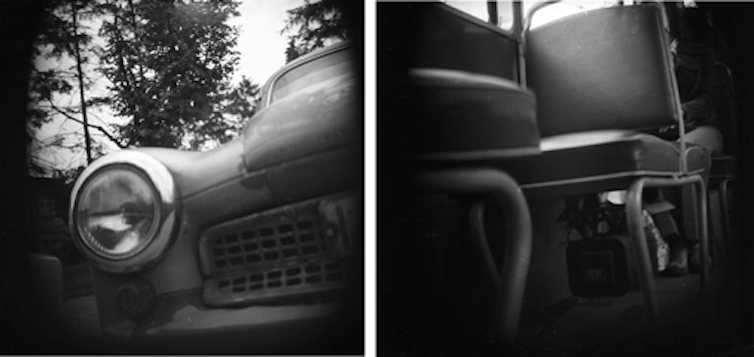 The dark edged shadows appear now as effect of the film – it is actually the edge of the buttonhole fabric.
Observations with a hidden camera around 1975. BStU MfS HA XVIII Fo 46 Bl. 36 and 23. Courtesy of the BStU Stasi Records Agency Berlin.
The dark edged shadows appear now as effect of the film – it is actually the edge of the buttonhole fabric.
Observations with a hidden camera around 1975. BStU MfS HA XVIII Fo 46 Bl. 36 and 23. Courtesy of the BStU Stasi Records Agency Berlin.
Photographs taken by buttonhole cameras offer a strange dark shadow around the edge of the image that look like the ghostly photographic effects of a groovy low-fi plastic camera. These photographs are often out of focus, the observer hurried by their determination to catch the suspects in action.
One series taken in 1975 observes a couple handing over a bag in the street.
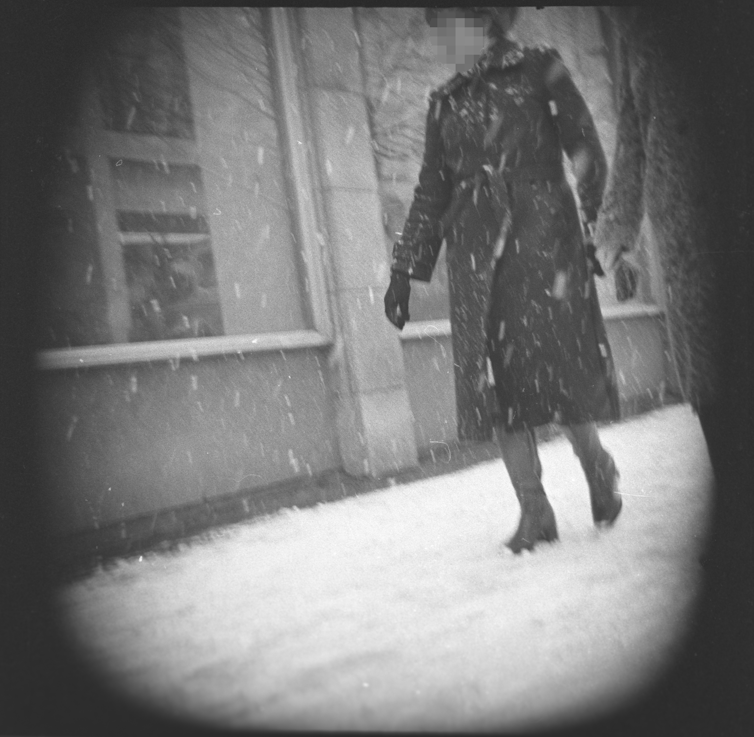 These covert photographs captured a couple exchanging a bag.
Observing suspicious suspects exchanging a bag on the street, Berlin, around 1975. BStU MfS HA II Fo 865 Bl. 09. Courtesy of the BStU Stasi Records Agency Berlin.
These covert photographs captured a couple exchanging a bag.
Observing suspicious suspects exchanging a bag on the street, Berlin, around 1975. BStU MfS HA II Fo 865 Bl. 09. Courtesy of the BStU Stasi Records Agency Berlin.
The Stasi operative followed the couple, taking photographs that record them walking to a car. The photographs cast a suspicious pall over these quite innocent actions. But there is no further information in the Stasi archive about this couple or this event. This is likely because many records were later damaged or destroyed by the regime to hide their illegal mass surveillance.
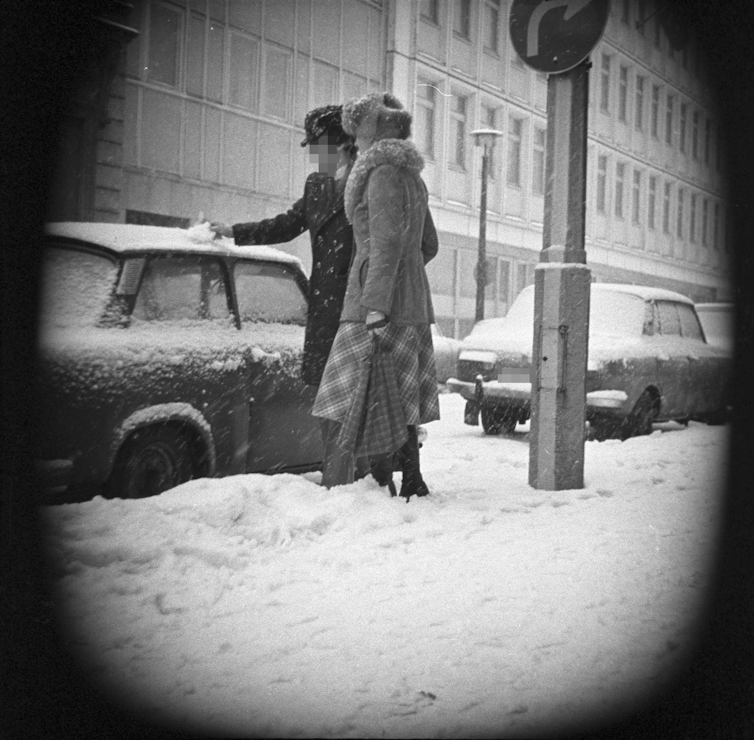 The actions could be innocent – but the act of photography makes them seem suspicious.
Observing suspicious suspects exchanging a bag on the street, Berlin, around 1975. BStU MfS HA II Fo 865 Bl. 13
The actions could be innocent – but the act of photography makes them seem suspicious.
Observing suspicious suspects exchanging a bag on the street, Berlin, around 1975. BStU MfS HA II Fo 865 Bl. 13
Escape routes
The Berlin Wall was erected primarily to stem the flow of over four million citizens who had left East Germany for the more prosperous and democratic West. More than 5,000 people escaped from East Germany between 1961 and 1989. Methods included jumping out of windows situated on the border; hot air balloons; tunnels; in car boots; and even one report of an attempted escape inside the hollow belly of a model cow.**
Read more: World politics explainer: The fall of the Berlin Wall
One famous escape took place on July 29 1965, when Heinz Holzapfel travelled with his wife and son from Leipzig to East Berlin. The family hid out in a ministry building close to the wall before heading to the roof and signalling with a torch to helpers in West Berlin, who threw them a nylon rope tied to a hammer.
The night was cold and windy and the flight across the wall, in a pulley made from a bicycle wheel and a sling, was highly dangerous.
A news photograph shows Heinz and his son safely in West Berlin, demonstrating the sling. They are pictured happy and smiling having survived their escape ordeal, which took over a year of planning.
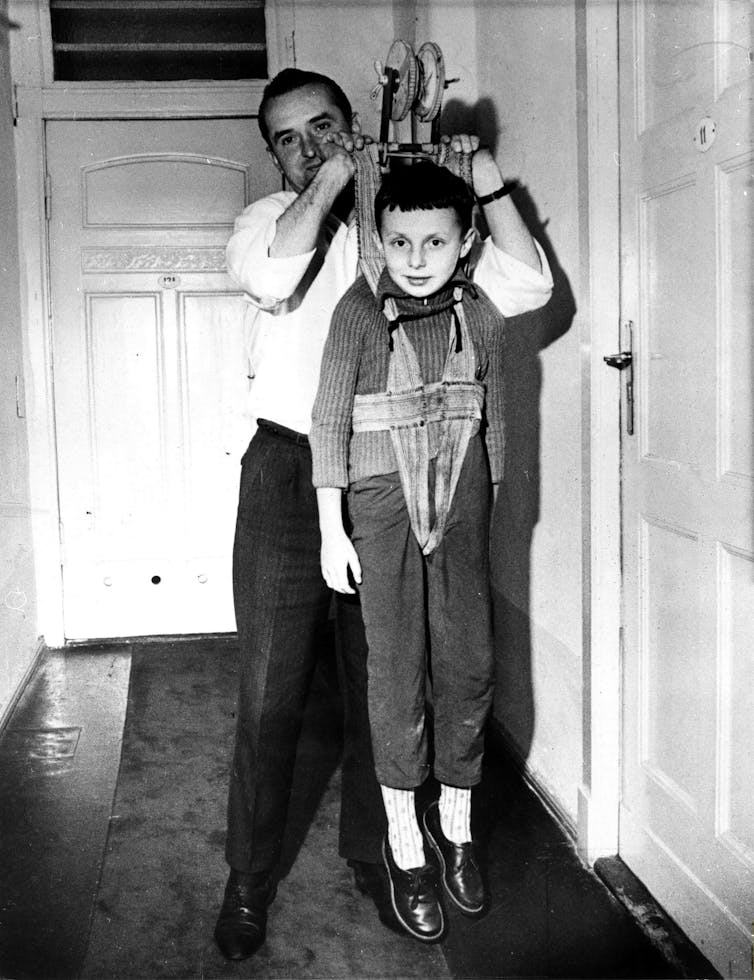 The escape harness the Holzapfel family used to cross the wall, photographed for a newspaper article on the escape.
Anonymous: Refugees, GDR, Flight of the Family Holzapfel to the West, 1965
The escape harness the Holzapfel family used to cross the wall, photographed for a newspaper article on the escape.
Anonymous: Refugees, GDR, Flight of the Family Holzapfel to the West, 1965
Surveilling the wall
Suspected defectors were followed by Stasi officers, with the aim of preventing an escape and arresting the suspects. Between July and August 1962, Stasi officers set up observation of an abandoned restaurant in Kreuzberg, Berlin. Informers had reported the digging of a tunnel from inside the restaurant and under the wall.
The officers created detailed reports of each person entering and exiting the building: hair colour, gender, height, clothing, what time they arrived and left, and if they came by car or on foot.
In addition to the copious notes are photographs. Some look like movie stills. Others are poorly shot as if the photographer was in a hurry to capture the moment.
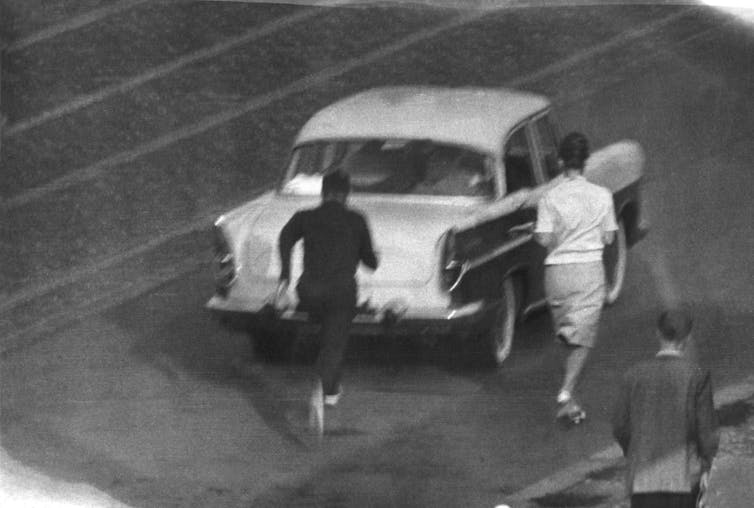 Suspected defectors are photographed meeting friends in a car.
Observation of a possible escape incident near a checkpoint in Berlin, August 26, 1962. BStU MfS HA I 13255, Bild 0123 8. Courtesy of the BStU Stasi Records Agency Berlin.
Suspected defectors are photographed meeting friends in a car.
Observation of a possible escape incident near a checkpoint in Berlin, August 26, 1962. BStU MfS HA I 13255, Bild 0123 8. Courtesy of the BStU Stasi Records Agency Berlin.
One day in August, Stasi agents took photographs in a flurry of activity, suspecting the escape attempt was imminent. A number of characters – deemed suspicious by their location near a checkpoint – were meeting friends in a car (many attempts of escape were made by cars ramming or driving under checkpoint barriers) while others observed from a nearby roof.
This action may have been a diversion. The tunnel and the attempted escape was abandoned for unknown reasons, and the Stasi were unable to make any arrests.
Painful memories locked in historical records
In late 1989, citizens stormed the offices of the East German Ministry for State Security following a series of revolutions that shook Eastern Europe. The fall of the Berlin Wall on November 9 would mark the end of the post-war era and the division of Germany.
Individuals subject to surveillance and imprisonment can now access their Stasi file. These files may hold photographs and evidence of informers who were family members, wives, husbands, or lovers.
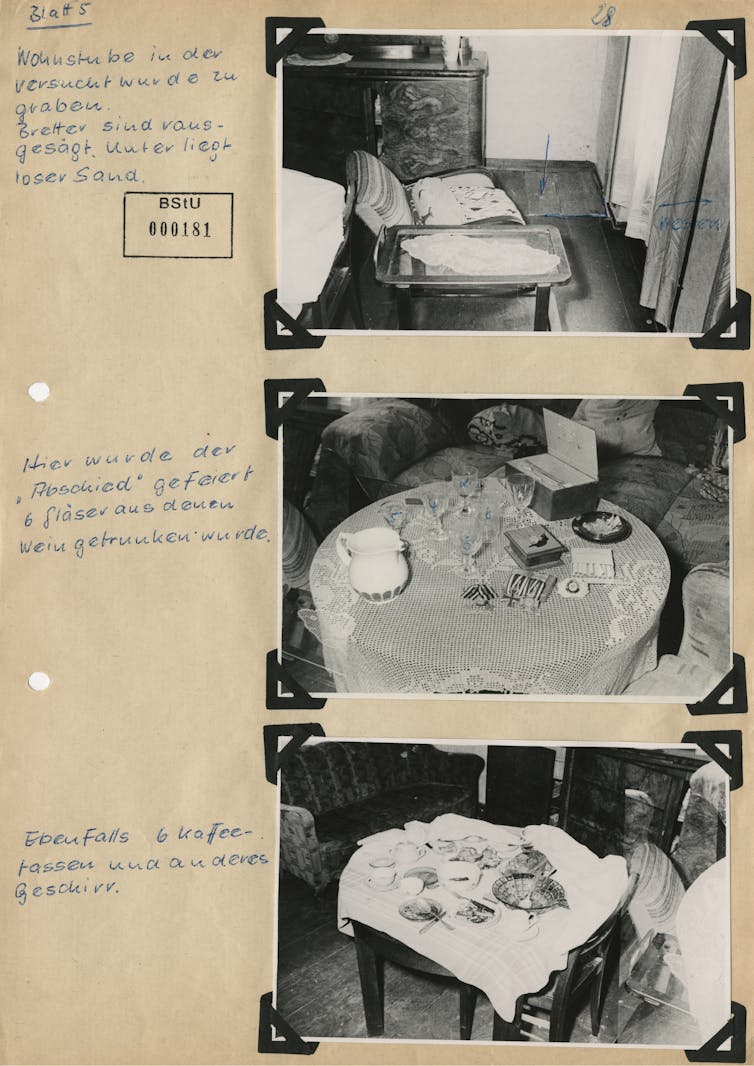 Files like this evidence of a successful tunnel escape of the Thomas Family, 7th of May, 1962, are now available to the public, including individuals subject to surveillance.
Stasi Records Agency, Berlin, BStU MfS HA I 3278 S. 0181
Files like this evidence of a successful tunnel escape of the Thomas Family, 7th of May, 1962, are now available to the public, including individuals subject to surveillance.
Stasi Records Agency, Berlin, BStU MfS HA I 3278 S. 0181
Vera Iburg, who works with the archives, told Der Spiegel: “It’s terrible, it makes you despair at the malicious lies people would tell, and at the weakness of human nature.”
We look on these photographs now as aesthetic objects and as archival evidence of a mass surveillance regime, yet they still hold a painful resonance for the victims.
It might serve us well to reflect on the lessons learned from the Stasi and the everyday lives constantly monitored.
Authors: Donna West Brett, Lecturer in Art History, University of Sydney


















