

Battle for the bush? Ignore the noise – most farmers like renewables
- Written by Elianor Gerrard, Senior Research Consultant, Institute for Sustainable Futures, University of Technology Sydney
Reaching net zero in Australia relies on the bush. That’s where the land, sun, wind and freshwater resources are.
But as the clean energy build accelerates, some landholders are pushing back. Unfortunately, their legitimate worries have been magnified by media coverage and vested interests.
The recent series of News Corp Australia Bush Summits promoted farming and mining while mining magnate Gina Rinehart took aim at the damage she claims renewables and the “net zero ideology” were doing to farmers already struggling with “devastating droughts, fires [and] floods”.
Clean energy – key to mitigating climate change – is growing rapidly, driven by projects in rural areas. In just five years, Australia has almost doubled how much clean energy goes into its main grid, reaching 40% this year.
The speed of the rollout has caused fractures in regional and rural areas as the “presumed benevolence” of renewable energy comes face-to-face with the realities of large-scale infrastructure development. In Victoria, controversial new laws mandating access for transmission line builders are likely to inflame relations with host landowners. The carrot of increased payments seems barely enough.
Farmers worry more and more about changes to the climate. Most quietly support renewables and many benefit directly from the reliable income of solar and wind. But rapid change can create real tensions, especially when change is seen as being done to a community, not with it.
What should be done? Policymakers, project developers and landowners should focus on finding ways of equitably sharing the very real benefits of the clean energy transition with the communities who will host them.
Polarisation serves vested interests
The energy debate has long been polarised in Australia, characterised by outrage and negativity. Australia’s long-running “climate wars” gave rise to a decade of political instability and a succession of prime ministers.
Media coverage amplifies the sense of an intractable conflict between clean energy projects and the bush. In politics, energy and climate policy continues to be weaponised in debates. The debate over the “net zero agenda” has fractured the Coalition.
Inflaming this debate is useful for vested interests who benefit from delaying climate action as long as possible.
Mining magnate Gina Rinehart claimed renewables were hurting farmers at the Broome Bush Summit.Farmers see climate change as their top threat
Farmers are already feeling the effects of climate change. In a 2023 survey of Australian farmers, 92% reported experiencing unwelcome changes in seasons and climate in recent years, and 71% are spending money to cut emissions from their farms.
Asked to name the main threat they were facing, 55% chose climate change. Just 1% chose transmission lines and another 1% chose the renewable rollout.
“The bush” is often presented as an immovable bloc resistant to renewables, but this framing is simplistic. Farmers have long fought against coal and gas projects in fertile areas such as the Hunter Valley. And many farmers directly benefit from clean energy projects, quietly exploring ways of pairing renewables and transmission lines with farming.
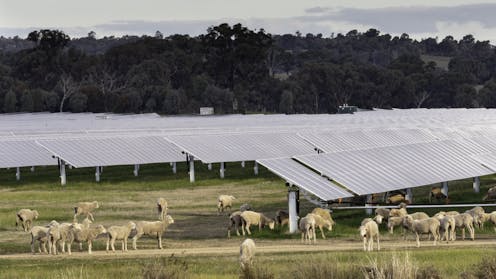
In July, Bendigo hosted a national expo on renewables and agriculture. Farmers, researchers, policymakers and advocates discussed methods such as agrivoltaics, where sheep graze under solar panels.
This month, Farmers for Climate Action hosted a national summit exploring similar territory. At the conference, farmers spoke about how renewables were a financial lifeline amid challenging conditions.

Taking the heat out of the debate
Rural concerns should not be dismissed. Wind farms attract fears over noise and visual impact, and large transmission lines provoke concerns over potential impact on farming through to lower property values.
The best way forward? Ignore the noise, listen to genuine concerns, and focus on sharing benefits, clear communication and making decisions collaboratively. Here’s how:
Share the benefits
Renewable developers often initiate community benefit schemes such as funding community initiatives or committing to local jobs. The Clean Energy Council estimates these schemes could be worth A$1.9 billion by 2050.
Renewable projects can help by leaving a legacy of infrastructure and programs to make life better in the bush. Shared equity schemes go even further. In Canada, communities get a mandatory 25% of project equity. In Australia, the First Nations Clean Energy Network is pushing for similar shared equity.
Decide together, share knowledge
Towns in designated renewable energy zones are getting in early to ensure the community has a bigger role through community meetings and discussion. Residents in Hay made it clear they wanted to ensure benefits would flow to their region.
Citizen assemblies can help create common ground in communities before conflict sets in.
Open discussion gives communities more power and more buy-in. Local knowledge and expertise can feed into related initiatives, such as encouraging biodiversity on solar farms.
Fill the information vacuum
When communities aren’t kept well informed, misinformation can flourish. Trust and transparency are key. Communication has to be early, two-way and ongoing. One solution may be local energy hubs, where staff can answer questions directly.
Share the load
Rural and regional areas are doing the heavy lifting on clean energy, as a NSW Parliamentary Inquiry recently heard. Urban areas can contribute through mechanisms such as the new urban renewable energy zone in the Illawarra, though these have their own complexities.
Community power networks offer another way for urban communities to shoulder some of the responsibility for the energy shift by producing, storing and using their own energy.
Through the increased electrification of homes – coupled with flexible demand and greater network utilisation – cities and urban areas could become “giant batteries.”
Polarisation is pointless
Change is not always easy. Anxieties can be magnified to create polarisation or gridlock. But issues can be worked through.
We need to put aside fearmongering and collaboratively decide how best to shape the emerging clean energy era to benefit all Australians – rural or otherwise.
Authors: Elianor Gerrard, Senior Research Consultant, Institute for Sustainable Futures, University of Technology Sydney
Read more https://theconversation.com/battle-for-the-bush-ignore-the-noise-most-farmers-like-renewables-264680

















