

US strikes on Venezuelan ‘drug boats’ have killed 14 people. What is Trump trying to do?
- Written by: Philip Johnson, Lecturer, College of Business, Government and Law, Flinders University
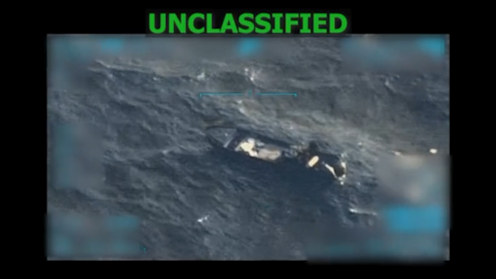
In the past few weeks, the United States military has been involved in multiple fatal strikes on boats in international waters off the coast of Venezuela.
The first airstrike was on September 5 and killed 11 people. The second occurred this week, killing three people. No efforts were made to apprehend the vessels or identify the people before the strikes.
President Donald Trump has claimed the boats and the people on them were trafficking illegal drugs bound for the US, dubbing them “narcoterrorists”.
The White House has provided little detail about the attacks in general, and no evidence the boats were trafficking drugs. It’s possible they weren’t.
Here’s what’s going on in the region and what might happen next.
Why is this happening now?
During the 2024 presidential election campaign, Trump repeatedly promised to crack down on immigration from Latin America.
He often drew a connection between crime and immigration, especially from Haiti and Venezuela (though some of the cases of gang crime he cited have since been questioned or debunked).
Once in office, Trump declared a number of gangs as terrorist organisations, including one Venezuelan group, Tren de Aragua.
The Trump government has claimed that Venezuelans deported from the US were members of Tren de Aragua, often without much substantial evidence.
Trump has also entertained the idea of using the US military to target criminal groups.
This is now reality, through a large military buildup deploying multiple warships, submarines and fighter jets to the Caribbean.
A tumultuous history
This is the latest chapter in a long and sometimes hostile relationship between Venezuela and the US.
Venezuela holds the world’s largest proven oil reserves, affording the country political and economic influence within the region. This has made Venezuela a valued ally, and sometimes a competitor, to the United States.
But for the past two decades or so, relations have been more antagonistic.
When left-wing populist President Hugo Chavez was in power in Venezuela in 2002, the US was accused of giving tacit approval to a coup attempt against him.
America has also imposed economic sanctions against the country since 2005. These particularly ramped up under Trump’s first administration against Chavez’s successor and current president, Nicolas Maduro.

While less popular than his predecessor, Maduro remains extremely powerful. US attempts to destabilise his government, including one in 2019, have been unsuccessful.
Although many in Venezuela would welcome a change of government, any US intervention in the region is likely to be immensely unpopular. It provides a nationalist rallying point for Maduro: a way to boost his local support.
What do we know about the gang?
Trump claims both boats were operated by the Tren de Aragua gang.
The group started in Venezuelan prisons before spreading across other Latin American countries, primarily through people fleeing Maduro’s authoritarian regime.
Estimates of the size of the gang are contested and hard to measure, but best guesses put it at around 5,000 members.
Tren de Aragua members have been identified in 16 US states, but there has been little conclusive evidence of large-scale criminal or terrorist activity. In New York, Tren de Aragua has primarily been associated with retail theft.
Why is the US bombing boats?
Destroying individual boats is unlikely to have an impact on drug trafficking into the US. Most fentanyl, for example, is trafficked into the US over land borders by US citizens.
However, bombing the boats does reinforce the idea of an existential threat to the United States that can only be defeated with violence. The same sense of threat is used to justify the deportation of hundreds of Venezuelans to brutal prisons in El Salvador.
The Venezuelan government is of less concern to Trump. Indeed, the White House has authorised increased imports of Venezuelan oil in recent weeks.
Others within the US government are more committed to regime change in Venezuela. For Secretary of State, Marco Rubio, the military operations are a direct effort to destabilise what he sees as an illegitimate Venezuelan regime.
Is it legal?
These airstrikes are the first unilateral US military action in Latin America since the invasion of Panama in 1989.
However, the military operations fit within a much longer history of overt and covert intervention in the region.
Scholars have said the decision to attack the boats was likely illegal under the law of the sea.
The US government justifies the attack in the broadest terms: Venezuelan gangs traffic drugs that can kill American citizens, therefore any violence is warranted to prevent this. This is an argument not about legality, but urgent security.
Impunity is the larger point, a display of power in itself. After the first strike, Vice President JD Vance declared “I don’t give a shit what you call it”.
Trump and Rubio have both asserted the strikes will continue, without concern for the possibility that they could be considered war crimes.
Without a clear prospect of legal jeopardy, the strikes will remain available as a way to project US power. The strikes will likely stop, or pause, when the government wants to claim that it has achieved some victory.
Authors: Philip Johnson, Lecturer, College of Business, Government and Law, Flinders University


















