

a short, sharp history of the bayonet
- Written by: Peter Monteath, Flinders University
Even the sound of a bayonet could be frightening. The audible whetting of blades in the enemy’s trenches could puncture a night’s rest with premonitions of steely death. The sight of gleaming blades, too, turned the stomach of many a soldier. For all the sheer, witless terror it could produce in those who heard, saw and perhaps felt its cold steel, there was no weapon more visceral than the bayonet.
It might have been a moment of inspired panic that brought the bayonet into existence. The bearer of a musket – maybe a soldier, maybe a hunter – having fired his weapon and missed his target, found himself at the mercy of a fast-approaching assailant.
With no time to reload, he plunged the handle of a dagger into the muzzle, converting it from firearm to elongated knife or pike. Perhaps he had missed his target altogether and expected to be assaulted at any moment, or perhaps his wounded quarry had disappeared into a thicket and needed to be chased at speed.
As time was of the essence, it could not be squandered in the cumbersome act of reloading. Shoved snugly inside the muzzle of a firearm, even a short dagger could deliver a lethal strike.
From its first use somewhere in southwestern France sometime in the first half of the 17th century, the genius of the invention spread far and wide. History has it that the first acknowledged military use of the bayonet was at Ypres in 1647. It also reveals that, for all its genius, the days of the “plug bayonet” were numbered. While the wooden handle was plugged in the musket, the weapon could not be fired. Worse than that, over-vigorous use might damage the barrel, or the blade might break while wedged firmly inside.
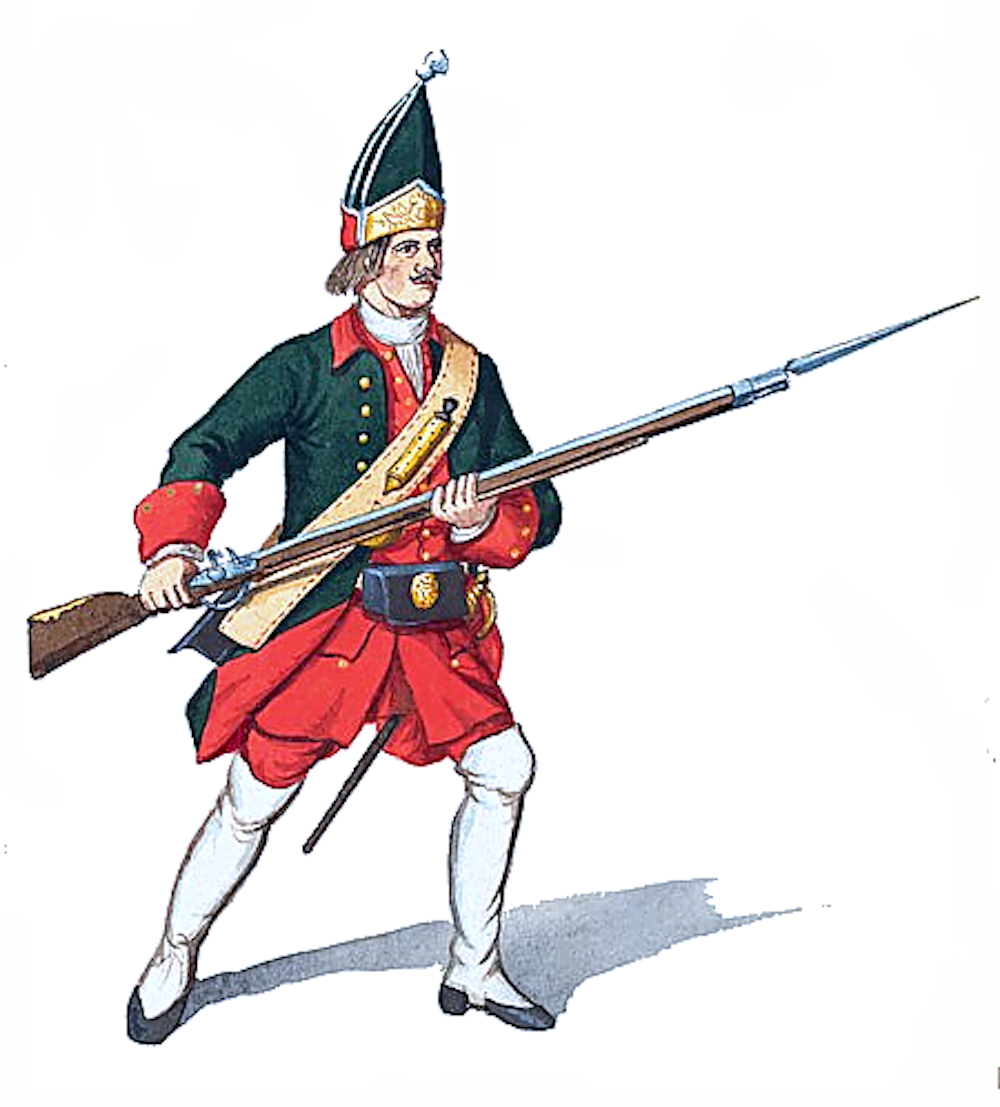 A Russian grenadier with bayonet in 1732.
Wikimedia Commons
A Russian grenadier with bayonet in 1732.
Wikimedia Commons
Over time, ways were found to attach blades to the outside of barrels, whether running alongside, on top or beneath them. The blades could be short and dagger-like. Or they could be as long as swords, so that when attached to long-barrelled weapons they could deliver their bearer the advantage of reach. In cross-section, they might be broad and thin like a carving knife, round like a stiletto, or star-shaped.
In their countless variations, bayonets appeared on many a battlefield in Europe and other parts of the world, until in the last decades of the 19th century they appeared to have met their match. The American Civil War and the Franco–Prussian War seemed to teach one incontrovertible lesson – that advances in military technology had rendered the humble bayonet obsolete. In the face of machine-gun fire or a bombardment of artillery, the infantryman with a fixed bayonet might never see his killer, let alone plunge the cold steel into him.
Yet while machine-guns, mortars and artillery might serve to mow down the serried ranks of the enemy or blow them apart, ultimately even positions strewn with corpses had to be occupied and claimed. It remained the infantrymen’s vital role to make contested territory their own. If the very sight of fixed bayonets did not persuade any surviving defenders to surrender, then the bayonets might still have work to do.
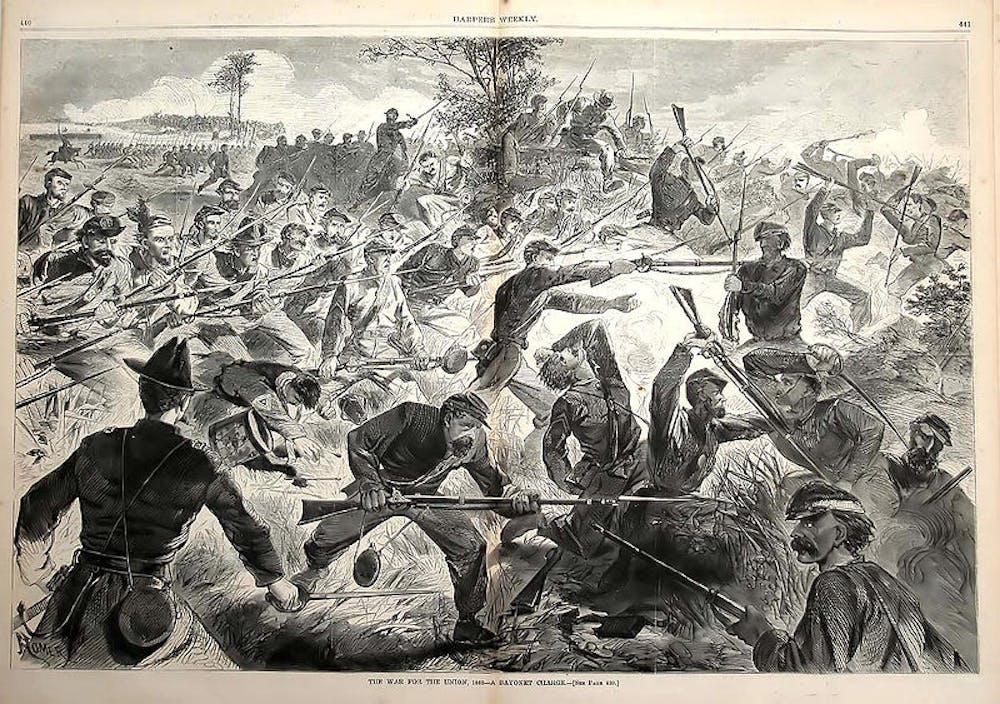 The War for the Union, 1862 – A Bayonet Charge (Harper’s Weekly, Vol. VII)
Wikimedia Commons
The War for the Union, 1862 – A Bayonet Charge (Harper’s Weekly, Vol. VII)
Wikimedia Commons
A 20th century revival
The 20th century proved that declarations of the bayonet’s demise had been premature. It remained standard issue for infantrymen all over the world, even if its shape and use varied.
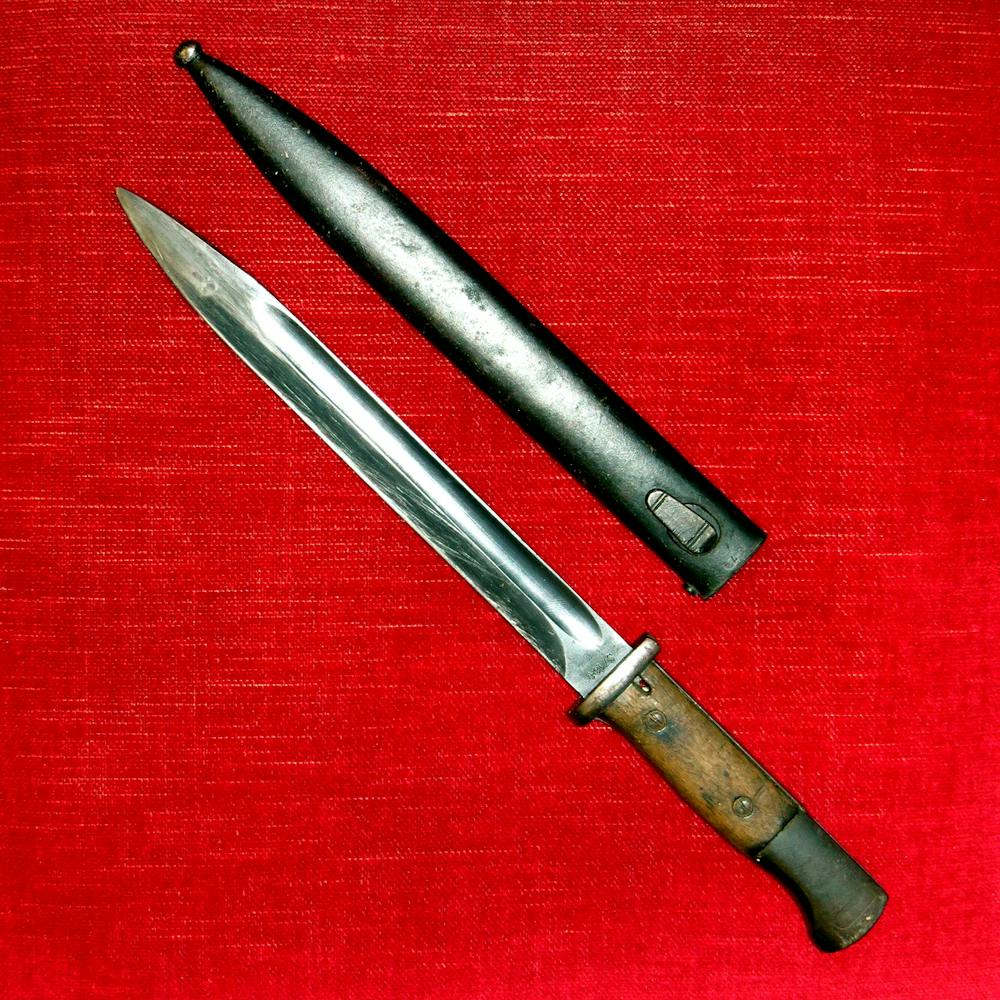 A German bayonet from the first world war.
Wikimedia Commons
A German bayonet from the first world war.
Wikimedia Commons
The Russians clung fanatically to their faith in the socket bayonet. The Japanese reintroduced a sword bayonet in 1897, inspired by a French weapon. Where stealth was of the essence, as it was in night attacks in the Russo–Japanese War, the bayonet delivered silent death. Americans, too, insisted that their infantry carry long bayonet blades – an intimidating 40 centimetres – on their belts, ready to be fixed when the need arose. In time and with experience, though, the Germans opted for shorter knife bayonets of 25 or 30 centimetres.
In Britain, and all her Dominions, the so-called “Pattern 1907” bayonet was preferred. Over the centuries, the fundamentals of the bayonet had barely changed, and the Pattern, too, consisted of a blade, a guard with crosspiece and muzzle ring, and a wooden hilt. Along much of the length of the blade ran a groove, a fuller. It reduced the weight of the weapon and also allowed air to pass into the wound, making it easier to extract the blade.
While most of the standard weapons of the British Empire’s armies were manufactured in Britain, Australia, like India, manufactured its own Pattern 1907 bayonets in both wars.
In the first world war they were made in a factory in Lithgow, while those from the second world war were stamped with 13 (for Orange Arsenal) or 14 (for Munitions Australia). The wooden grips were stamped with “SLAZ”, an abbreviation of their British maker, Slazenger, active in the sporting goods business back to the 1880s.
Kept normally in a scabbard attached to the soldier’s belt, when fixed to the standard-issue Short Magazine Lee Enfield rifle, the Pattern 1907 extended the soldier’s reach by more than 40 centimetres.
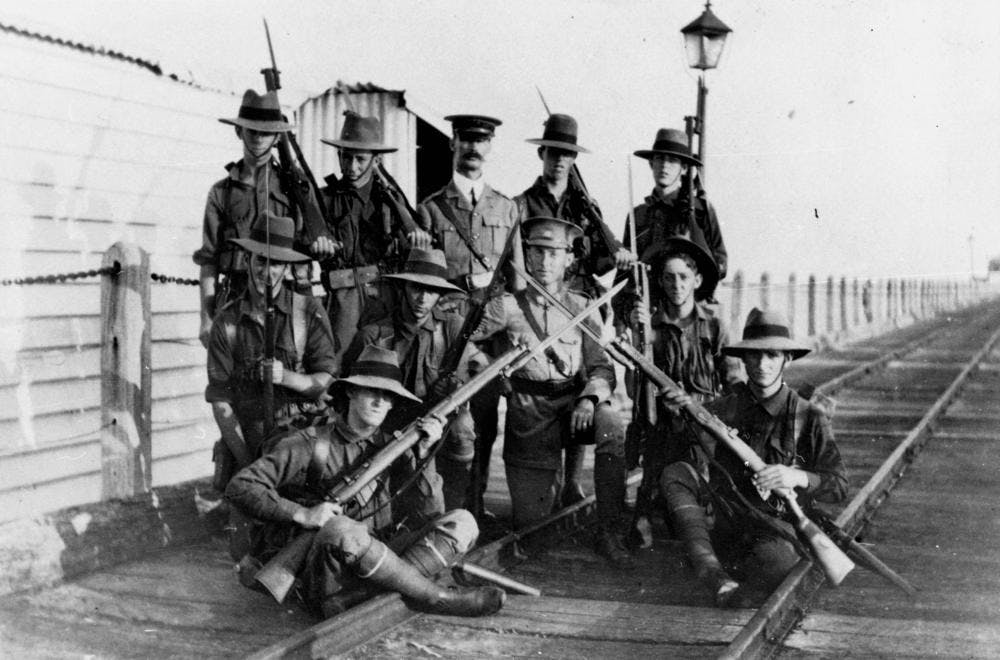 Australian soldiers guard the jetty in Bowen during world war one.
Wikimedia Commons
Australian soldiers guard the jetty in Bowen during world war one.
Wikimedia Commons
Australia’s willing killers
Bayonets were standard equipment in the first world war, even as the accelerated development of military technology enforced the trend to mechanised, industrial killing. Australians earned themselves a reputation for using their bayonets with relish. Well trained and drilled in their use, they plunged, parried and stabbed with great vigour at Gallipoli and on the Western Front. The Australians, as the historian Bill Gammage has put it:
by reputation and probably in fact, were among the most willing to kill. They had an uncomplicated attitude towards the Hun, conditioned largely by propaganda and hardly at all by contact, and they hated him with a loathing paralleled, at least in the British Army, only by some other colonial troops. Accordingly many killed their opponents brutally, savagely, and unnecessarily.
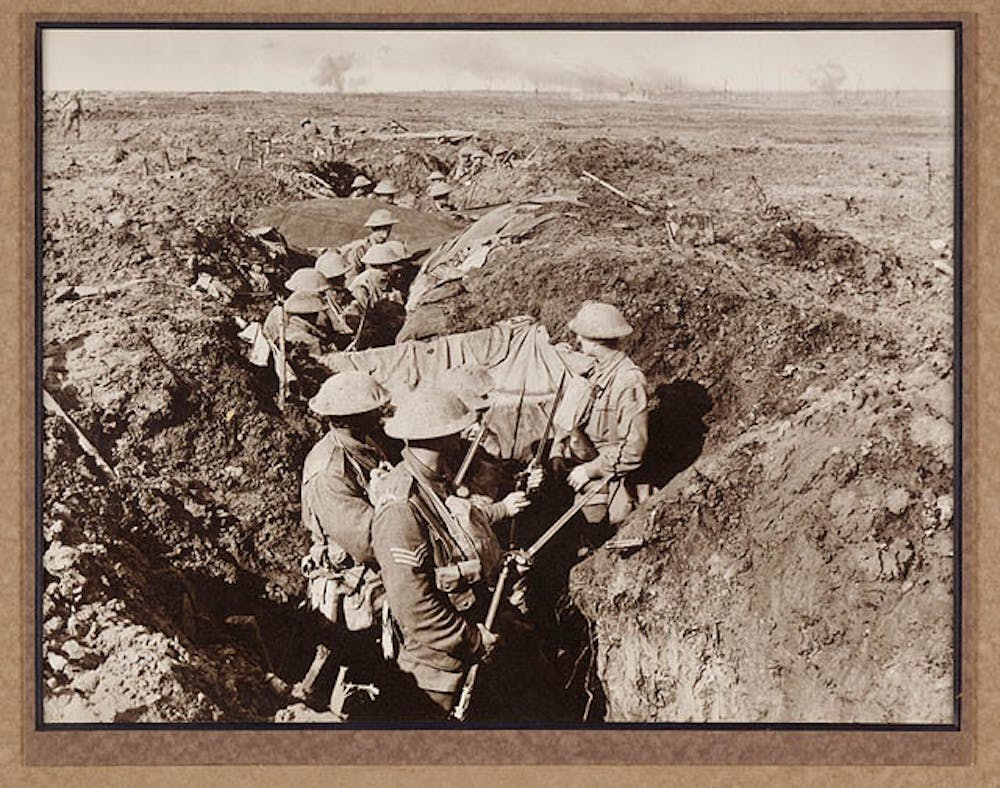 Australian infantry in the trenches with bayonets during World War One.
Frank Hurley/Wikimedia Commons
Australian infantry in the trenches with bayonets during World War One.
Frank Hurley/Wikimedia Commons
It was not only the Germans who became acquainted with the Pattern 1907. At Gallipoli Albert Jacka won Australia’s first VC of the war by shooting five Turks and bayonetting two others. Another Australian, Nigel Ellsworth, noted that in advance of a night attack on Turkish lines:
one can’t buy a place in the main firing trench, and men are known to have refused for their positions during the fighting. They stand up in the trenches &; yell out ‘Come on, we’ll give you Allah’ & … let some Turks actually get into our Trenches then tickle them up with the bayonet.
‘Steel has an unearthly terror’
Archie Barwick, a farmer from New South Wales, spoke of being transported into a state of “mad intoxication” when he took to the Turks with fixed bayonet.
I can recollect driving the bayonet into the body of one fellow quite clearly, & he fell right at my feet & when I drew the bayonet out, the blood spurted from his body.
A New Zealand officer writing home from Gallipoli claimed that the Turks “redoubled” their fire over the New Zealanders’ positions at night. It was “the one hope of deterring the dreaded bayonets of our men … steel has an unearthly terror for them”.
In a similar vein, another Australian wrote boastfully to his family of the short work he made of Germans:
They get it too right where the chicken gets the axe … I … will fix a few more before I have finished. It’s good sport father, when the bayonet goes in their eyes bulge out like a prawns.
If there was a danger in the over-zealous use of the bayonet, it was that the weapon might be driven so far and firmly into the opponent’s body that it was difficult to extract it. The Queenslander Hugh Knyvett recalled a case where a fellow Australian drove his bayonet through a German and into a hardwood beam, from which it could not be withdrawn. The blade had to be released from the rifle, “leaving the German stuck up there as a souvenir of his visit”.
By the latter stages of the first world war, the Australians’ skill had manifested in the use of a particular lethal movement with the bayonet known as the “throat jab”.
It is well illustrated in William Longstaff ’s iconic painting Night Attack by 13th Brigade at Villers- Bretonneux, which shows an Australian holding aloft his Lee Enfield, bayonet attached, and thrusting it into a German’s exposed throat.
 Night attack by 13th Brigade at Villers- Bretonneux.
Australian War Memorial
Night attack by 13th Brigade at Villers- Bretonneux.
Australian War Memorial
In recalling his own role in that battle in the night from 24 April to Anzac Day, Walter Downing wrote:
Bayonets passed with ease through grey-clad bodies, and were withdrawn with a sucking noise … Many had tallies of twenty and thirty and more, all killed with the bayonet, or bullet, or bomb. Some found chances in the slaughter to light cigarettes, then continued the killing.
Still, in reality the bayonet’s role in the first world war was more prominent in the telling than on the battlefield. Sober analysis showed that the vast majority of deaths and casualties were put down to machine-guns and artillery. As for the Australians themselves, more than half of those admitted to field hospitals in France suffered injuries from shells and shell-shock, and more than a third from bullets. The combined tally from bombs, grenades and bayonets was just over 2%.
The fear of cold steel
After the war, even former combatants voiced their awareness of the bayonet’s shortcomings. It might have been helpful for certain mundane tasks like opening tins, chopping firewood or perhaps roasting meat over a fire, but in a charge across open land in the sights of German machine-gunners, it was at best an unwelcome burden.
In close quarters, too, it had its drawbacks. Fixed in readiness to the end of a Lee Enfield and lugged along a trench, its most likely victim was a comrade in arms, who might receive a prod to the buttocks or a poke in the eye.
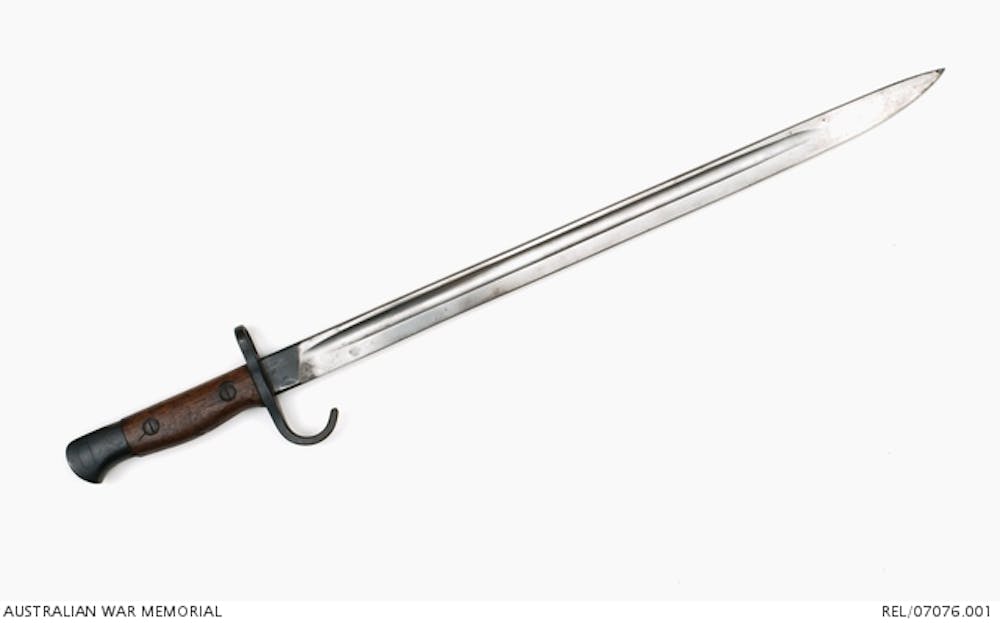 A Pattern 1907 bayonet with hooked quillon.
Australian War Memorial
A Pattern 1907 bayonet with hooked quillon.
Australian War Memorial
Nonetheless, by 1939, the bayonet still had its place in every army. The true value of the bayonet was in the soldier’s mind, not at the end of his rifle.
That was true in two ways. While the greatest threat to the 20th century soldier was the bomb or the bullet delivered anonymously from afar, the most animating of fears was that of “cold steel” inserted into his body in a mortal duel, the most intimate form of combat death.
The most feared weapons in war are not necessarily the most dangerous. One reason why field hospitals counted relatively few casualties caused by bayonet wounds may well have been that many a soldier turned and ran before taking his chances against a surging line of men, bayonets glistening, and in all likelihood adorning their advance with the kinds of cries or yells designed to curdle blood.
In those circumstances, only in the rarest cases would bayonet steel clash with steel. Unlike the arrival of the bullet or the shell, the bayonet’s advent was seen, possibly heard, and with judicious retreat was probably avoidable. As one soldier of the second world war put it, “If I was that close to a Jerry, where we could use bayonets, one of us would have already surrendered!”
More crucial, though, than the psychological effect of the bayonet on the enemy was its impact on the men who wielded it. To take the lives of fellow human beings required not just weapons, but a mentality that tolerated the act of killing and even facilitated it.
In this war, as in the last, at military training schools across the world, instructor sergeants taught their charges to lunge, thrust and parry. Bayonets in hand, recruits were exhorted to plunge their weapons into swinging sacks of sawdust or bags of straw, aiming for those parts marked as weak and vulnerable.
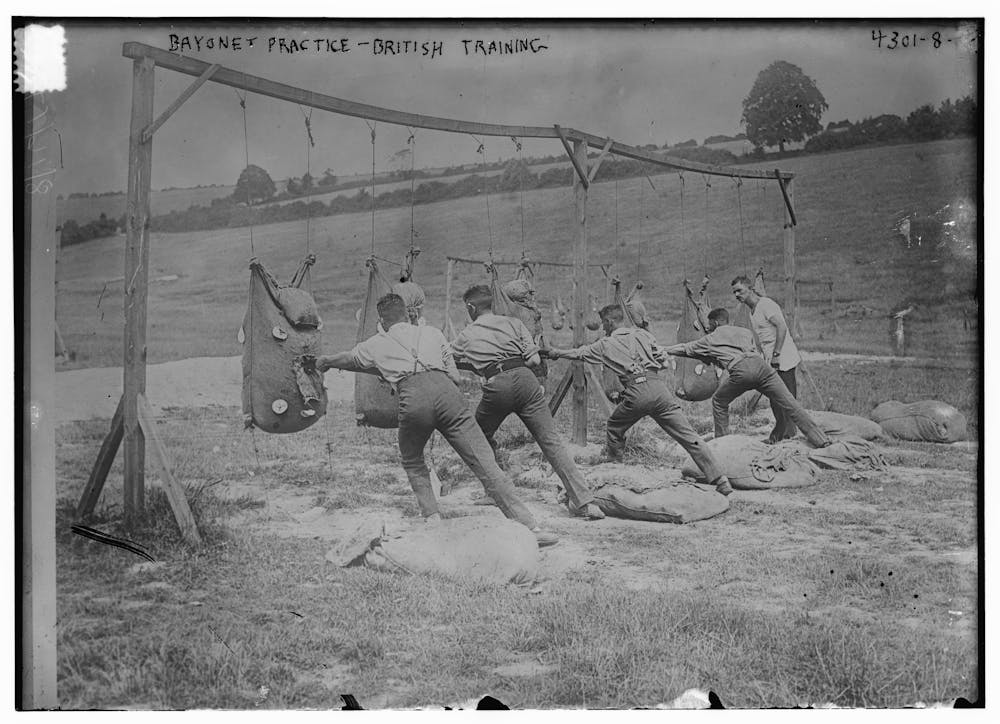 British soldiers practising with bayonets in the first world war.
Wikimedia Commons
British soldiers practising with bayonets in the first world war.
Wikimedia Commons
To ramp up the level of realism, some British recruits practised “in abattoirs, with warm animal blood thrown in their faces as they plunged home their bayonets”.
Confidence in the use of the bayonet, it was believed, would give infantry the courage to advance from their positions and confront the enemy directly. They developed was what some called “the spirit of the bayonet”, l’esprit de la baïonnette. More crudely, it was a “lust for blood”. Although the statistics insisted it was unlikely that the bayonet would be the cause of death, it was crucial because it engendered in its bearer the desire to advance and to kill.
A mental reflex
Ideally the effect of such training, then, was not just to acquire the strength and skills akin to those of a fencer or swordsman. It was to develop a mental reflex perhaps best understood as the form of associative learning that psychologists term “classical conditioning”.
Just as Pavlov’s dog was conditioned to salivate on the appearance of a metronome – an artefact the dog had been trained to associate with the presentation of food – so in the mind of the infantryman the command to fix bayonets would trigger a hyper-aggressive state.
At that point it might even have seemed to the soldier that all agency had shifted to his bayonet, which would tug him into wild acts of violence, as if he had “no choice but to go along with its spirit”. As one infantryman put it, the “shining things leap from the scabbards and flash in the light … They seem alive and joyous; they turn us into fiends, thirsty for slaughter.”
If any soldiers in the second world war were entitled to the view that the march of military technology had rendered the bayonet obsolete, it was the parachutists and mountain troops Hitler sent to invade the island of Crete in May 1941.
Superbly trained and equipped, they had proved to themselves and the world that warfare had entered a new era. Germany’s armed forces, the Wehrmacht, had demonstrated that in the modern age, death could be delivered anonymously and at a distance, above all from the skies. The age of intimate killing was over.
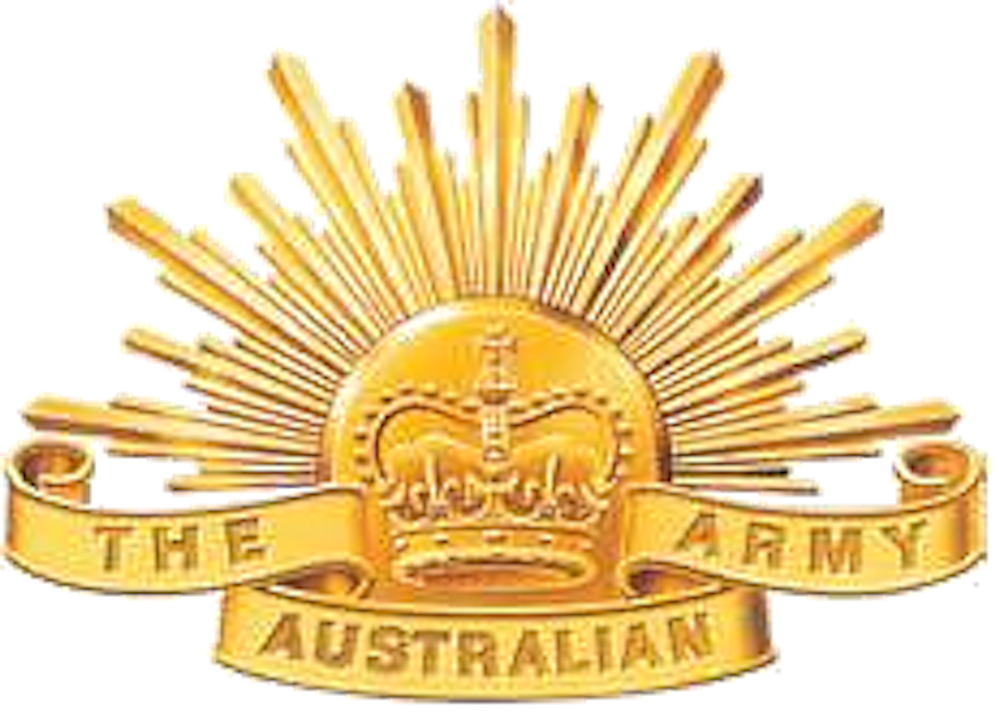 The Australian army’s rising sun badge.
Wikimedia Commons
The Australian army’s rising sun badge.
Wikimedia Commons
Or so it seemed. In Crete they were to confront Australians and New Zealanders who, like their fathers, were deeply familiar with the spirit of the bayonet. On the upturned brims of their slouch hats, the Australians displayed their allegiance to a powerful tradition in the form of the Rising Sun badge, a semi-circle of glistening bayonets radiating from a crown.
Like the Anzacs of the Great War, the Anzacs of 1941 were well trained in the use of the Pattern 1907 – they could lunge and stab with all the skill and deadliness of their forebears. When the order was given to fix bayonets, these Anzacs of 1941, too, would be expected to spill blood.
NB: Bayonets were used in charges as recently as in the Falklands War, the Second Gulf War and in Afghanistan. In many parts of the world to this day, training for infantrymen introduces them to the “spirit of the bayonet”.
This is an edited extract from Battle on 42nd Street - War in Crete and the Anzacs’ bloody last stand by Peter Monteath (NewSouth Books).
Authors: Peter Monteath, Flinders University
Read more http://theconversation.com/friday-essay-a-short-sharp-history-of-the-bayonet-126010


















