

Why Australia is still grappling with the legacy of the first world war
- Written by: Bart Ziino, Senior Lecturer, School of Humanities and Social Sciences, Deakin University
Historians have long been engaged in a fractious, sometimes spiteful, debate about the legacies of the first world war. This is especially so because the politics of the war continue to resonate in our own discussions of national identity and purpose.
We debate the extent to which the Anzac tradition reflects our understanding of what makes a good Australian, and how important our cultural affinities are with Britain. Did the war curtail a progressive spirit, and entrench political conservatism, or did it encourage a new confidence in ourselves?
These evaluations were already present the moment the war ended in November 1918. Australians had endured a terrible trauma. Sixty thousand of them were dead from a population of not quite 5 million. Another 150,000 returned sick or wounded, physically and mentally.
Read more: World politics explainer: The Great War (WWI)
Those at home were quick to draw attention to their own sufferings, too. They had known the war not only in its military dimensions, but as an ordeal of waiting and worrying, of constantly fearing the worst. The Victorian parliamentarian John Percy Jones simply declared the war
has kept me in a condition of mental agony. I am hardly able to realise even yet that the fearful times through which we have been passing are now over.
What, then, should we make of that sacrifice? Some called the nation to unity around the experience of the war, and in doing so elevated the Anzacs to the peak of Australian virtue.
In the federal parliament, Senator Edward Millen declared:
this war, amongst other things, has made Australia a nation in a sense that it was not before. It has given us a new conception of national life.
A divided nation
But it was also clear the war had driven apart Australians in the demands it made on the people. Calls to unity faltered, as intense debates over recruiting for the army crystallised in two failed attempts to endorse compulsory military service by plebiscite.
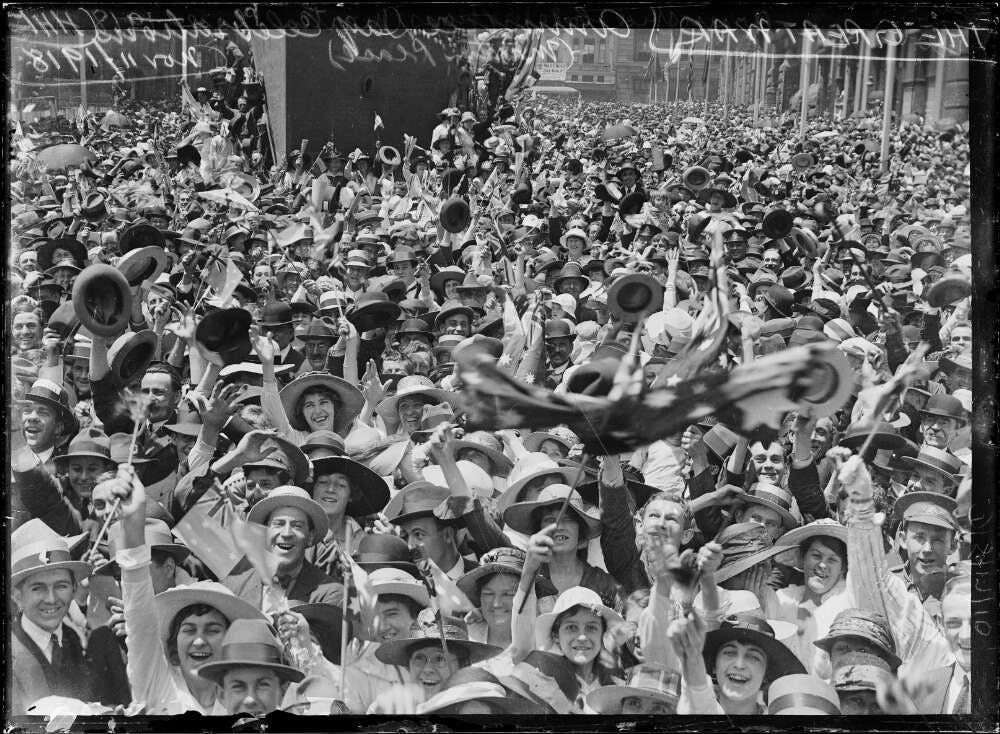 Armistice celebrations in 1918. Conscription campaigns polarised Australian politics and society.
National Library of Australia
Armistice celebrations in 1918. Conscription campaigns polarised Australian politics and society.
National Library of Australia
The conscription campaigns divided Australians bitterly. Those who voted against the principle found their loyalty to nation and empire questioned. Those in favour faced accusations they betrayed Australia’s future by sending its young men to die.
Australians voted against conscription in October 1916 and again in December 1917, but the effect was still to polarise Australian politics and society. The Labor Party split over the issue. Prime Minister Billy Hughes walked out and formed government with his erstwhile opponents.
The party’s now unequivocal anti-conscription sentiments found it tarred with the brush of disloyalty and ensured a conservative ascendancy in federal politics until 1929.
Even in private life, those political divisions were deep and abiding. One woman wrote to her soldier husband at the front that she had broken off friendships over the issue:
they don’t come here now since conscription I told them what I thought of them.
Returned soldiers as ‘most deserving’
It is small wonder that those on the political left – many historians included – should feel uncomfortable about the effects of the first world war on Australian society and culture.
 Dugout at Gallipoli. 60,000 Australians were killed in the First World War.
State Library of Victoria, CC BY
Dugout at Gallipoli. 60,000 Australians were killed in the First World War.
State Library of Victoria, CC BY
The tendency of the war had been to draw Australia more closely into the British Empire’s embrace. The German threat provoked deep expressions of cultural unity with Britain from Australians, and further encouraged them to see their future security in terms of even closer defence and economic ties with the empire.
The Anzac tradition itself embodied those difficult politics, as it promoted the Empire-loyal “digger” as the embodiment of the Australian national character.
Read more: 100 years since the WW1 Armistice, Remembrance Day remains a powerful reminder of the cost of war
In Anzac’s rhetoric, Australian soldiers had proved themselves the exemplars of a series of desirable qualities such as courage, initiative, and loyalty to mates. But they had not so much achieved independence for Australia as raised Australia to equality within a British brotherhood.
For those on the political left, the veneration of the digger displaced all other potential contributions to the making of Australian nationhood, including the contributions of women, pacifists and political radicals.
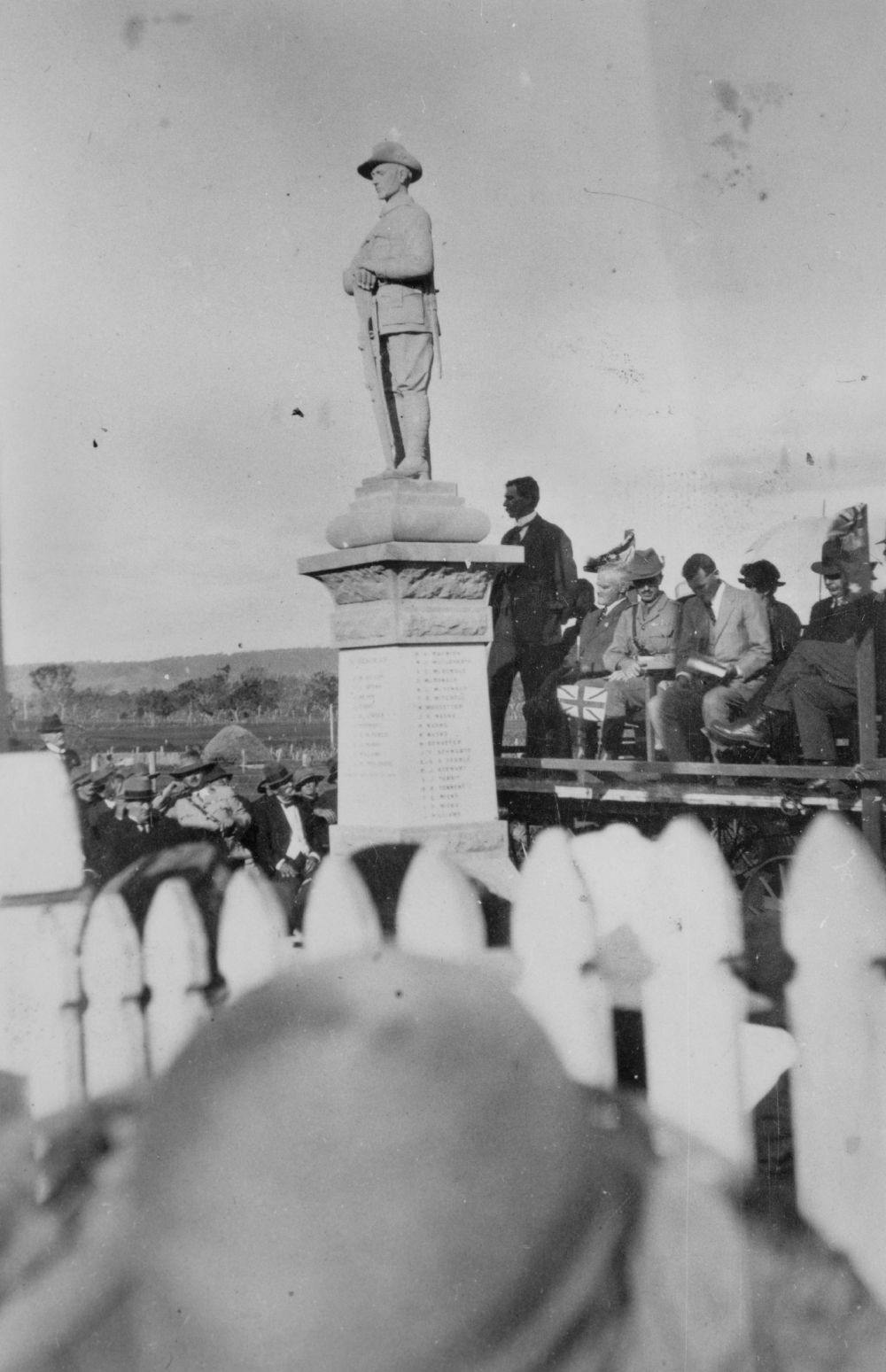 Australian soldiers became the embodiment of national character, and they assumed the position of the most deserving in citizenship hierarchies.
State Library of Queensland
Australian soldiers became the embodiment of national character, and they assumed the position of the most deserving in citizenship hierarchies.
State Library of Queensland
It reorganised hierarchies of citizenship, so returned soldiers assumed the position of the most deserving, whether in terms of government largesse or in cultural terms as the embodiment of national character.
But conservative historians have naturally been much more comfortable with that interpretation of the war’s effects than their counterparts.
It speaks to a sense that Australians held close to their British descent and traditions, while also recognising the economic and security value of continued close ties. And it gave Australians a figure whose characteristics were not only to be admired, but emulated in civic life and subsequent conflicts.
Read more: How the Great War shaped the foundations of Australia's future
A century on from the national trauma of 1914-18, the politics of that event remain present. The kind of Australia we prefer to see depends on whether we regret or embrace the effects of the first world war on Australian politics and culture.
As we gather again on the anniversary of the end of the “war to end all wars”, we might observe that the conclusion of the war only started the long and continuing effort to come to terms with its meaning.
Authors: Bart Ziino, Senior Lecturer, School of Humanities and Social Sciences, Deakin University


















