

One Battle After Another is the latest film shot in VistaVision, a 1950s format making a big comeback
- Written by: Ben McCann, Associate Professor of French Studies, University of Adelaide
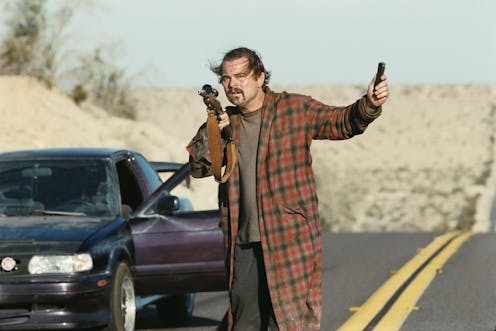
Paul Thomas Anderson’s eagerly awaited new film, One Battle After Another, hits Australian screens tomorrow. The action-political thriller is Anderson’s first film in four years, and his first collaboration with actor Leonardo DiCaprio.
The film is also noteworthy because of Anderson’s decision to shoot on VistaVision, a high-resolution format from the 1950s that’s making a big Hollywood comeback.
Much like the resurgence of vinyl in music, and film in photography, the revival of VistaVision reflects a desire to return to analogue formats that feel uniquely “crafted” in an otherwise hyper-digitised world.
A new way of making films
In the 1950s, Hollywood faced an existential threat: television. Studio bosses realised one way to draw people back to cinemas was to offer spectacular images through bigger screens and immersive widescreen formats. New technologies such as 3D and colour offered something small, black-and-white TV sets couldn’t.
In 1953, 20th Century Fox patented CinemaScope. Films such as The Robe (1953) and 20,000 Leagues Under the Sea (1954) were shot using special lenses that squeezed a wider image onto regular 35mm film. When projected back onto the screen with another type of lens, the image could be stretched out. The widescreen format was born.
Then, in 1955, producer Mike Todd developed Todd-AO, an early form of curved widescreen that projected 70mm film onto enormous screens. Oklahoma (1955) and Around the World in Eighty Days (1956) were shot this way.
Paramount’s answer to the demand for widescreen was VistaVision. This process uses 35mm film, which is the most commonly used film gauge. But instead of the film running vertically through the camera gate, as is usually done, it runs horizontally so each frame is eight perforations (sprocket holes) wide, rather than the standard four perforations.
A larger frame means more light, which means greater scope for high resolution, colour and textural detail.
A new benchmark for immersive viewing
Because CinemaScope squeezed the image (during filming) and then unsqueezed it (during projection), it was prone to edge distortion, or “warping”. Close-up shots, especially of actors’ faces, would appear stretched or overly round.
VistaVision didn’t warp images in this way. As such, it became particularly attractive for directors and cinematographers who wanted enormous panoramic or wide shots. It also allowed for sharper images, especially when filming close-ups, architectural spaces and natural landscapes.
Audiences were eager to experience the new format. The Bing Crosby musical White Christmas (1954) was the first Paramount film to be shot in VistaVision. One critic applauded the film’s “fine pictorial quality […] the colours on the big screen are rich and luminous [and] the images are clear and sharp”.
Cecil B. DeMille’s biblical epic The Ten Commandments (1956) was another successful case – as was director John Ford’s classic western The Searchers (1956), in which VistaVision was ideal to frame the huge buttes and mesas of Monument Valley.
Alfred Hitchcock used VistaVision for some of his finest films, including Vertigo (1958) and To Catch A Thief (1955).
Disappearance and resurgence
Despite its initial success, VistaVision was rarely being used for full-length features by the early 1960s, and was slowly replaced by other formats. One-Eyed Jacks (1961) was the last major American film shot entirely in VistaVision in its original era.
A prime reason was the cost: the process of running film horizontally meant consuming double the amount of film stock. Also, over time film stock improved, which meant it could capture the finer grain and enhanced colour VistaVision initially offered.
American filmmakers started looking enviably across the Atlantic to their French counterparts, who were using lighter cameras and cheaper film stock to easily film on location, such as in streets, cafes and hotel rooms. VistaVision, meanwhile, worked best in the controlled confines of the studio.
That said, VistaVision never entirely disappeared. And now, we are witnessing its comeback. Brady Corbet’s The Brutalist (2024) was the first film in decades to be shot fully in VistaVision. Oscar-winning cinematographer Lol Crawley spoke enthusiastically about the minimalist and maximalist possibilities:
We used it not only for capturing aspects of the architecture and landscape, but you can also shoot the most beautiful portraits on the format. Essentially you’re encompassing two different things: you have the shallower depth of field of a longer lens, but also the field of view of a wider lens.
A return to old-school craftsmanship
Since The Brutalist, Paul Thomas Anderson and several other high-profile auteurs have opted for VistaVision, including Emerald Fennell for her version of Wuthering Heights (2026), Alejandro González Iñárritu for his as-yet-untitled Tom Cruise film, and Yorgos Lanthimos for Bugonia (2025).
The return of VistaVision speaks to showmanship and product differentiation, something Anderson has been eager to publicise ahead of the release of One Battle After Another. It is one of several old formats making a comeback in an era of digital fatigue and AI slop.
Dune (2021) and Dune: Part Two (2024) were shot in 70mm IMAX, and Christopher Nolan’s next film, The Odyssey, will do the same. Ryan Coogler’s Sinners (2025) was filmed in Ultra Panavision, another innovation that faded out in the 1960s.
The wider context here is the post-pandemic struggle to get people back to cinemas. At a time when most content is streamed online, the use of a unique, outmoded format makes a statement. The bold disclaimer “shot in VistaVision” becomes a distinctive mark of craftsmanship and prestige.
Reviews for One Battle After Another are full of praise for Anderson and cinematographer Michael Bauman. However, very few venues still have the original projectors designed to run the VistaVision format, so only audiences in Los Angeles, New York, Boston and London will have access to the full-blown experience.
But don’t despair, as everyone else can still watch the film in various 70mm, IMAX and digital 4K versions. Sit back and enjoy the ride!
Authors: Ben McCann, Associate Professor of French Studies, University of Adelaide

















