

Warn, hide or stand out? How colour in the animal world is a battle for survival
- Written by Iliana Medina, Lecturer in Ecology, The University of Melbourne
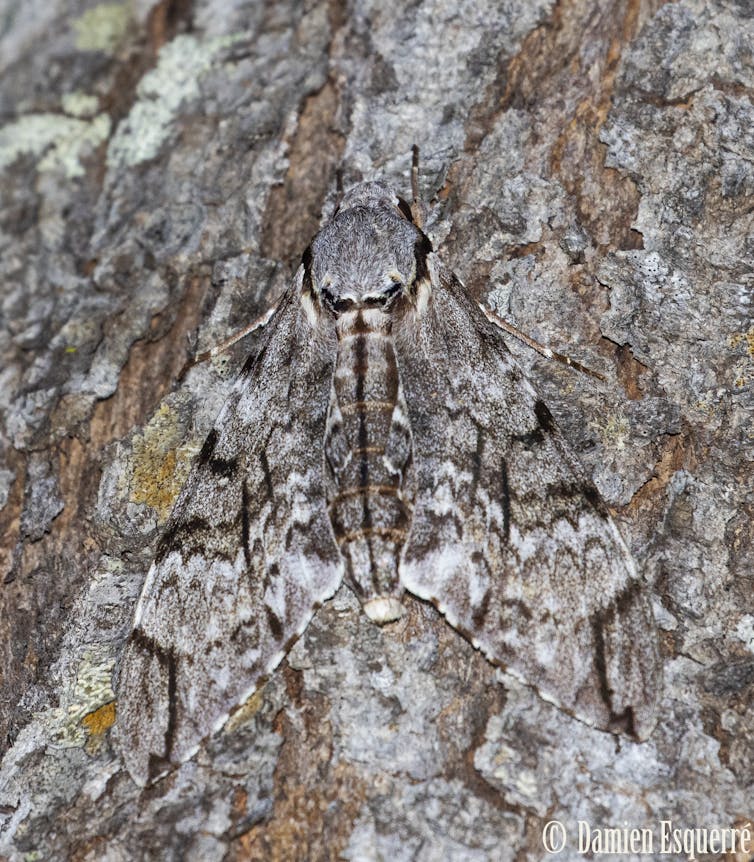
The animal world is incredibly colourful, and behind this colour palette is a constant game of survival.
Most animals use camouflage, covering themselves in stealthy patterns to hide from predators. Others display bright and bold colours to warn potential predators they are not a good meal. This second strategy is known as aposematism or warning colouration. Although less common than camouflage, it has evolved hundreds of times in butterflies, beetles, bugs, sea slugs, poison frogs and even birds.
One long-standing question is why species use one of these strategies over the other. Is one of these strategies usually more successful? Under which specific circumstances does one strategy beat the other? Our new study, published today in Science, helps answer these questions.

Testing multiple theories
Both camouflage and aposematism can co-exist in the same region. In Australia, for example, there are many examples of camouflaged insects such as the spotted predatory katydids and the lichen spiders.
On the other hand, species such as the cotton harlequin bug – a common stink bug found in urban areas – and the handmaiden moth display bright orange and red colours to advertise to predators they are not a pleasant meal. Some animals (but fewer) such as mountain katydids even use both strategies by changing colour, or hiding and revealing colourful patches.

There are dozens of theories about why some species are camouflaged instead of warningly coloured, and it is a challenge to pull these ideas apart.
Small localised studies have independently tried to test the effect of different factors separately. For example, we know light levels are important in the success of camouflage strategies. We also know the success of warning colouration often relies on predators having experienced the prey before, and having learned to avoid warning signals.
But is lighting or predator learning ability more important?
Results from a single place tell us about that place, but we see the same strategies all over the world. Do strategies perform the same way everywhere?
To solve this mystery, our large team of collaborators ran the same experiment in 16 different countries around the world, in different forests with different levels of light, and different prey and predator communities.
 Cotton harlequin bugs (Tectochoris diophthalmus) display bright orange and red colours to advertise to their predators that they are not a pleasant meal.
Thomas Wallenius
Cotton harlequin bugs (Tectochoris diophthalmus) display bright orange and red colours to advertise to their predators that they are not a pleasant meal.
Thomas Wallenius
15,000 paper moths
Together we deployed more than 15,000 artificial prey – paper moths – with three different colours: a classic warning pattern of orange-and-black, a sneaky brown that blends in, and an uncommon bright blue-and-black. Each paper target was baited with a mealworm, which allowed us to measure the survival of each type of colouration. If the bait was taken, we assumed a predator decided to consume that target.
The typical warning colour represented the widely distributed orange-and-black combination we see in many toxic animals, such as the monarch butterfly and poison frogs. The uncommon warning colour corresponded to a less used warning pattern that is still highly visible, similar to the Ulysses butterfly.
Having these two warning colourations allowed us to test whether predators avoid the orange-and-black signal because it is familiar or simply because it is highly visible.
We found there is no single “best” strategy. Instead, the local predators, local prey, and the forest light all contributed to whether camouflage or warning colours were most protective.
 The Ulysses butterfly uses striking blue-and-black colours to deter predators.
pamday4/iNaturalist, CC BY-NC
The Ulysses butterfly uses striking blue-and-black colours to deter predators.
pamday4/iNaturalist, CC BY-NC
The predators present in the community – and how intensely they attacked prey – had the biggest impact on which prey colour was most successful at avoiding attack. We found that in places where there were lots of predator attacks – where competition for food is probably intense – predators are more likely to attack prey that looks dangerous or distasteful. This means camouflage was most protective in areas with lots of predation.
But the camouflaged prey couldn’t hide as well in every environment. For example, in well-lit environments, the benefits of camouflage were lost, while light conditions did not affect how the orange-and-black prey performed.
Familiarity with prey was also important. In places where camouflaged prey is abundant, hiding was less effective, as predators likely learn how to find camouflaged prey.
On the other hand, in places where warning colours were common, predators were better at avoiding the typical warning signal, but not the atypical one. This suggests predators learn to avoid familiar warning signals, which helps to explain why so many animals share similar colour combinations.
 The spotted predatory katydid (Chlorobalius leucoviridis) uses camouflage to survive.
Amanda Franklin
The spotted predatory katydid (Chlorobalius leucoviridis) uses camouflage to survive.
Amanda Franklin
Predicting future changes
Our study shows how multiple features of the environment determine which strategy is more protective. It also shows the success of camouflage strategies might be more dependent on ecological context than that of warning signals.
As climate change transforms habitats, conditions that are vital to the success of different antipredator strategies can also change.
For example, camouflage strategies could fare worse in transformed habitats that have little vegetation cover and high levels of light.
Our findings can help better predict the effect these changes might have on animals that use different colour strategies against predators and mitigate against them.
Authors: Iliana Medina, Lecturer in Ecology, The University of Melbourne

















