

12 simple ways you can reduce bushfire risk to older homes
- Written by: Douglas Brown, Casual Academic, Western Sydney University
Seventy-five years of Australian research into how houses respond to bushfire has identified 21 main weak points in houses and the area immediately surrounding them.
In recent decades this knowledge has been used to inform new building construction. But older houses are generally not built to the same standard, unless they have been significantly renovated.
Older homes make up the majority of buildings in bushfire prone-areas. There are some simple things that can improve the performance of an older house in a bushfire. Here are 12 suggestions: six simple projects that could be done over a weekend or two, and six low-cost things you could do in a single afternoon.
Read more: Where to take refuge in your home during a bushfire
Six weekend projects:
1. Remove some garden beds next to the house
This is particularly true for garden beds near timber-framed windows and doors. For timber and fibro homes, garden beds adjacent to the house should be avoided entirely. At the very least prune dense bushes close to timber-framed windows back hard.
2. Sand and repaint weathered timber door and window frames
Over time, paint peels and cracks appear in the exposed and weathered timber. During a bushfire, embers can lodge in these cracks and ignite.
3. Enclose the subfloor with a metal mesh
Flammable items are often stored underneath the house. If this area is not enclosed these items will catch, often due to ember attack, and pose a threat to every room in the house. The exposed underside of timber floors can be protected with a lightweight, non-combustible layer.
Read more: Curious Kids: how do bushfires start?
4. Repair or replace weathered timber decking
Just as embers can land in cracks in door and window frames, the same can also happen to weathered timber decking. Most decks are right next to the house and if they go up fire easily spreads to the home.
5. Have a 1-2 metre non-flammable area immediately around your house
Think of it as an additional protective defence area. You could use gravel, paving tiles, bricks, concrete, or ground rock such as scoria.
6. Get a professional roof inspection
Roofs gradually weaken and require maintenance. A professional roof repairer can check that tiles are in place, repair damaged ridge tiles, and ensure that skylights, air vents, evaporative coolers, and solar panels are in good order and are free from gaps where embers could enter.
The product specifications for timber door and window frames, metal mesh, and decking materials can be found in the relevant Australian Standard and steel construction standard. Actual requirements for houses vary according to the bushfire attack level associated with a specific block of land.
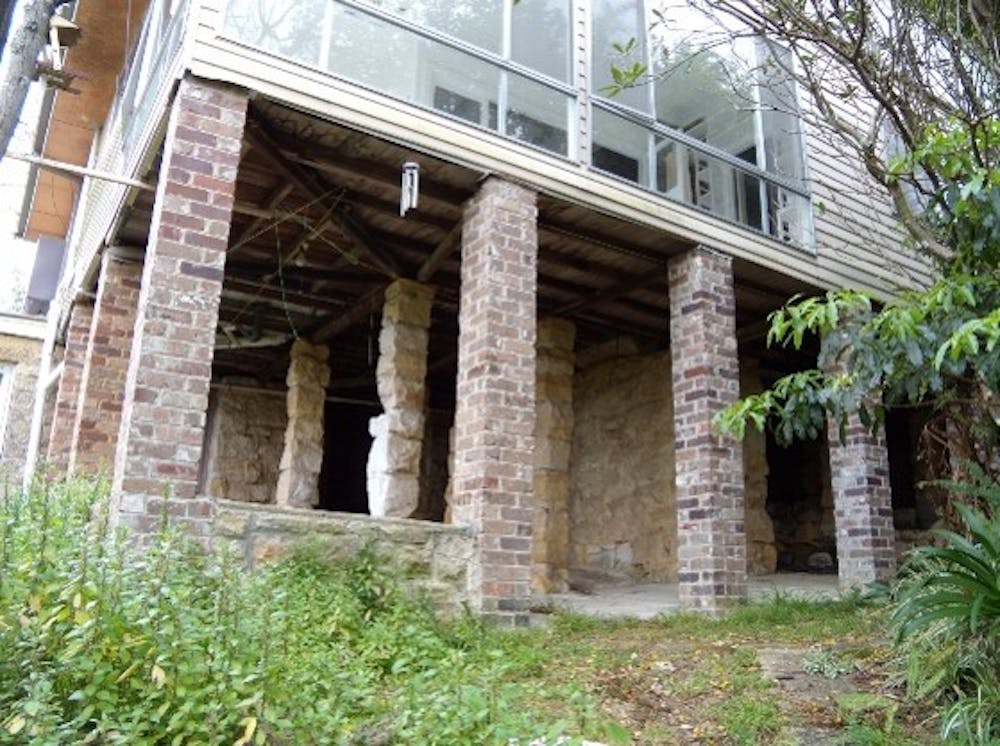 Open sub floor spaces are vulnerable, especially if used to store flammable material.
Douglas Brown, Author provided
Open sub floor spaces are vulnerable, especially if used to store flammable material.
Douglas Brown, Author provided
Six easy afternoon projects
1. Replace natural coil doormats with synthetic
While they appear harmless, natural organic doormats can cause a fire to grow if they ignite. Due to their density they burn for a long time, and can spread flames to timber door frames. A synthetic mat will only flare up for a short time.
2. Remove organic mulch from garden beds next to the house
Burning embers can easily ignite dried-out organic mulch, setting fire to surrounding plants. If garden beds are near the house, particularly timber door and window frames, the danger is increased. Either remove mulch in garden beds next to the house or – if the mulch is suitable – dig it in deeply.
3. Store firewood in an enclosed metal container
It is best to store wood well away from the house, but no one wants to walk metres in cold winters to get that wood. So some firewood is often stored close to the house on a burnable deck, and often it’s left there over summer. Putting it into a large metal container can remove that fire risk.
4. Remove flammable material from the front porch, roof cavity, decking and underfloor area
When embers enter the roof cavity and underneath the house, flames can rapidly spread to every room. It is vital to keep these areas clear of flammable materials.
5. Replace timber benches on timber decks with synthetic ones
A timber bench on a timber deck next to a timber house is an unnecessary risk, similar to having a wood pile on a timber deck.
6. Turn pressure relief valves on outside gas bottles away from the house
Both the 2003 Canberra and the 2016 Wye River bushfires showed the danger of having gas bottle valves facing the house. In both fires, houses were destroyed when either the gas plume flamed or gas bottles exploded.
While these projects will improve the bushfire protection of your home, they can’t guarantee your home will survive a bushfire, especially during catastrophic bushfire conditions. It is also crucial to upgrade your home insurance so you can meet the higher costs of new building standards, in the event you have to rebuild. And in all cases, act on warnings given by your state or territory fire authority.
The advice given in this article is general and may not suit every circumstance.
Authors: Douglas Brown, Casual Academic, Western Sydney University
Read more http://theconversation.com/12-simple-ways-you-can-reduce-bushfire-risk-to-older-homes-122712


















