

New research shows Chinese migrants don't always side with China and are happy to promote Australia
- Written by: Wanning Sun, Professor of Media and Cultural Studies, University of Technology Sydney
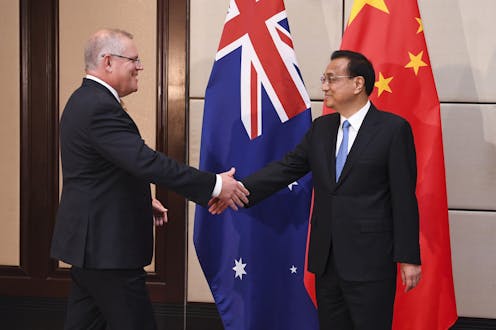
The Australian government has indicated that “diaspora communities” are crucial to Australia’s public diplomacy mission to promote the country abroad. It has also identified online and social media as essential “public diplomacy tools”.
But in terms of projecting an attractive image of Australia to potential tourists, students and investors in China, the task is not that simple.
Too often, the Department of Foreign Affairs and Trade’s earnest soft power goals are undermined by various political agendas and concerns over foreign interference and national security.
As for the media, the ABC has attempted to connect with Chinese audiences by offering some of its online content in Mandarin. But the ABC’s coverage can still feel alienating to Chinese migrants. This stems from a feeling that much of its reporting conforms to a pre-determined narrative of the danger of China’s rising influence in the country.
Read more: How Australia’s Mandarin speakers get their news
What Chinese migrants think of Australia
The role of Chinese migrants in public diplomacy, meanwhile, is little understood.
Earlier this year, we conducted a survey of more than 800 Australia-based, Mandarin-speaking social media users as part of a study of Chinese-language digital and social media in Australia.
Our aim was to determine how Chinese migrants view both Australia and China, how news coverage of both countries shapes these views, and whether they feel they have a role to play in promoting either country.
Read more: Morrison says China knows 'where Australia is coming from', after meeting Chinese vice-president
We asked participants whether they have generally positive views about their experience of living or studying in Australia and how often they share these views with potential Chinese visitors or migrants to Australia.
Perhaps surprisingly, our survey respondents answered with a resounding “yes”, despite the alienation they sometimes feel from English-language media and a sense their allegiance to Australia is regularly being questioned.
When asked how often they share positive stories about Australia via Chinese social media platforms, 72% of respondents said they often or sometimes shared such information.
A similar level of pro-Australian sentiment was evident when participants were asked how often they share negative stories about Australia from the local Chinese media or English-language media. (For example, stories about the high cost of living, racism against Chinese or the boring lifestyle.) Nearly 77% said they rarely or never share such stories.
When asked with whom they share positive or negative stories about Australia, nearly two-thirds said “Chinese people living in China”, while 28% said Chinese immigrants living elsewhere in the world.
Interestingly, our survey participants’ willingness to promote Australia to Chinese people worldwide did not mean they had negative views about China. Nearly 80% said they would also be willing to promote China to Australians as a tourist destination or potential place for business opportunities.
Not overly pro-China on sensitive issues
This speaks to the ability of Chinese migrants to sustain dual loyalties to Australia and China, without much apparent conflict between the two.
Our respondents also showed a considerable degree of sophistication in their views on China–Australia relations and issues the Australian media typically present in a polarising manner. When asked whether they sided with China or Australia on these issues, we saw an interesting split.
For example, a significant number of participants said they sided with China in relation to disputes over Huawei (73%) and the South China Sea (79%). However, support for China was dramatically lower in relation to China’s influence in Australia (40%), trade disputes (38%) and, perhaps most surprisingly to many Australians, human rights (just 22%).
Even though they didn’t back China on these last four issues, participants didn’t give their unambiguous support to the Australian viewpoint, either. The number of respondents who chose “not sure” on these four issues ranged between 32% and 45%.
Human rights was the only issue where more respondents sided with the Australian viewpoint rather than China’s (46% compared to 22%).
Negative news on China leads to unhappiness
Similarly, when respondents were asked how they felt about negative news about China or the Chinese government in the Australian media, they expressed a range of opinions.
Respondents were nearly equally split on the fairness of such reporting, with 27% saying they felt the Western media portrayed China in an overly negative light and 22% saying they felt such reporting allowed them to know the truth about China.
The most popular response, however, was telling: 35% of participants said they felt unhappy because of the hostility of the Australian media to China, regardless of whether or not the reporting was truthful.
This suggests that while most Chinese-Australians are generally supportive of Australia, the mainstream media’s narrow focus on China’s influence seems to impact negatively on their happiness and overall feeling of connectedness with Australian society.
Read more: Megaphone diplomacy is good for selling papers, but harmful for Australia-China relations
What this means for public diplomacy
Overall, Chinese migrants in Australia are spreading a positive message about the country voluntarily. They do so without any support from the Australian government, and despite the often negative reporting about China in the Australian media and hyperbolic public aspersions cast on them.
Based on our findings, it would behove the Australian government to try and find ways to harness this largely bottom-up, pro-Australian, word-of-mouth energy in the service of public diplomacy.
This is especially important now, given the dire state of diplomatic relations between our two countries.
Authors: Wanning Sun, Professor of Media and Cultural Studies, University of Technology Sydney


















