

What’s the difference between moths and butterflies? Look at their antennae
- Written by Caitlyn Forster, Associate Lecturer, School of Life and Environmental Sciences, University of Sydney
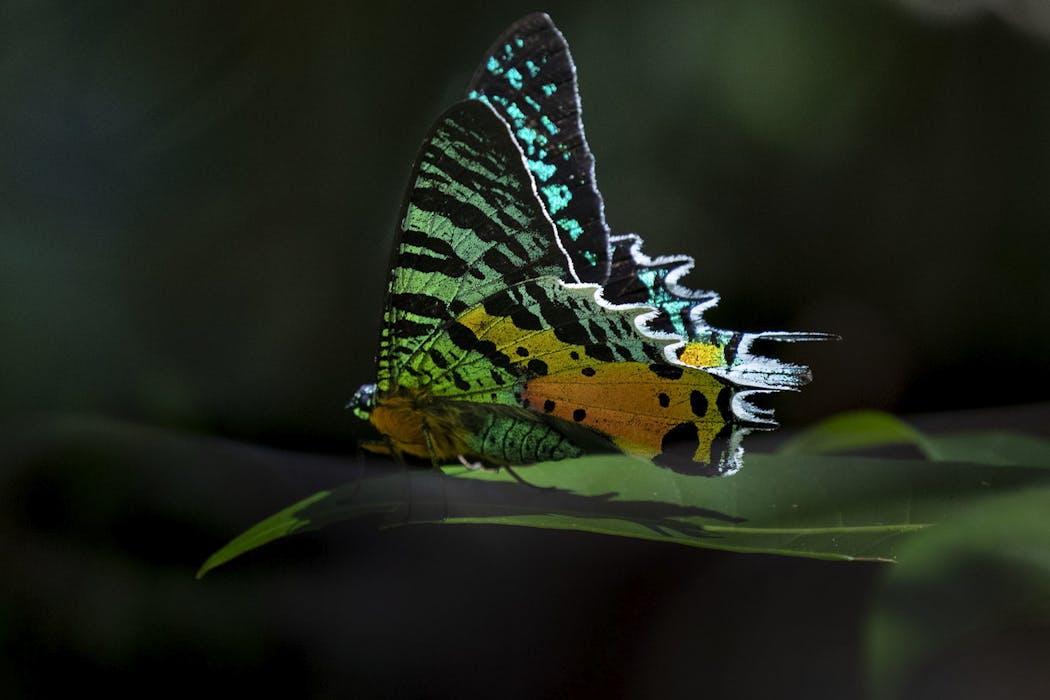
As the weather starts to warm in Australia, you might notice the pleasant flutter of butterflies in your garden during the day. And perhaps if you’ve left a porch light on during the night, you will see a flurry of moths have gathered around it.
To an untrained eye, these fluttering insects can seem similar. And indeed, both are from the order of insects called Lepidoptera, which roughly translates to “scaly wings”. That’s because the wings of butterflies and moths are covered in microscopic scales. These scales are important for providing these insects with their beautiful colours, and they’re the cause of the “dust” that often comes off moths when handled or found in the back of a pantry.
But there are some key differences between these two kinds of creatures. So what makes a moth a moth and a butterfly a butterfly?
What is a moth?
When we think about moths, we’re often thinking about little, brown, (definitely not) boring insects in our pantries, and flying around our porch lights. However, there is so much variation in this group of insects, given there are about 22,000 species in Australia.
Moths generally have straight antennae. But if they’re males, their antennae are often fluffy and feather-like. These fluffy antennae are used to help them find mates from large distances.

Most moths are nocturnal, preferring to fly at night. And many flowers are adapted to be pollinated by night-flying insects such as moths. Dragonfruit, for example, benefit from pollination by moths and the flowers bloom at night.
Because they fly at night, moths can’t use the same visual cues, such as sunlight, that butterflies use to navigate. Instead, they use a range of non-visual cues to know where they are in the dark. For example, Australian bogong moths, which can travel up to 1,000 kilometres during their migrations, are known to use magnetic fields and stars to navigate.
Many moths are excellent at camouflage. Historically, there have been stories surrounding how peppered moths became darker due to the industrial revolution, but there are much more impressive moths! For example, moths from the genus Eudocima manage to look like a curled leaf with completely flat wings. Bee hawk-moths can trick us into thinking they’re bees.
Due to the significant amount of time they spend camouflaging and travelling at night, there’s less value to moths to be extremely colourful. So many moth species are duller in colour than their flamboyant cousins, the butterflies.
They’re also less hungry. Generally speaking, lepidopterans have a long coiled mouthpart to help them feed on nectar (and sometimes other things, including corpses).
However, many moths spend so much time feeding as caterpillars, that as adult moths they don’t have mouthparts. They live short adult lives that include mating and starving to death.

What is a butterfly?
Butterflies are the charismatic, popular members of the insect world, and with good reason. They come in a range of colours, and can be large and relatively easy to see. However, there are a lot less butterflies in Australia compared to moths, approximately 450 species.
So what makes a butterfly a butterfly?
The main factor that determines a butterfly is its clubbed antennae. Unlike those of moths, butterfly antennae consist of a long thread with a bead at the end. However, this can be pretty hard to see while they are fluttering around!
Butterflies are also day flying. This drastically changes how they look and behave in comparison to moths. Butterflies come in a range of bright and beautiful colours because they can be seen during the day.
Some butterflies are colourful simply to attract mates. Some, such as monarch butterflies, have aposematic displays, which aim to warn off predators by advertising the butterfly’s potential to be poisonous. Others, such as European swallowtails use deimatic displays, aimed to startle predators by imitating something scary like a face.
There are also examples of caterpillars that mimic bird poo, but that’s less of a defining factor.
 The monarch butterfly (Danaus plexippus) has orange and black colouring to warn off predators.
dbrudin/iNaturalist, CC BY-NC-ND
The monarch butterfly (Danaus plexippus) has orange and black colouring to warn off predators.
dbrudin/iNaturalist, CC BY-NC-ND
There are always exceptions to the rules
We can’t talk about moths without discussing some of the species that don’t necessarily follow all the rules. There are many brightly coloured moths, including the Madagascan sunset moth and the heliotrope moth.
To make things more confusing there are also groups of moths that have hardly any scales on their wings, including clearwing moths.
Not all moths fly around at night, either. Tiger moths, for example, are frequently seen flying during the daytime, and are brightly coloured.
So sometimes, it can be really hard to determine where the line is between a moth and a butterfly.
 The white antennae wasp moth (Amata nigriceps) is commonly seen during the day.
mattcampbellaus/iNaturalist, CC BY-NC-SA
The white antennae wasp moth (Amata nigriceps) is commonly seen during the day.
mattcampbellaus/iNaturalist, CC BY-NC-SA
How can we help moths and butterflies?
Our fluttering insects face many threats, including pesticide use, climate change and habitat loss. Planting a range of flowers in your garden can help provide food and habitat for moths and butterflies.
You can also get involved in citizen science, by uploading sightings of insects you see on apps like iNaturalist. If you’re interested in learning more about the grand travel of bogong moths, take photos of ones you see and upload them to Bogong Watch.
Authors: Caitlyn Forster, Associate Lecturer, School of Life and Environmental Sciences, University of Sydney

















