

How do Triple Zero calls actually work? A telecommunications expert explains
- Written by: Mark A Gregory, Associate Professor, School of Engineering, RMIT University
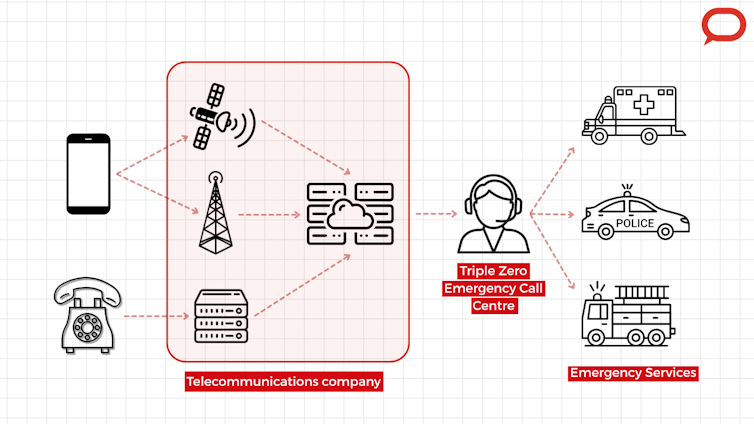
Making a call to triple zero (000) for a life threatening or time-critical emergency is something most of us learn how to do when we first use a phone.
But do you know how a Triple Zero call actually works?
While it might seem simple, there are many steps involved between you calling Triple Zero, and paramedics, police or firefighters arriving to help. And as the recent Optus Triple Zero outage that left multiple people dead highlights, there are also several points of potential failure.
A federal responsibility
First, some important background.
The federal government is responsible for telecommunications nationally. It has put in place legislation and regulations for the operation of Emergency Call Services – the technical term for Triple Zero.
The Australian Communications and Media Authority regulates and monitors the provision of Triple Zero under Part 8 of the Telecommunications (Consumer Protection and Service Standards) Act 1999.
The first step
The very first step in the process is, of course, a person making a call to Triple Zero – or the international emergency number (112). People with a speech or hearing impairment can also use the 106 text-based service, provided by the National Relay Service.
You don’t need a sim card to call Triple Zero – nor a plan with a mobile phone company. However, you do need to be within an area with some network coverage.
Mobile phones connect to phone towers using radio waves that oscillate at a frequency within one of the spectrum bands allocated for mobile networks. The transmission equipment located on the phone tower receive the signal being carried on the radio waves and convert it into digital data. This data is then carried across the mobile phone core network via optic fibres (or sometimes microwaves or satellite) to its destination.
Sometimes your network provider – for example, Optus, Vodafone/TPG or Telstra – may have no coverage where you are, but another network provider will. If this case, you will see an “Emergency calls only” message on your phone, and your call will be sent through an alternative network. This process is known as “camp-on”.
But this process can sometimes fail, as the recent Optus outage demonstrated. It was caused by an upgrade to a key system which only affected the Triple Zero network – not the regular network. Optus’s mobile towers did not stop transmitting – or, in technical terms “wilt”. This prevented Optus phones from connecting to the Telstra or Vodafone mobile networks to make Triple Zero calls.
This was similar to another Optus Triple Zero outage – one that thankfully didn’t have fatal consequences – that occurred in November 2023 that resulted in a national outage of the entire Optus network.
But if you find yourself within the 5 million square kilometres of Australia currently without any mobile coverage at all, you will not be able to make a Triple Zero call.

What happens next?
The Triple Zero call (provided it goes through) then goes to the nominated emergency call service operator in Australia – currently Telstra. It is responsible for the system that connects calls from the telecommunication carrier networks to the state and territory emergency service organisations.
To fulfil this responsibility, Telstra has Triple Zero emergency service call centres located around Australia.
After answering the Triple Zero call, a call centre operator will ask the caller about the emergency at hand, then transfer them to the relevant emergency service organisation, such as the ambulance, fire or police.
Trained personnel will then handle the call and dispatch an emergency response team.
How is Triple Zero going to improve?
A review of the November 2023 Optus national outage identified the need for a Triple Zero custodian. The custodian would be responsible for overseeing the efficient functioning of the Triple Zero ecosystem, including monitoring the end-to-end performance of the ecosystem.
Earlier this week, the federal government introduced legislation to parliament to enshrine the powers of the custodian into law. Under this legislation, the custodian will be able to demand information from telecommunications companies such as Optus. This will enable it to not only monitor Triple Zero performance, but also identify risks and respond more quickly to outages.
Direct-to-device mobile technology is also currently being developed which will enable calls to Triple Zero that are connected through Low Earth Orbit satellites. This will be a major improvement to safety nationwide – particularly for people living in regional and remote areas, and during emergencies such as fires and floods.
Earlier this year, an amendment to the Telecommunications Act 1997 passed Parliament that enhances consumer safeguards. These safeguards include strengthening mobile network operator obligations.
Last month the federal government also released draft legislation for a universal outdoor mobile obligation. This would require mobile operators to provide reasonable and equitable access to outdoor mobile coverage across Australia.
So hopefully in the next couple of years, Australians should be able to make calls to Triple Zero – no matter where they find themselves.
Authors: Mark A Gregory, Associate Professor, School of Engineering, RMIT University

















