

Why Trump is not a death knell for global climate action
- Written by: Matt McDonald, Professor of International Relations, The University of Queensland
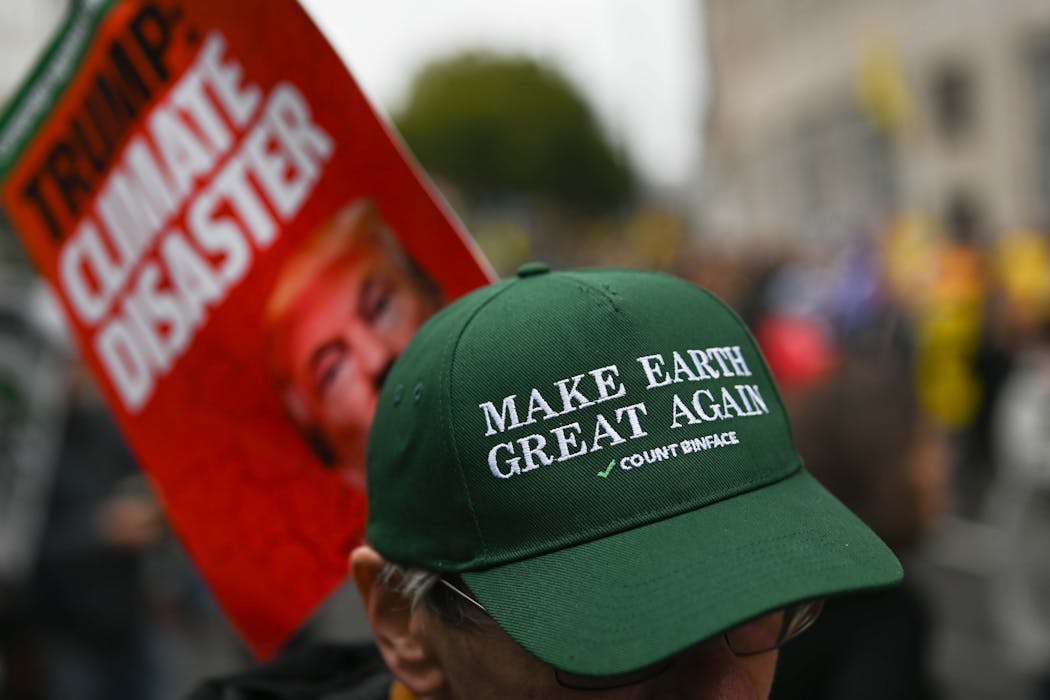
In his rambling speech to the United Nations last month, United States President Donald Trump described climate change as “the greatest con job ever perpetrated on the world”.
Of course, this claim was unfounded, ignoring the overwhelming scientific evidence that climate change is occurring.
It was also unlikely to convince gathered dignitaries, who appeared bemused by a speech better suited to a campaign rally than a presidential address to world leaders.
But coming on the eve of the crucial global COP30 climate talks in Brazil, the speech does raise the question: what does the second Trump administration mean mean for international climate action?
Trump digs coal
Beyond enabling climate denialists and disinformation peddlers, Trump has ultimately delivered on his campaign promise to aggressively support the US fossil fuel sector. In his words: “drill, baby, drill”. Or, more recently: “mine, baby, mine”.
Soon after his inauguration, Trump signed an executive order to withdraw the US from the Paris Agreement, the legally binding UN treaty aimed at limiting global temperature rise well below 2°C degrees over pre-industrial levels.
Last month, Trump announced a plan to open up 13 million acres of federal land for coal mining, and offered hundreds of millions in federal subsidies for coal projects.
He has ordered the removal of climate data from government sites and all but eliminated direct government funding for climate science research and monitoring.
And he has gutted the Inflation Reduction Act, the signature climate initiative of the Biden administration that was designed to stimulate large-scale investment in renewable energy.
All told, Trump’s initiatives are likely to mean an additional 7 billion tonnes of emissions will be created compared to a scenario where the US met its Paris commitments.
This is bad news. But what implications will it have for international climate cooperation?
Dark clouds on the climate horizon
Clearly, 7 billion tonnes of additional emissions is a problem. By some accounts, this represents around one fifth of the global carbon budget if we are to keep to the Paris target of under 2°C.
And when the world’s most powerful state, largest economy and second-largest greenhouse gas emitter walks away from the United Nations Framework Convention on Climate Change (UNFCC), it does not bode well for international climate action.
Of course this raises the question of how the Brazilian climate talks organisers can motivate states to adopt strong emissions targets when wealthy, high-emitting countries walk away. There is a real risk the US position takes the pressure off other high-emitting countries, such as the Gulf States and Russia, who are disproportionately responsible for the problem.
Finally, climate finance – financial resources used to support action on climate change – looms once again as a crucial issue at climate negotiations. Securing sufficient funding will be far more complicated given Trump’s “America First” platform, which prioritises foreign and domestic policies serving US interests.
Despite this, there are still grounds to be optimistic.
Leadership without the US
A first point in the case for cautious optimism is that global emissions have potentially peaked and are on the verge of decline for the first time since the Industrial Revolution.
This has been driven by unprecedented global investment in renewable energy. The energy market is changing rapidly despite aggressive US subsidies for the fossil fuel sector. Global energy investment is likely to top A$1.5 trillion in 2025. Meanwhile, coal, oil and natural gas will see the first decline in global investment since the COVID pandemic.
There are also signs other countries, like China, view the US position as an opportunity. Last month Beijing outlined a target for emissions reduction (7–10% by 2035) for the first time in its history. Even though China is still adding to its fleet of coal-fired power stations, it is also adding more solar and wind capacity than the rest of the world combined.
China may want to make a case for itself as a responsible global leader in contrast to the US. This could in turn advance China’s strategic interests in regions such as the Pacific which are acutely vulnerable to climate effects.
So far, there’s no evidence countries have used US backsliding as an excuse to pull back from international cooperation. No country has left the Paris agreement since Trump’s withdrawal.
In 2001, when the Bush administration signalled the US wouldn’t ratify the Kyoto Protocol, Australia’s Prime Minister John Howard soon followed suit.
But in 2025, only months after the US withdrew from Paris, Prime Minister Anthony Albanese outlined an increased emissions target.
Even at home, Trump’s position has not amounted to a death knell for climate action. California, whose governor Gavin Newsom famously parodied Trump’s communication style on social media, already oversees one of the world’s largest emissions trading schemes and has entered into a climate partnership with Brazil to further cooperation ahead of COP30.
All in all, there are grounds for cautious optimism, even hope, that the rest of the world might band together without US leadership.
Eyes on COP
Negotiators at next month’s COP30 talks will face formidable challenges which have only become more pressing as a result of the Trump administration’s climate stance.
But past experience suggests hard-fought COP negotiations can build strong momentum for global action by focusing international attention.
Perhaps they can build pressure on the US to come back into the fold, or at least enable pro-climate actors within the US to pursue reform despite President Trump’s interference.
Authors: Matt McDonald, Professor of International Relations, The University of Queensland
Read more https://theconversation.com/why-trump-is-not-a-death-knell-for-global-climate-action-266350


















