

If government bailouts of companies are the new normal, we need a better strategic vision
- Written by John Quiggin, Professor, School of Economics, The University of Queensland
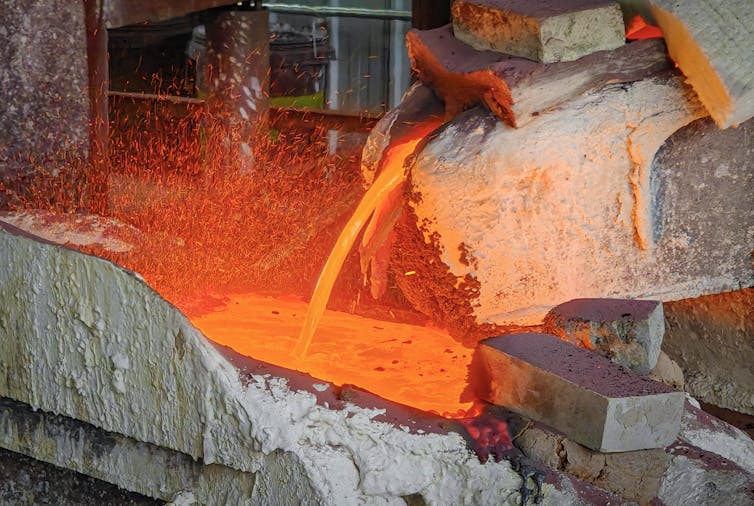
The federal government’s announcement of a A$600 million rescue package for Glencore’s copper smelting and refining operations in Mount Isa and Townsville marks a definitive shift in Australia’s industry policy.
The announcement follows the $2.4 billion rescue of the Whyalla steelworks, and a smaller assistance package for metals smelter Nyrstar.
At the time it was announced, the Whyalla rescue could be seen as a one-off special case. The steelworks’ owner, Sanjeev Gupta, had run into financial difficulties associated with the collapse of its major financier, Greensill Capital. The rescue plan included support for a transition from unsustainable blast furnace technology to “green steel”, though this remains problematic.
By contrast, Swiss giant Glencore is a highly profitable corporation that has made a business decision to close its copper operations. The bailout will keep those operations going for three years, after which the same issue will likely re-emerge.
In combination with the Nyrstar bailout, we now see an expectation that federal and state governments will undertake such rescues regularly, on a 50-50 cost-sharing basis.
A final break with neoliberalism
This shift marks a final break with the policy framework (variously called “neoliberalism” or “economic rationalism”) under which intervention of this kind was seen as an undesirable “distortion” of the market, to be undertaken only in emergencies, if at all. The underlying assumption was that market signals would yield the most efficient allocation of resources.
This shift is not occurring in isolation. Neoliberal ideas have been in retreat since the global financial crisis of 2008.
China has presented its own, state-led model as a superior alternative, and has sought to use control of “critical minerals” as an instrument of geopolitical strategy. Its plan last week to tighten export controls on critical minerals sparked an angry response from US President Donald Trump, who threatened to impose 100% tariffs on China in retaliation.
The US has been backing away from free-trade ideas since the election of the first Trump administration in 2016, and has now abandoned them altogether.
More questions than answers
But it is one thing to abandon the dogmas of neoliberalism. It is quite another to develop a coherent alternative.
A framework that includes bailouts of mineral processing operations as a routine policy tool raises some major questions.
- What are the criteria for such a bailout?
- What, if anything, should the public receive in return?
- What (presumably) unintended consequences arise if failing operations receive assistance, while their competitors do not?
In the light of recent policy discussions, it might seem sensible to focus on minerals deemed “critical” in the context of digital technology and the clean energy transition. Australia maintains a list of these minerals.
However, the recent rescues have been for minerals (iron, lead, zinc and copper) not on this list, although both zinc and copper are classed as as “strategic”.
Looking at evidence from the United States, United Kingdom and European Union, as well as Australia, is unhelpful, as it expands the list of minerals considered “critical” in at least one major jurisdiction to well over 50 elements. Only a handful of naturally occurring metals (including silver, cadmium, gold, mercury and technetium) fail to make at least one of these lists.

Tough choices need to be made
If we are to have a policy based on strategic support of mineral smelting, we will need a much more stringent test, and some hard choices as to which minerals really matter.
In particular, do the aluminium smelters established with substantial government support in the 1980s merit a renewed round in the face of sustained oversupply? Or should we let the US industry, now protected by high tariffs, take the burden of challenging China’s dominance?
Mining giant Rio Tinto is currently in talks with the federal and New South Wales governments to avert the shutdown of the nation’s largest aluminium smelter in the Hunter region. There is also concern the accelerated retirement of the Gladstone power station may imperil Rio Tinto’s Boyne smelter.
The provision of assistance to highly profitable companies such as Glencore and Rio Tinto raises further questions. For example, should such assistance require a return to the public, such as the government taking an equity stake in the company concerned?
Alternatively, we might consider that assistance for mineral processing only makes sense if the minerals in question will one day be more scarce and costly than they are now.
Should we set an advance requirement for a higher return to the public in periods of high prices, as Queensland has done with coal?
Finally, should strategic efforts of this kind be coordinated with allies, and if so, which allies? In the past, it would have been natural to line up with the US against the possibility of trade coercion from China. But now, at least in trade policy, the US is more adversary than ally.
We need to explore regional partnerships with friendly neighbours such as Indonesia and (slightly further afield) South Africa.
Like it or not, the days of free-market trade policy and a rules-based international order are over. If we are not to stumble on with ad hoc bailouts, Australia needs a new strategic vision.
Authors: John Quiggin, Professor, School of Economics, The University of Queensland

















