Google AI


Modern Australian

Two true crime books on the mushroom trial are out – one is told by a fictional juror

  • Written by: Rick Sarre, Emeritus Professor in Law and Criminal Justice, University of South Australia
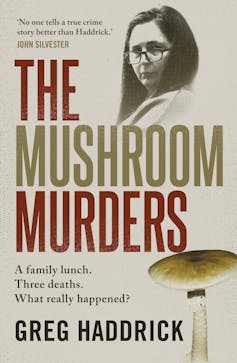
Two true crime books on the mushroom trial are out – one is told by a fictional juror

Two books on the recent Erin Patterson trial have just been published, both by experienced true crime writers. Both are meticulously researched (primarily relying on the transcripts of evidence), well written and eminently readable. The timing of their publication is remarkable, given it’s only been a month since the sentencing. Having said that, neither book seems rushed.

Greg Haddrick, who writes from the perspective of “a fictional juror” in The Mushroom Murders, also wrote In the Dead of Night, about the 2020 murder of Russell Hill and Carol Clay in Victoria’s remote Wonnangatta Valley. Duncan McNab, author of Recipe for Murder, is a former detective, a private investigator (specialising in criminal defence) and an investigative journalist.

Review: The Mushroom Murders – Greg Haddrick (Allen & Unwin); Recipe for Murder: The poisonous truth behind Erin Patterson – the mushroom murderer of Leongatha – Duncan McNab (Hachette)

I enjoyed both books immensely – not for the horror of the tale itself, but for the insightful way they tackle this most intriguing story. Neither book offers anything new by way of evidence, as what is written is all on the public record. But readers will nevertheless find a great deal to interest them in the narrative of both authors, especially their descriptions of the legal wranglings and media frenzy.

Haddrick’s imagined perspective as a (female) juror who runs a (fictitious) picture-framing business in Morwell is an intriguing literary device. He is careful to advise readers that he neither approached nor spoke to any of the real jurors. Indeed, the law does not allow such an approach, given the requirement of the confidentiality of their deliberations.

The entire book is narrated by this fictional person. “I wanted readers to feel they were on that journey with the jury,” Haddrick explains in his preface. All the evidence, he says, “comes directly from, and only from, the evidence those jurors heard and saw during the trial”. Some readers may find his choice of storytelling technique somewhat disingenuous, but the narrative gives the book an impressive immediacy.

Haddrick writes, again in his preface: “Like all of us, our narrator has her own strengths, flaws and opinions, and she does speculate. But where she does engage in speculation, it is clearly identified as separate from the evidence that leads to her verdict — and it reveals some surprising insights into police methodology along the way.” True, there is much written about some very impressive policing, but I found none of it surprising.

On the first page of Haddrick’s book, we read: “A family lunch. Three murders. What really happened?” One might opine that it’s a tad misleading to state that a book narrated by a fictional juror and engaging in speculation regarding (her) thought processes can tell us “what really happened”. But this gradual, unfolding narrative from the perspective of an (albeit imaginary) juror remains a compelling tale if the reader is happy to suspend disbelief and see the trial through her (fictional) eyes.

Does this literary device pose an ethical issue? Perhaps so (especially if it leads to misleading understandings of the facts or the law), but in the legal sense there is no difficulty as long as it’s clearly explained.

The setting

On July 29 2023, in the small rural Victorian town of Leongatha, members of Patterson’s extended family sat down for a casual Saturday lunch of beef Wellington. As Haddrick quips in his opening pages, this has become the most talked-about meal since the Last Supper.

The next day, all four guests were hospitalised. Within a week, three of them were dead: Erin’s mother-in-law Gail Patterson, her husband Don Patterson, and Gail’s sister, Heather Wilkinson. Ian Wilkinson, Heather’s husband, was fighting for his life.

When Patterson was arrested and charged with their murders, the case captured media attention around the world. After a trial that lasted 11 weeks and produced 3,500 pages of transcript, a jury of 12 (seven men and five women) determined she had deliberately poisoned her estranged husband’s parents, and his aunt and uncle, leading to the deaths of three of them and the life-threatening illness of the fourth.

As McNab writes,

Patterson’s cruelty in watching four people who had been nothing but kind and loving to her eat a meal she knew would kill them was the ultimate act of betrayal.

Mushroom murders – a fictional juror’s view

Haddrick’s The Mushroom Murders principally tells what was going through the mind of his fictional juror as she heard the evidence. Readers interested in the way criminal evidence is presented will get a clear picture of that process. His speculation of the iterative process that possibly goes through a juror’s thinking as the evidence unfolds is well constructed. But it is only speculative.

The first third of the book takes readers through all the evidence of Erin’s relationship with her estranged husband, Simon. It was a fractured and, at times, tempestuous marriage. It is easy to gloss over this narrative since it reads like Days of Our Lives, but it is important in the story. At this stage, the fictional juror is entirely sympathetic to Erin, taking to heart the trial judge’s reminder to the jury, in his preliminary remarks, of the importance of the presumption of innocence. But as the story continues and the beef Wellington is served (it arrives halfway through the book), the tempo increases. With a third of the book to go, Haddrick has his juror thinking that sticking with “Team Erin” was becoming more difficult. It was getting harder and harder to keep “presuming innocence”. At so many moments in the story, there were no reasonable explanations for her behaviour compatible with innocence. Those moments continue all the way to the book’s conclusion. Haddrick’s epilogue is devoted to the post-trial release of evidence that had been excluded (and charges dropped) regarding three allegations that Erin attempted to poison Simon during their marriage. His narrator’s strong opinion is that the trial judge’s ruling in a preliminary hearing to exclude these allegations from the trial treated the jury as mugs. I know we had been told at the beginning of the trial to put those dropped charges out of our minds, but I’m sorry. If it leads to a situation like this, where the blindingly obvious question never gets asked, that’s just legal nonsense. That might be his fictional juror’s feeling, but Justice Beale’s direction in the preliminary hearing had been vindicated by a three-member Court of Criminal Appeal. The law on this subject is clear: the High Court ruled in 1995 that prejudicial evidence (such as the unsubstantiated allegations regarding three earlier attempts to poison Simon) is inadmissible unless the judge considers that evidence has very strong probative value, that is, evidence sufficiently useful to prove something important in the case at hand. In this case, he did not. If those charges were to be pursued, that would need to happen in a separate trial. Recipe for Murder Duncan McNab’s Recipe for Murder does not have the first-hand immediacy of The Mushroom Murders, but it, too, is compelling. Indeed, some readers may find McNab’s analysis more insightful, as it is not underpinned by Haddrick’s literary musing.
McNab’s book shares a similar structure to Haddrick’s. There is a description of the family, their church, the often fractured relationship between Simon and Erin, their multiple marital separations, their children, their Christian faith (or, in Erin’s case, ostensible atheism) and their finances. McNab takes readers through the evidence of Erin’s fascination with true crime, and her ill-health self-diagnoses (including ovarian cancer and heart issues). He describes her relationships with her own parents, both deceased. In messages to friends, he reveals, Patterson called her mother “essentially a cold robot” and said “Dad was a doormat”. He also reveals her propensity to be loose with the truth, including her being sacked from her job as an air traffic controller for lying about her work hours. He departs from the formal record of the trial evidence in explaining Justice Beale’s ruling in the fast-tracked preliminary hearing, namely that the allegations relating to Simon’s previous illnesses (the alleged attempted poisonings) could not be tried in the “beef Wellington” trial. Moreover, he explains the ruling on the location of the trial (Morwell, not Melbourne), noting that under the Victorian Criminal Procedure Act unless there are strong reasons related to unfairness, the trial should take place at the court most proximate to where the alleged offending occurred. (By contrast, Haddrick’s book does not deal with the reasoning in these preliminary matters at all.) Next in the McNab narrative comes the meal, the deaths, and the investigations, including a close look at the forensic science evidence, such as the sighting of deathcap mushrooms growing in rural Victoria, and Erin’s phone being “pinged” in the vicinity. Then follows the funerals – and inevitably, the arrest of Erin Patterson. Because he is writing with the value of hindsight, McNab is never in doubt about the correctness of the verdict. Read one, not both Recipe for Murder is significantly more detailed than The Mushroom Murders in relation to the summing up to the jury by prosecution counsel, defence counsel and finally the judge. This process would take nearly six days once the examinations in chief, the cross examinations and reexaminations finally came to an end. On day 40 of the trial, the jury (after the balloting out of two jurors, to reduce the number to 12) retires to consider its verdict. It returns nearly six days later with guilty verdicts on all four charges. Surprisingly, neither author makes any comment that this was an extraordinarily lengthy process, other than McNab’s quip that there was “a vast amount of evidence.” Yes, that may be true, but as both authors admit, that evidence was very persuasive. Importantly, Recipe for Murder then pays significant attention to the victim impact statements. There were 28 tendered to the court, seven of them read aloud; some, like Ian Wilkinson’s, by their authors; some, like Simon Patterson’s, by proxies. Simon’s statement referred to his children: Like all of us, they face the daunting challenge of trying to comprehend what she has done. The grim reality is they live in an irreparably broken home with a solo parent when almost everybody knows their mother murdered their grandparents. A grey-haired man with a backpack. Ian Wilkinson pictured outside the Supreme Court of Victoria in August. Con Chronis/AAP Directing his attention to the sentencing hearing, McNab tells us Justice Beale heard from defence counsel that Erin would likely spend 22 hours a day in her cell. Beale took that into account. There was to be, he announced, three life sentences (the maximum penalty under Victorian legislation) to be served concurrently. The non-parole period was set at 33 years. (The Victorian Director of Public Prosecutions is now appealing that non-parole period on the basis that it was overly lenient.) McNab concludes his discussion of the sentencing remarks with suitably understated drama: “An emotionless Erin Patterson was led from the courtroom.” Both books are commendable. But there is no value in reading both, as they cover much of the same material. If I had to pick one as a tool for teaching students the art of examination (and cross examination) of witnesses, and the processes of trial, verdict and sentencing, McNab’s Recipe for Murder would be my choice. A third book on the trial will be published next month – The Mushroom Tapes, by Helen Garner, Chloe Hooper and Sarah Krasnostein. It is clear there is more for us to read, and perhaps learn, about what unfolded in the Victorian Supreme Court, sitting at Morwell, during the winter of 2025. Authors: Rick Sarre, Emeritus Professor in Law and Criminal Justice, University of South Australia

Read more https://theconversation.com/two-true-crime-books-on-the-mushroom-trial-are-out-one-is-told-by-a-fictional-juror-266676

Pool and Deck Design: How to Plan the Perfect Outdoor Living Space for Your Sydney Home

For many Australians, the backyard is where life happens. Summer barbecues, weekend swims and long evenings outdoors are all part of the lifestyle, ...

Is Solar Pool Heating Worth It? What Sydney Homeowners Should Know

There's nothing quite like a backyard pool on a hot Sydney day. But once autumn rolls in, many pools sit unused for months because the water is simp...

Planning a Luxury House Move: A Week-by-Week Timeline for Prestige Sydney Homes

Selling or buying a prestige home is a major milestone. Whether it's a waterfront residence in Birchgrove, a grand Federation home in Haberfield or ...

Downsizing or Upgrading Your Caravan? Here's How to Sell It Without the Hassle

Selling a caravan can feel like a major task, especially when you are unsure about its value, paperwork, or how to find a buyer. Whether you are dow...

The Best Overseas Adventure Holidays for Australians Who Love the Outdoors

Australia offers no shortage of incredible outdoor experiences, but sometimes the best way to satisfy your sense of adventure is to head overseas. A...

Cape Town Wine Shuttle: Winelands Tasting & Tours

Embark on an unforgettable journey through the picturesque Cape Winelands, where world-class wines and breathtaking scenery await. Our Cape Town Win...

Why Giant Rats Tail Grass Keeps Coming Back After Spraying

Giant Rats Tail Grass (GRT) is one of the most frustrating pasture weeds for farmers and lifestyle property owners. You spray an infested area, see th...

When Custom Cardboard Boxes Make Sense for Your Business

Custom cardboard boxes can be useful when a standard carton does not fit a product, packing method or presentation requirement particularly well. A ...

Virtual Livestock Fencing and GPS Tracking: Improving Visibility Across Cattle Properties

What Virtual Livestock Fencing Means for Modern Cattle Management Managing cattle across extensive properties requires more than knowing where anim...

Sydney Pawnbrokers Explained: How Hocking Your Car Actually Works

Sometimes you need cash, and you need it soon. If you own a car, you may already have a way to get it. That's what people mean when they say they've...

Moving Interstate from the Gold Coast to Brisbane (or Back)? What Removalists Wish You Knew First

Have you talked to anyone who’s done the move? They say the same thing: the drive up the M1 is the easy part. It's everything around it that catches...

Why the Spring School Holidays Are a Great Time to Visit Coffs Harbour

The spring school holidays are a good time to spend a few days on the Coffs Coast. The weather is starting to warm up, there is plenty to do outdoor...

What to Do When an Older Car Is No Longer Worth Keeping in Melbourne

Ever looked at another repair quote and wondered whether your old car is still worth the trouble? It is a common turning point for Melbourne motoris...

Your Baby's First Year: A Local Guide to Feeding, Sleep, and When to Get Extra Support

Ask ten parents in a Brisbane mothers' group how their baby is feeding or sleeping, and expect ten different answers.  Someone's baby sleeps throug...

Kitchen and Laundry Makeover Ideas That Don't Require a Full Renovation

Full kitchen renos are expensive — and most people don't actually need one.  They need the kitchen to stop looking like it's stuck in 2009, or they...

How Technology Is Reshaping the Modern Australian Commercial Kitchen

The commercial kitchen has always been shaped by technology. Refrigeration changed how ingredients could be stored, modern ventilation transformed k...

The Number on a Roller Blind Fabric That Nobody Explains

Somewhere in the fabric book, next to the colour name, there is a percentage. Three per cent. Five per cent. Ten per cent. Nobody explains it, most c...

What’s Trending in Men’s Jewellery This Father’s Day!

Finding a Father’s Day gift that feels personal, stylish and genuinely wearable is not always easy. While socks and novelty mugs have traditionally ...