

the Englishman who stole thousands of specimens from our museums
- Written by Prudence Gibson, Lecturer and Researcher in Plant Humanities, UNSW Sydney
In August 2025, there was a plague of Monarch butterflies near Nannup in Western Australia. Thousands of winged creatures arrived – attracted to two invasive weeds, cotton bush and milkweed. In a time of a bitter loss of bees and butterflies in our ecologies, the multitude of fluttering wings was sweetly poignant. But not all butterflies represent a happy tale.
Review: The Butterfly Thief – Walter Marsh (Scribe)
Back in 1947, it was discovered over 3,000 collected museum specimens had been stolen from three Australian museums by independent butterfly collector Colin Wyatt.
Wyatt had stolen the butterflies over multiple visits the previous year, by pretending he was researching the collection for a book. He then hid the stolen insects in his hat or pockets.
Worse still, he replaced and relabelled the important taxonomic specimens with fake ones, using incorrect collector names and locations. The fake butterflies were real butterflies (often closely related species) painted to change their appearance or with altered labels. Wyatt’s theft had ongoing ramifications for insect collection research, where accuracy is critical for understanding distribution, evolution and diversity.
Journalist Walter Marsh has excavated the story of this heist in The Butterfly Thief. Through meticulous research, Marsh fleshes out the character of Wyatt, who stole these butterflies (including many holotypes) from Adelaide, Melbourne and Sydney museums. A holotype is like a first edition, where that butterfly was the first to be collected, named and described by a Western collector.

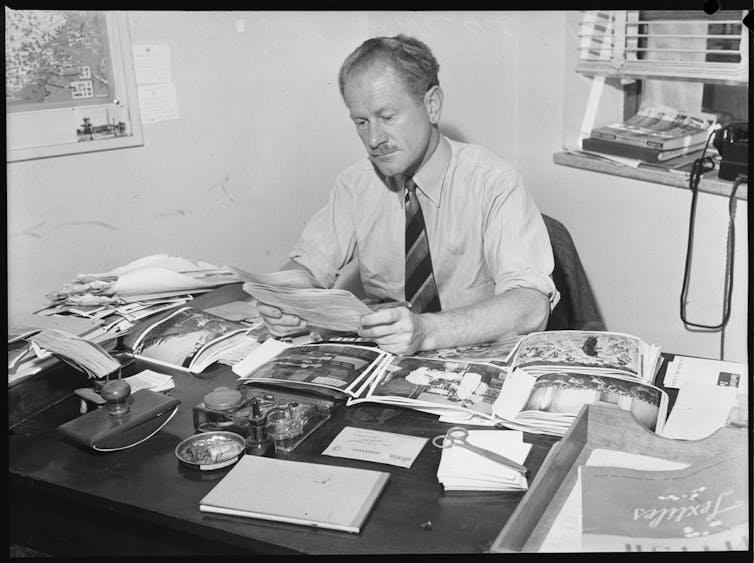
Wyatt, an English artist, writer and champion skier who in 1937 toured Australia to play his accordion and to yodel, already had around 40,000 butterflies in his personal collection before the heist. After a global hunt, he was tracked down by Scotland Yard in a house in Surrey, England.
But who was this man who pulled off such a complex heist? Marsh draws an image for us by reenacting Wyatt’s early entomological life. “Wyatt’s fingers trembled the first time he caught a butterfly in a net.” He could “remember the anxiety of waiting to capture the insect”.
Born in 1909, Wyatt was sent to boarding school in Switzerland due to a serious illness. He went on to study languages at Cambridge, then art at London’s Slade School and in Paris.
By 1939, the charismatic jetsetter, Olympic skier and man-about-town had moved with his new wife Mary to Woollahra, a posh leafy suburb of Sydney. He exhibited his art alongside Australian artist Sidney Nolan. He then joined the RAAF, painting camouflage for the war effort, as did the famous Australian artist William Dobell. These camouflage painting skills came in handy, once Wyatt had stolen thousands of butterflies from major museums – to be replaced with painted fakes.
The cast of characters
The Butterfly Thief is a rollercoaster ride of well-researched details about the people and institutions touched by Wyatt. It is hard to hold narrative momentum when there are so many entomologists, museum directors, archaeologists, collection directors and field researchers touched by the case. However, Marsh does so by drawing us back to the lepidopterist’s true passion – the butterflies.
He details the earlier Australian insect contingent, such as Johnny Hopson. Hopson was a guide who took lepidopterists Alec Burns and Gustavus Athol Waterhouse to find butterflies at Barrington Tops, a volcanic plateau north of Newcastle, in the 1920s. These trips were a game of insect chasing.
We meet Dick Pescott, director of the National Museum of Victoria when the heist occurred. Pescott was the person who had to face the press and tell them about the Wyatt crimes in 1947.
How did Wyatt get into the museums and steal these precious specimens? It was easier than it should have been, as there were some security flaws at the time. He befriended curators and charmed collection managers. He even made sure he was locked inside the Adelaide Museum overnight (there was some confusion with security staffing that night) to steal butterflies, uninterrupted.
Jumping forwards, we follow Michael Braby, an entomologist at Australian National University who in 2016 spotted a specimen that had been touched up or painted to look like a Barringtonensis, or Flame Hairstreak butterfly. Braby realised the connection with the 1947 heist and had to alert staff at the Australian Museum to tell them one of Wyatt’s fakes had been found, 72 years later. This resulted in a forensic cross-checking. There were many more that had fake labels, false collectors and incorrect locations, across all three museums.

Charged for butterfly theft
Back in 1947, before the fakes were identified, but soon after the actual butterfly thefts were noticed, a New Scotland Yard detective and the head entomologist from London’s Natural History Museum turned up at Wyatt’s mother’s house in Surrey. Among the hoarded trove of 40,000 butterflies Wyatt had collected since boyhood, there were the boxes of over 3,000 rare Australian specimens he had shipped to England shortly before leaving Australia.
Wyatt was charged and appeared in the West Ham Court in London in May 1947. He pleaded guilty but told the judge he wasn’t in his right mind because Mary, his wife, had asked for a divorce. The judge decided this was a fair enough excuse and Wyatt was fined 100 English pounds. This was a big international story, because of his reputation as a likeable rogue. He was ordered to return the stolen butterflies.
 Colin Wyatt, second left, at a Lepidopterists Society annual meeting in Ottawa.
Photo: Canadian National Collection
Colin Wyatt, second left, at a Lepidopterists Society annual meeting in Ottawa.
Photo: Canadian National Collection
In the end, some (but no means all) of the butterflies were returned to Australia in August that year. But some had been damaged. Others had had their appearance and information changed to look like different, more valuable, butterflies. The holotypes were unrecognisable and their labels mixed up. Order and documentation are what makes these collections effective, so these mix-ups are heartbreaking.
Museum staff slowly added yellow notes to the forged specimens created by Wyatt, acknowledging they were fakes. These butterflies are not on display now.
The dark side of collecting
The genre of this book is “scientific true crime”. It’s a rollicking tale, but Marsh is careful to acknowledge that these museum collections histories are not only very male and white, but part of a rapacious and sometimes violent colonial history of empire.
For example, Marsh takes time to talk about how some white settlers hunted Aboriginal people like game, to sell their body parts and skulls for scientific research. (When Colin Wyatt and his wife Mary travelled to New Guinea to collect butterflies, Wyatt described the people as fuzzy-wuzzies.)
Even the South Australian Museum director Edward (Ted) Stirling was complicit in human remains digs and by 1884, he was fielding requests to exchange “skulls of natives” with museums as far away as Berlin. He went on to have similar conversations with museums based in Cambridge and New York.
Marsh goes deeply into this imperial cultural theft and trafficking of body parts. This acknowledgement of an enduring imperial lack of ethics and the violence associated with scientific exploration and collection is welcome. A glorification of science without these contexts is not truth-telling.
What happened to Colin Wyatt? Well, he never returned to Australia. He divorced Mary, stayed in Surrey, England and sold the rest of his butterfly collection. In the end, he died in a plane crash in 1975.
Authors: Prudence Gibson, Lecturer and Researcher in Plant Humanities, UNSW Sydney

















