

NZ deputy PM under fire, but maintains no laws broken in party donations scandal
- Written by: Andrew Geddis, Professor, University of Otago
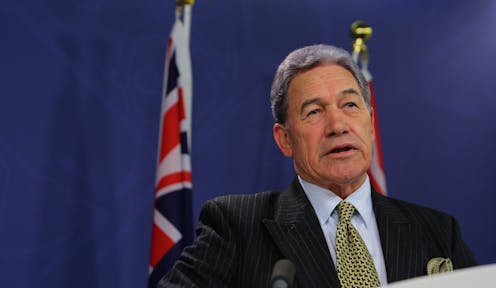
New Zealand’s deputy prime minister, Winston Peters, is under pressure following a complaint to the New Zealand Electoral Commission about his party’s mysterious funding arrangements.
Under electoral law, political parties have to disclose all donations above NZ$15,000. But the New Zealand First party, a coalition partner in the Labour-led government, has a somewhat opaque relationship with a trust called the New Zealand First Foundation, which has loaned the party tens of thousands of dollars in the past three years.
Those giving money to the foundation can remain anonymous because under electoral law, loans are not subject to the same disclosure requirements as donations.
But the foundation’s trustees are the New Zealand First party’s lawyer and an ex-member of parliament, who is now a lobbyist. This raises questions about the legality of the funding.
Read more: New Zealand politics: how political donations could be reformed to reduce potential influence
Money, politics and scandal
The relationship between private wealth and public power bedevils all democracies. In particular, constant tension surrounds the use of such wealth to fund political parties and candidates that contest public office.
This issue often emerges in the form of a scandal, where some practice or behaviour is revealed that challenges current legal or social norms. New Zealand is in the midst of such a moment.
While the loans from the foundation are legal, they have the practical effect of preventing the public disclosure of whoever provided the money in the first place. Reporting based on leaked internal documents reveals that the foundation’s funding sources include “companies and individuals who work in industries that have benefited from a NZ$3 billion Provincial Growth Fund” overseen by a New Zealand First minister.
As further reported, the foundation also appears to have directly paid for some of New Zealand First’s activities without those payments being disclosed as donations to the party. If correct, that practice looks to be at least questionable under existing electoral law.
While the New Zealand Electoral Commission is now examining the matter, its investigatory role is somewhat limited as it cannot require anyone to produce additional documentation. But should the commission conclude that the recent revelations show New Zealand First (or, more specifically, its party secretary) has committed an offence against the Electoral Act, it has a statutory obligation to refer the matter to police.
Such a referral would, of course, be politically very damaging to the party. Unfortunately, it would not be unprecedented. The country’s Serious Fraud Office already is examining allegations relating to the opposition National Party’s treatment of some NZ$100,000 in donations. To have two of New Zealand’s political parties under police investigation for possible illegal activity is hardly a ringing endorsement of the country’s political culture.
Is the law fit for purpose?
The alternative may not be all that much better. Consider what it means if, after discussing the matter with the party and the foundation, the commission concludes that no laws have been broken. After all, the leader of the New Zealand First party, Winston Peters, maintains this to be the case.
It would demonstrate New Zealand’s electoral law simply is not fit for purpose.
It would mean a key part of the government can be intimately connected to a legally opaque foundation that has raised hundreds of thousands of dollars from primary industry leaders, wealthy investors and multi-millionaires; that the foundation can use that money for the benefit of a party and its MPs; and that no one outside of the party and those who gave the money need know what is going on.
Such a state of affairs surely would threaten New Zealand’s ranking as the world’s second least corrupt nation in the world. It is important to note there is no indication that any form of quid pro quo actually exists here, but this would make it hard to sustain public trust and confidence in our governing arrangements.
Read more: A full ban on political donations would level the playing field – but is it the best approach?
For this reason, the current scandal is already generating calls for change to New Zealand’s electoral laws. Former National Party prime minister, Jim Bolger, advocates an end to private donations to political parties and a system of public funding. Author Max Rashbrooke advocates a combination of low limits on private donations and the use of “democracy vouchers”, which give every citizen a small amount of money to donate to the political party of their choice.
Those are proposals that New Zealand ought at least to consider seriously. For as long as the country continues to leave the funding of political parties and candidates up to those individuals and groups with wealth to spare, we will see scandals like the current one reoccur.
Authors: Andrew Geddis, Professor, University of Otago


















